Department of Tissue Engineering and Regenerative Medicine

PUBLICATIONS

Explore our past publications highlighting advancements in tissue engineering and regenerative medicine, showcasing innovative approaches, biomaterial development and translational research that contribute to the future of healthcare.

0

Total Articles Published for Year 2025

0

Articles Published in TOP 10% Journal (Year 2025)

READ OUR TOP 10% JOURNAL

REVIEW

Barathan Muttiah, Law Jia Xian

Published: January 2025

npj science of food (q1, if 6.3)

Milk is a nutrient-rich liquid produced by mammals, offering various health benefits due to its composition of proteins, fats, carbohydrates, vitamins, and minerals. Beyond traditional nutritional aspects, recent research has focused on extracellular vesicles (EVs) found in milk and their potential health benefits, especially for gastrointestinal (GI) health. Milk-derived EVs have been shown to influence gut microbiota, promote gut barrier integrity, support tissue repair and regeneration, modulate immune responses, and potentially aid in managing conditions like inflammatory bowel disease (IBD) and colorectal cancer…

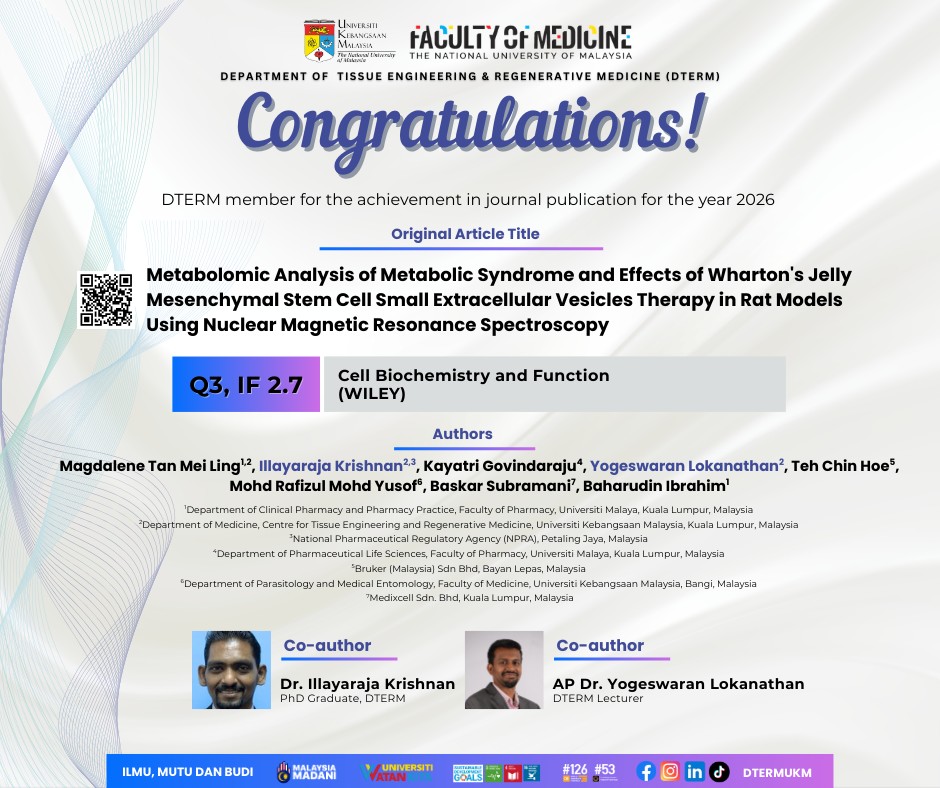
Background:Quality control (QC) is an important element in ensuring drug substances’ safety, efficacy, and quality. The dosing regimen for sEVs can be in the form of protein concentration or the number of particles based on the results of a series of quality controls applied as in-process control. Methods:Wharton’s Jelly Mesenchymal Stem Cells (WJMSCs) were isolated from four independent umbilical cord samples and were characterized following the International Society for Cellular Therapy (ISCT) guidelines. Small extracellular vesicles (sEVs) were isolated separately from these four WJMSCs samples using the Tangential Flow Filtration (TFF) method and were characterized per Minimal Information for Studies of Extracellular Vesicles (MISEV2018) guidelines. Each isolated and concentrated sEV preparation was standardized and its purity was determined by the ratio of the number of particles to protein concentration.

ORIGINAL RESEARCH

Illayaraja Krishnan, Chiew Yong Ng , Li Ting Kee , Min Hwei Ng , Thavachelvi Thangarajah, Ani Amelia Zainuddin, Zalina Mahmood, Shathiya Rajamanickam, Baskar Subramani, Yogeswaran Lokanathan

Published: January 2025

International Journal of Nanomedicine (Q1, IF 6.7)

REVIEW

Maimonah Eissa Al-Masawa, Loai A Elfawy, Chiew Yong Ng, Min Hwei Ng, Jia Xian Law

Published: January 2025

International Journal of NANOMEDICINE (Q1, IF 6.7)

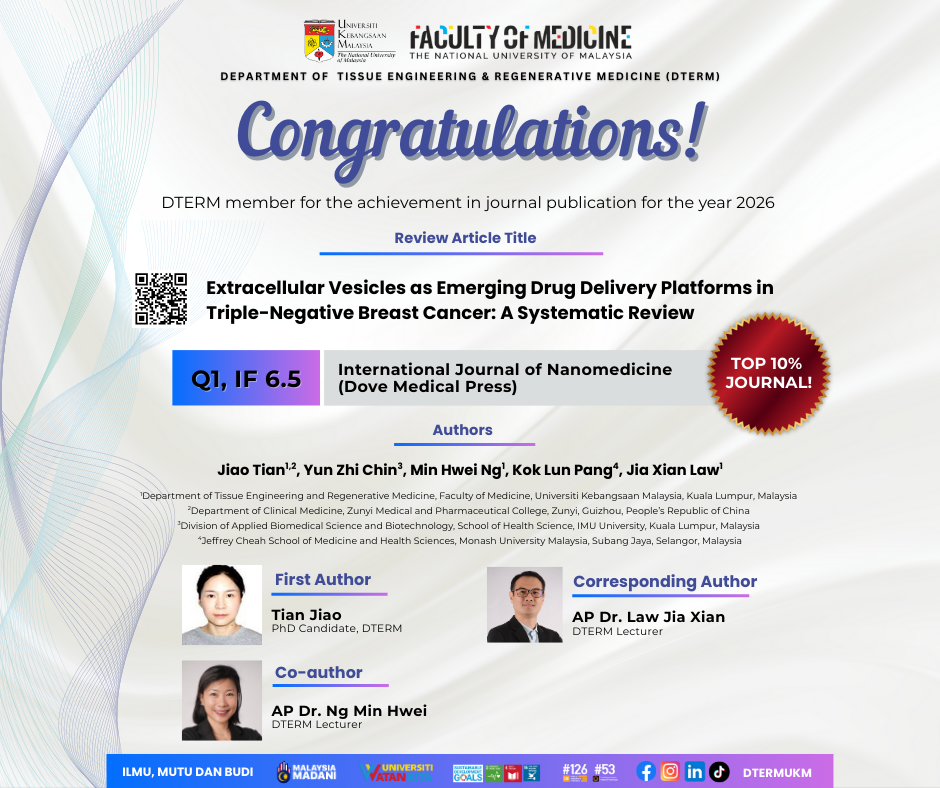
Atopic dermatitis (AD) is a global concern marked by inflammation, skin barrier dysfunction, and immune dysregulation. Current treatments primarily address symptoms without offering a cure, underscoring the need for innovative therapeutic approaches. Mesenchymal stromal cell-derived extracellular vesicles (MSC-EVs) have attracted attention for their potential in immunomodulation and tissue repair, similar to their parent cells. This review provides a comprehensive analysis of the current landscape of MSC-EV research for AD management. We identified 12 studies that met our predefined inclusion criteria. We thoroughly reviewed both human and animal studies, analyzing aspects such as the source, isolation, and characterization of MSC-EVs, as well as the animal and disease models, dosage strategies, efficacy, mechanisms, and adverse effects…

Research has unveiled the remarkable properties of extracellular vesicles derived from mesenchymal stromal cells (MSCs), particularly in promoting wound healing, aiding re-epithelialization, revitalizing aging skin, and inhibiting hyperpigmentation. However, investigations into the potential of small extracellular vesicles from umbilical cord-derived MSCs (UC-MSC-sEVs) in reducing scarring and preventing hyperpigmentation remain limited. Therefore, this study aims to evaluate the impact of UC-MSC-sEVs on the synthesis of the skin’s extracellular matrix (ECM) and pigmentation using in vitro models…

ORIGINAL RESEARCH

Li Ting Kee, Jhi Biau Foo, Chee Wun How, Abdul Ghani Nur Azurah, Hong Hao Chan, Mohd Heikal Mohd Yunus, See Nguan Ng, Min Hwei Ng, Jia Xian Law

Published: February 2025

International Journal of NANOMEDICINE (Q1, IF 6.7)

REVIEW

Anam Anjum, Alvin Man Lung Chan, Hafiz Bilawal Hussain, Yogeswaran Lokanathan

Published: May 2025

International Journal of NANOMEDICINE (Q1, IF 6.7)

Spinal cord injury (SCI) is severe damage to part of the central nervous system (CNS) that can result in impaired sensory and motor function, significantly impacting the quality of life for patients and creating a substantial economic burden on society. The process of SCI involves both primary and secondary injury, with the latter being a series of heightened responses triggered by the initial damage. The complex nature of SCI’s pathological mechanisms has made it challenging to develop effective treatment strategies in clinical settings. Small extracellular vesicles (sEVs) are membrane-bound vesicles with a size range of ≤ 200 nm, released from cells into extracellular spaces. These vesicles are heterogeneous and can originate from various intracellular compartments…

Research has unveiled the remarkable properties of extracellular vesicles derived from mesenchymal stromal cells (MSCs), particularly in promoting wound healing, aiding re-epithelialization, revitalizing aging skin, and inhibiting hyperpigmentation. However, investigations into the potential of small extracellular vesicles from umbilical cord-derived MSCs (UC-MSC-sEVs) in reducing scarring and preventing hyperpigmentation remain limited. Therefore, this study aims to evaluate the impact of UC-MSC-sEVs on the synthesis of the skin’s extracellular matrix (ECM) and pigmentation using in vitro models…

REVIEW

Siti Zawiah Abdul Malik, Yugashini Muhilan, Fazlina Nordin, Min Hwei Ng, Jia Xian Law, Siti A. M. Imran, Izyan Mohd Idris & Gee Jun Tye

Published: June 2025

Stem Cell Research & Therapy (Q1, IF 7.3)

error: Content is protected !!