

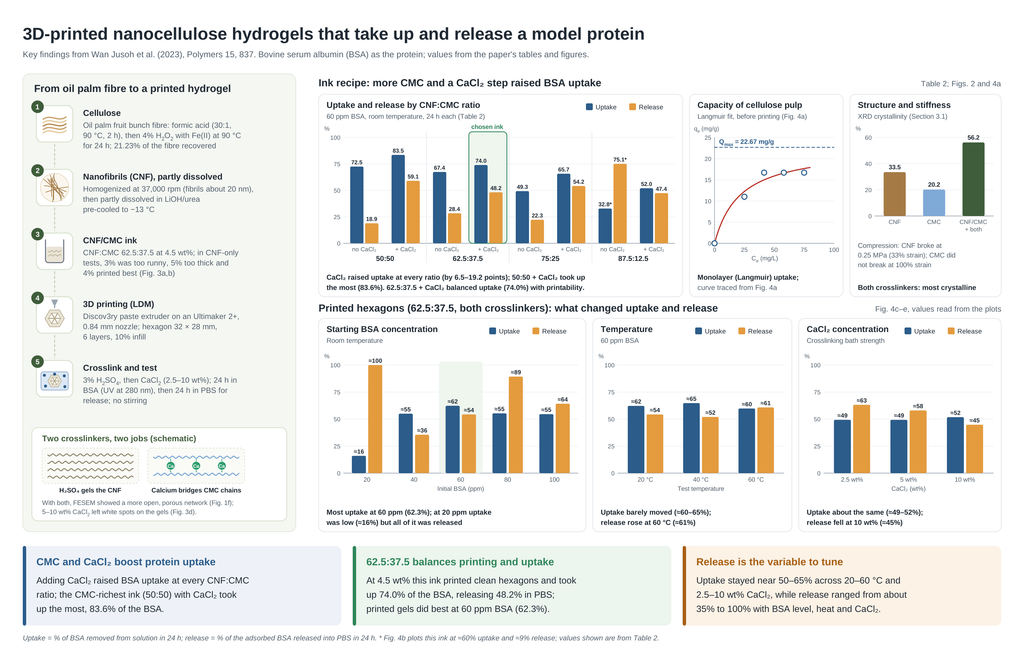
Recent research by Dr. Wan Nazihah Liyana, successfully developed a 3D-printable gel from oil palm waste designed specifically to soak up and release proteins. By blending strong natural cellulose fibers with a highly absorbent plant derivative (CMC), the team discovered that treating the printed mixture with calcium dramatically boosted its ability to absorb proteins. The researchers identified an optimal “sweet spot” recipe—containing roughly 62.5% cellulose and 37.5% CMC—that provided the perfect balance, allowing the material to print cleanly into structured shapes while still successfully capturing 74% of the target protein. Furthermore, the study revealed a fascinating mechanism: while the gel’s overall capacity to absorb the protein remained fairly steady regardless of heat or calcium levels, the amount of protein it subsequently released was highly sensitive to temperature, initial protein concentration, and the amount of calcium used. This suggests that by simply adjusting the gel’s environment or chemical bath, scientists can highly tune and control exactly how much protein the material releases.
Please read our article here:
Nanocellulose-Based Biomaterial Ink Hydrogel for Uptake/Release of Bovine Serum Albumin. Polymers, 15(4), 837
Authors: Wan Jusoh, W. N. L., Mohan, D., Sajab, M. S., Abdul, P. M., Kaco, H., Ding, G., & Baini, R. (2023).