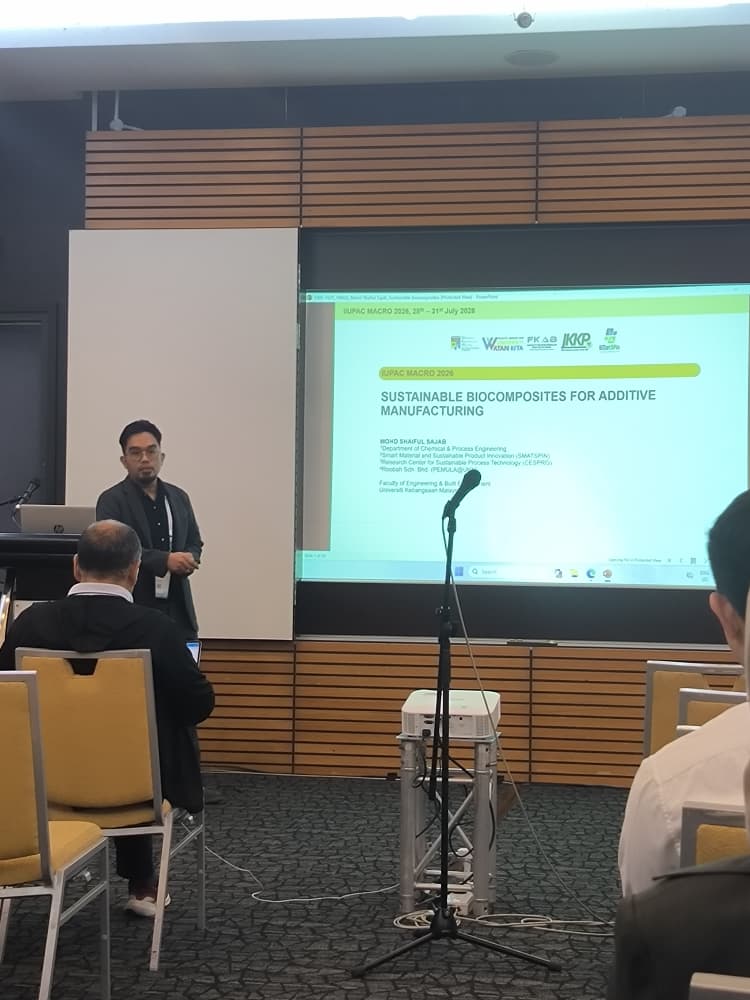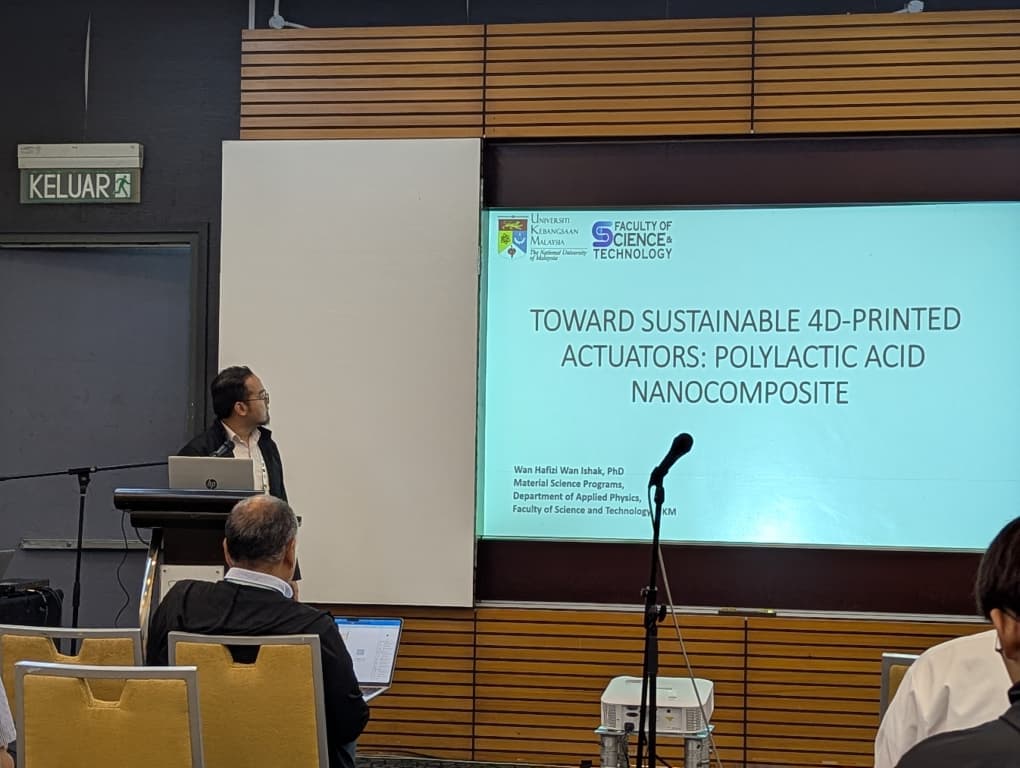

Our research group made a strong impact at the 51st IUPAC World Polymer Congress (MACRO 2026), held at the Borneo Convention Centre Kuching in Sarawak, Malaysia, from July 28 to 31, 2026. Organized by the Institut Kimia Malaysia under the theme “New Polymers and Innovative Materials for a Sustainable Future,” this prestigious international gathering brought together leading minds in polymer science to tackle global material challenges. Representing our team as invited speakers, Assoc. Prof. Dr. Mohd Shaiful Sajab and Dr. Wan Hafizi Wan Ishak delivered talks highlighting our commitment to advancing sustainable material engineering and circular economy solutions.
Assoc. Prof. Dr. Mohd Shaiful Sajab delivered an address titled “Sustainable Biocomposites For Additive Manufacturing,” detailing our group’s progress in converting local bio-resources and functionalized bio-nanofibers into next-generation 3D printing materials. Dr. Shaiful emphasized innovative strategies to overcome the traditional mechanical and thermal limitations of bio-based plastics, opening new avenues for high-performance bio-inks and eco-friendly filaments. His talk underscored the importance of establishing closed-loop recycling pathways within additive manufacturing, offering a viable strategy to reduce industry reliance on fossil-fuel-derived polymers while maximizing the value of agricultural side-streams.
Building upon the theme of sustainable innovation, Dr. Wan Hafizi Wan Ishak presented his lecture titled “Toward Sustainable 4D-Printed Actuators: Polylactic Acid Nanocomposite,” focusing on the intersection of bio-based materials and shape-programmable technologies. Dr. Wan Hafizi showcased how integrating functional nanostructures into biodegradable polylactic acid matrices allows for the creation of smart nanocomposites capable of predictable, time-dependent transformations in response to external stimuli. These sustainable 4D-printed actuators hold immense promise for applications in soft robotics, biomedical devices, and self-deploying structures, proving that advanced responsive materials can be developed without compromising environmental integrity.
The participation of our team members at MACRO 2026 underscores our leadership in bio-based materials research and reinforces the global relevance of our work. Beyond sharing technical findings, the congress provided an invaluable platform to build international collaborations and engage with key stakeholders in the polymer community. Moving forward, our team remains dedicated to translating fundamental research on renewable resources into practical, high-value technologies that support a sustainable future.