

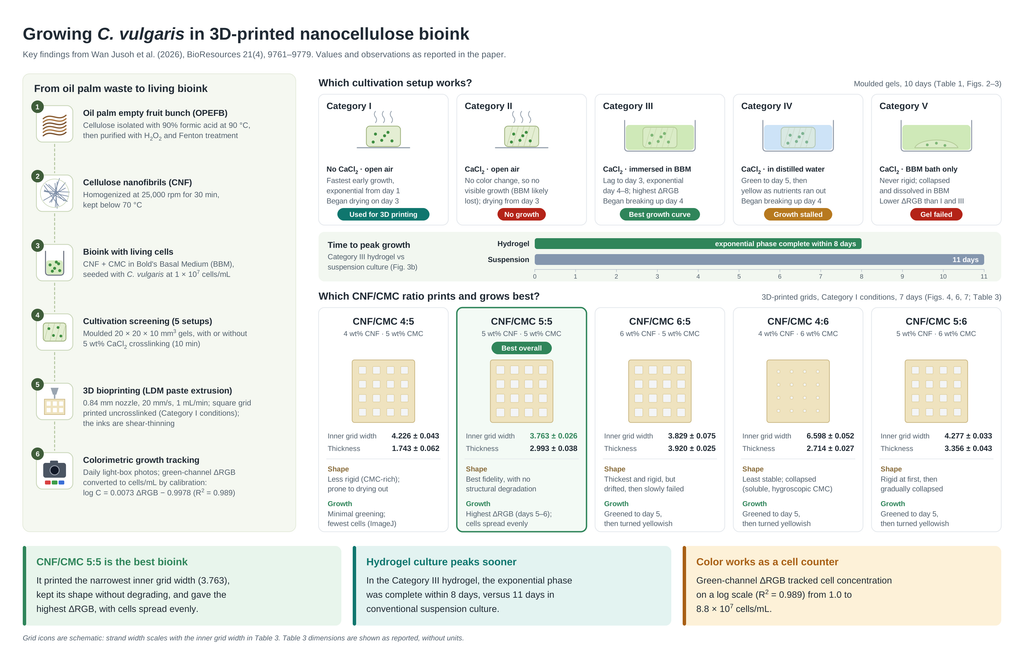
Recent research by Dr. Wan Nazihah Wan Jusoh, successfully transformed waste from oil palm plants into a printable gel, or “bioink,” capable of supporting living microscopic algae. The study found that growing the algae within this 3D-printed gel was actually faster than traditional liquid environments, with the algae reaching its peak growth phase in just 8 days instead of 11. To easily monitor this growth, the researchers used a clever method of photographing the gels daily; by measuring the intensity of the green color, they could accurately track how fast the cells were multiplying. After testing different gel recipes, the team discovered that a perfectly balanced mixture of two types of cellulose components (a 5:5 ratio of CNF to CMC) produced the best overall results. This specific blend not only printed the finest structures and held its shape flawlessly without collapsing, but it also provided the ideal environment for the algae cells to spread out evenly and thrive.
Please read our article here:
Microalgae Cultivation (Chlorella vulgaris) within Nanocellulose-based Biomaterial Ink for 3D Bioprinting. Bioresources, 21(4), 9761-9779.
Authors: Jusoh, W.N.L.W., Ern, G.T.J., Yasin, N.H.M., Abdul, P.M. and Takriff, M.S., Sajab, M.S., (2026)