

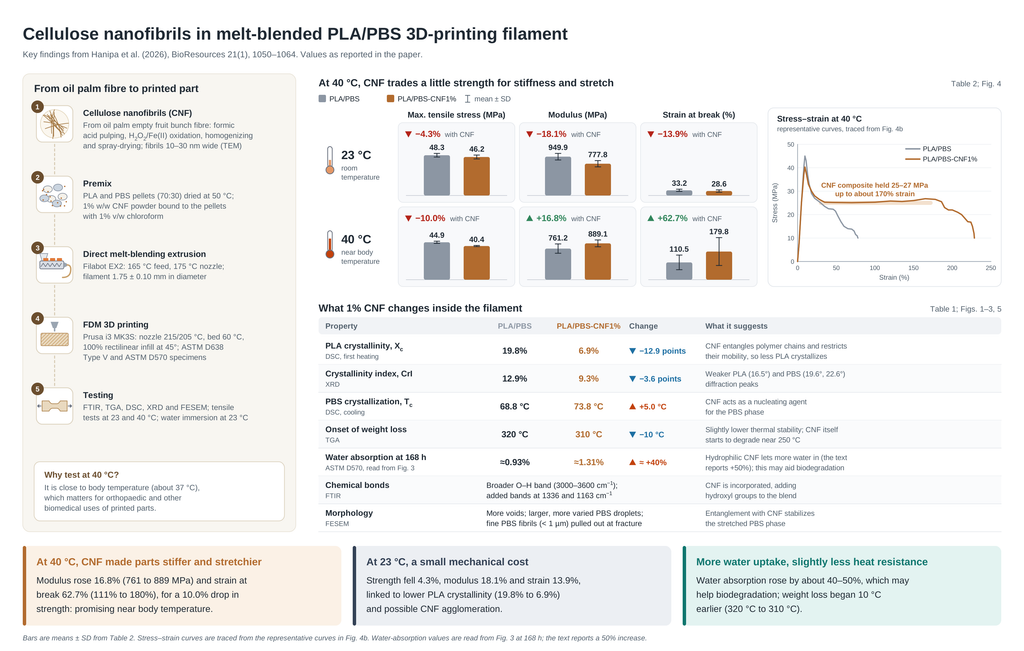
Recent research by Dr. Muhammad Alif Fitri, explored how adding a tiny amount of natural cellulose fibers from oil palm waste changes the properties of a blended 3D printing plastic. While mixing in just 1% of these microscopic fibers made the printed material slightly weaker and less flexible at normal room temperature, the researchers found a significant benefit when the material was tested at 40°C, a condition very close to human body temperature. In this warmer environment, which is highly relevant for creating medical and orthopedic implants, the fiber-enhanced plastic became almost 17% stiffer and over 60% more stretchable, trading away only a minor amount of its overall pulling strength. Furthermore, the addition of the natural fibers caused the plastic to absorb roughly 40% to 50% more water and slightly lowered its heat resistance. Rather than being a flaw, this increased water absorption is actually a promising trait for medical applications, as it can help the printed parts naturally break down and safely dissolve in the body over time.
Please read our article here:
Effect of cellulose nanofibrils in direct melt-blending of poly(lactic acid) and poly(butylene succinate) for 3D-printing. BioResources, 21(1), pp. 1050–1064
Authors: Hanipa, M.A.F., Zaidi, S.A.S., Wan Ishak, W.H. and Sajab, M.S. (2026).