

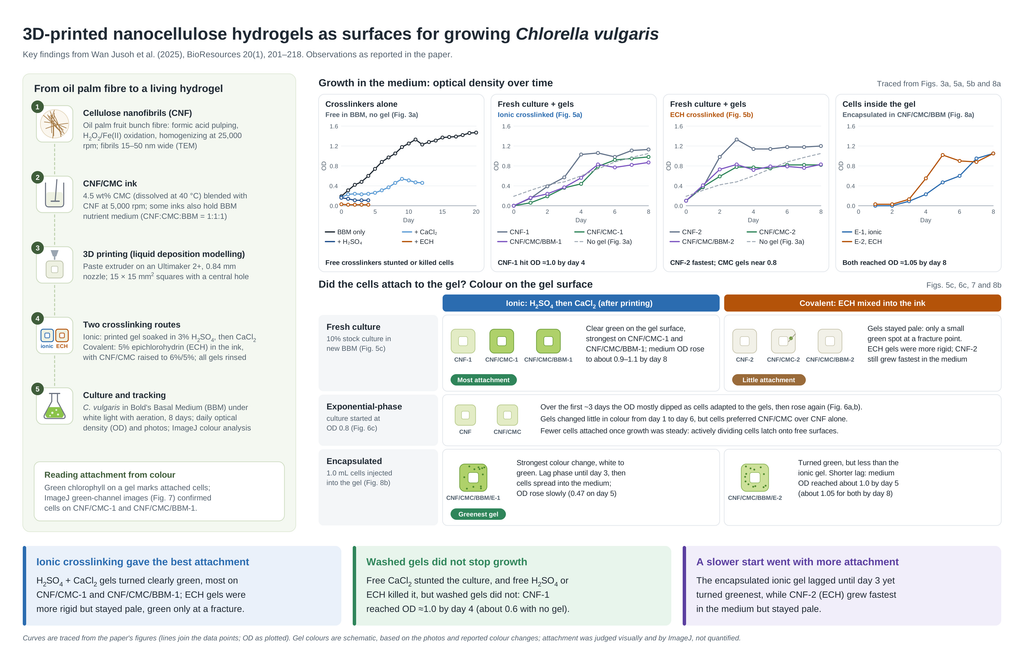
Recent research by Dr. Wan Nazihah Liyana, explored using 3D-printed gels made from oil palm waste to create a supportive environment for growing microscopic algae. The researchers needed to use specific chemicals to harden these gels, but they found that if these chemical setting agents were left freely floating in the liquid, they would stunt or completely kill the algae. However, once the 3D-printed gels were properly washed, they safely supported the algae’s growth without harming the cells. The study compared two different methods for setting the gels and found that an “ionic” method (using a combination of acid and calcium) was the most successful for getting the algae to attach, which was visibly confirmed as the gels turned clearly green. A second method using a different chemical (ECH) made the gels much more rigid but resulted in pale gels, as the algae preferred to grow rapidly in the surrounding liquid rather than latching onto the printed structure. Interestingly, when researchers injected the algae directly inside the best-performing ionic gel, the cells took a few days to adapt but ultimately produced the greenest gel overall, demonstrating that a slower initial start resulted in the strongest physical attachment to the gel.
Please read our article here:
Interaction of Chlorella vulgaris: Cell Attachment on Nanocellulose-Based Hydrogel for Sustainable Microalgae Cultivation. BioResources, 20(1), pp.201-218.
Authors: Jusoh, W.N.L.W., Sajab, M.S., Yasin, N.H.M., Abdul, P.M. and Takriff, M.S., 2025.