

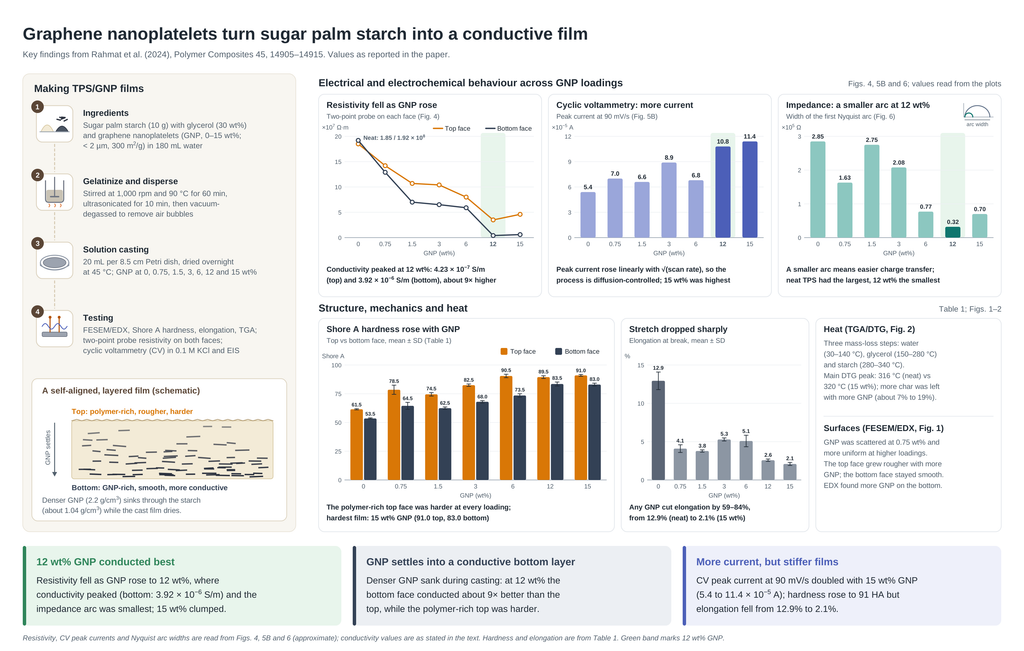
Recent research by Dr. Noor Fadhilah, demonstrated how adding microscopic carbon flakes, known as graphene nanoplatelets, can transform ordinary sugar palm starch into an electrically conductive material. Interestingly, as the liquid mixture dried, the heavier graphene naturally sank, creating a two-sided film: a rough, tough, starch-rich top layer and a smooth, highly conductive graphene-rich bottom layer. The study found that a 12% graphene mixture was the ideal amount for electrical performance, allowing electricity to flow most easily and keeping the flakes from clumping together. At this 12% mixture, the bottom face conducted electricity about nine times better than the top face. While adding graphene significantly boosted the material’s ability to carry an electrical current and slightly improved its heat resistance, it also created a mechanical trade-off. The films became much harder but lost nearly all of their natural flexibility, with their stretchiness dropping drastically from 12.9% down to as low as 2.1% when maximum graphene was added.
Please read our article here:
Thermoplastic Sugar Palm Starch Reinforced Graphene Nanoplatelets for Sustainable Biocomposite Films. BioResources, 19(1).
Authors: Rahmat, N. F., Sajab, M. S., Afdzaluddin, A. M., Ding, G., & Chia, C. H. (2024).