

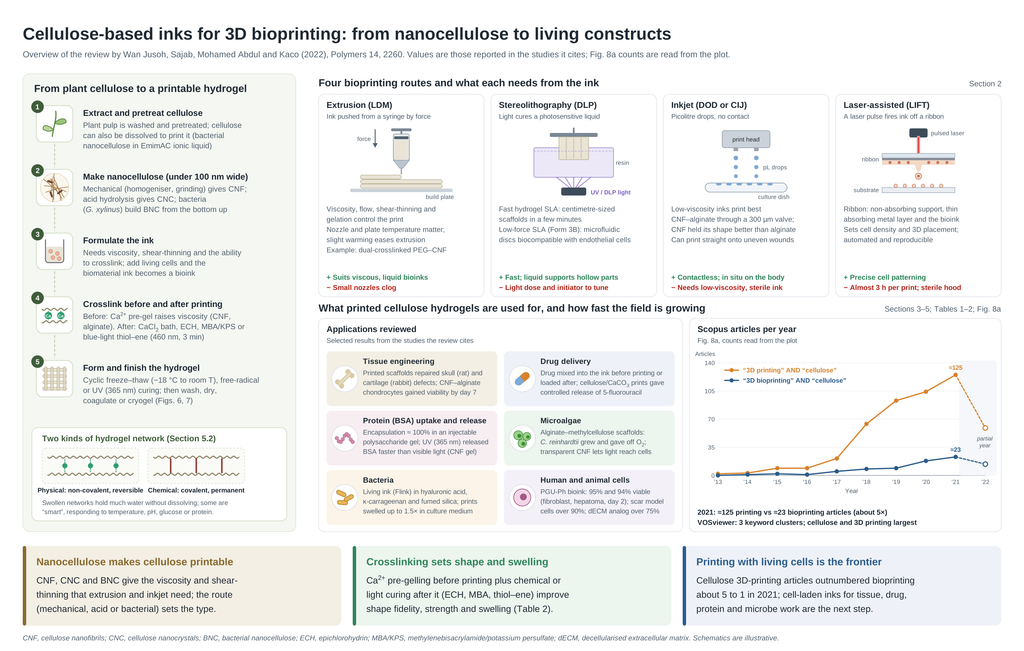
A recent review by Dr. Wan Nazihah Liyana, outlines the rapid evolution of using plant-derived cellulose as a foundational material for 3D bioprinting. The review highlights that by breaking down standard plant pulp into microscopic nanocellulose, scientists can create a printable gel that possesses the perfect thickness and flow properties required for 3D printers. To ensure these printed structures successfully hold their shape and control how they absorb water, they are treated with chemical hardeners or light-curing techniques both before and after the printing process. Researchers currently utilize a variety of methods to construct these gels, ranging from squeezing the material out of a syringe (extrusion) to using precise lasers or ultraviolet light to solidify photosensitive liquids. Other advanced, contactless techniques like inkjet printing can even be used to deposit the material directly onto uneven body wounds. Once optimized, these specialized water-filled gels can be loaded with living cells or bacteria to create active “bioinks” capable of remarkable medical feats, such as repairing skull and cartilage defects in animals, delivering controlled drug dosages over time, or cultivating oxygen-producing microalgae. Despite these impressive applications, the review notes that bioprinting with living cells remains an emerging frontier; data from 2021 showed that general 3D printing research involving cellulose was still about five times more common than studies specifically focused on living bioinks.
Please read our article here:
Recent Advances in 3D Bioprinting: A Review of Cellulose-Based Biomaterials Ink. Polymers, 14(11), 2260
Authors: Wan Jusoh, W. N. L., Sajab, M. S., Mohamed Abdul, P., & Kaco, H. (2022).