

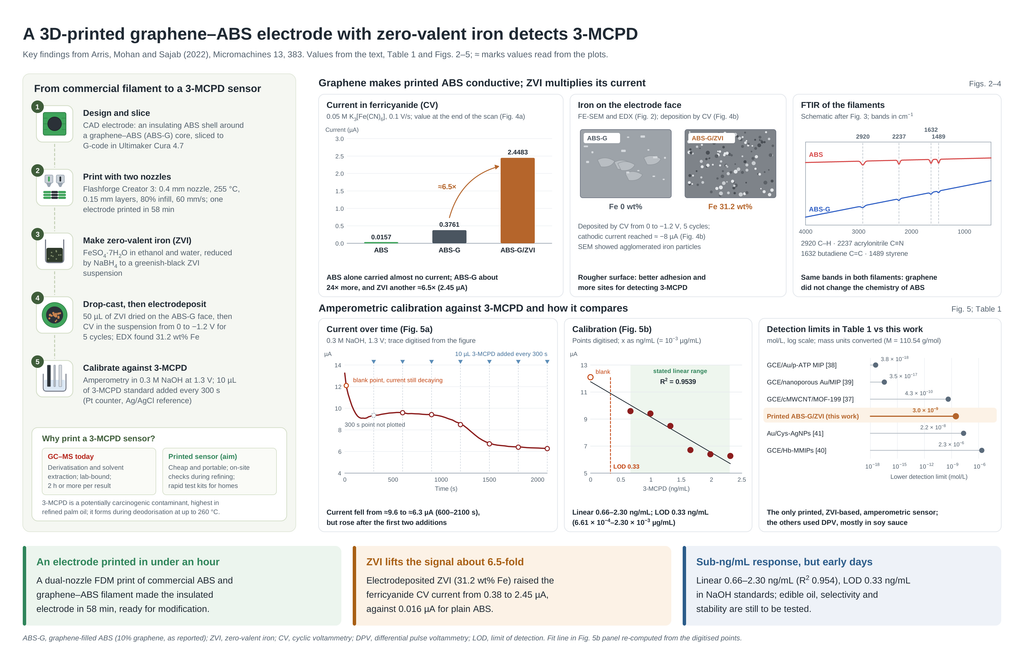
A study by Farrah Aida introduced an innovative, fast-printed 3D sensor designed to detect 3-MCPD, a potentially cancer-causing chemical that commonly contaminates refined palm oil. This portable sensor was created in just 58 minutes using a dual-nozzle 3D printer that combined regular ABS plastic for insulation with a special graphene-filled ABS plastic to carry an electrical signal. To boost the sensor’s sensitivity, the researchers coated the graphene surface with zero-valent iron particles (ZVI). This iron coating significantly increased the surface area and multiplied the sensor’s electrical current output by roughly 6.5 times, bringing the signal up to 2.45 microamps. Testing the device in chemical solutions proved it could successfully detect trace amounts of 3-MCPD, displaying a clear linear response as chemical concentrations increased and achieving a low detection limit of 0.33 nanograms per milliliter. This marks a major step forward, as this is the first printed, iron-based sensor of its kind, offering a cheap and rapid alternative to the slow, two-hour lab tests currently required by the food industry.
Please read our article here:
Facile Synthesis of 3D Printed Tailored Electrode for 3-Monochloropropane-1, 2-Diol (3-MCPD) Sensing. Micromachines, 13(3), 383.
Authors: Arris, F. A., Mohan, D., & Sajab, M. S. (2022).