

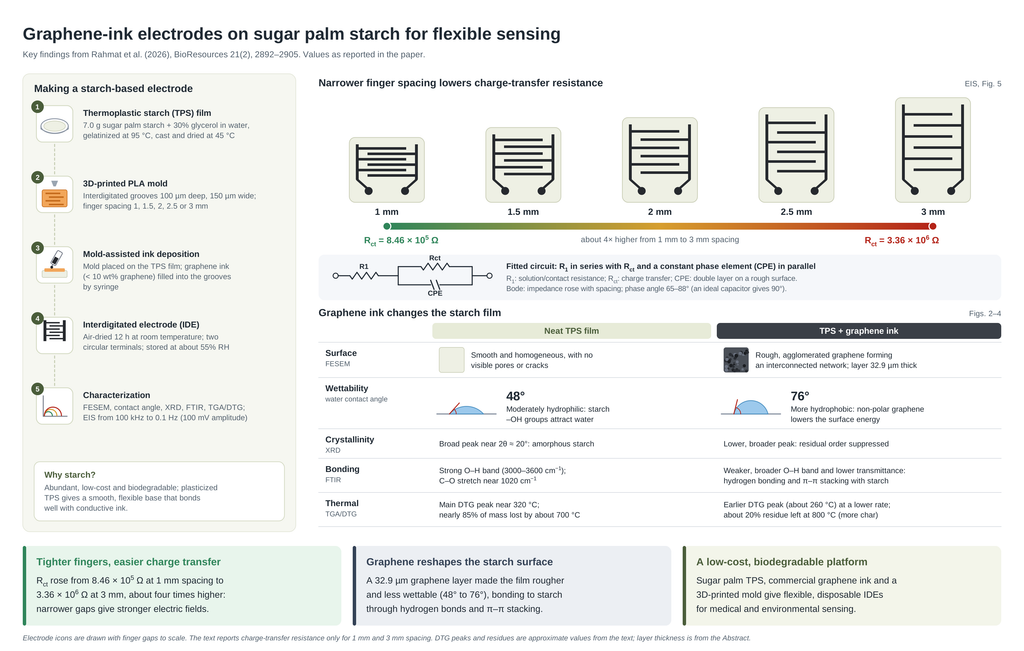
Recent research by Dr. Noor Fadhilah, successfully developed a flexible, low-cost, and eco-friendly electronic sensor component using starch extracted from sugar palms as the base material. To create the electrical pathways, the team used a 3D-printed mold to precisely apply a conductive graphene ink onto the smooth starch film. The study showed that adding this graphene layer changed the naturally water-absorbing starch into a rougher, more water-resistant material, creating a strong microscopic bond between the two. When testing the electrical properties, the researchers found that the physical layout of the printed ink was crucial; moving the circuit lines closer together significantly improved performance. By narrowing the gap between the lines from 3 millimeters down to 1 millimeter, it became about four times easier for electrical signals to flow through the sensor. Ultimately, this combination of biodegradable sugar palm starch and easily applied graphene ink offers a promising new way to manufacture disposable, flexible sensors for medical and environmental testing.
Please read our article here:
Graphene-Starch based Electrodes for Flexible Sensing Applications. BioResources, 21(2), 2892-2905.
Authors: Rahmat, N. F., Radzuan, S. A. M., Afdzaluddin, A. M., Ding, G., Chia, C. H., & Sajab, M. S. (2026).