

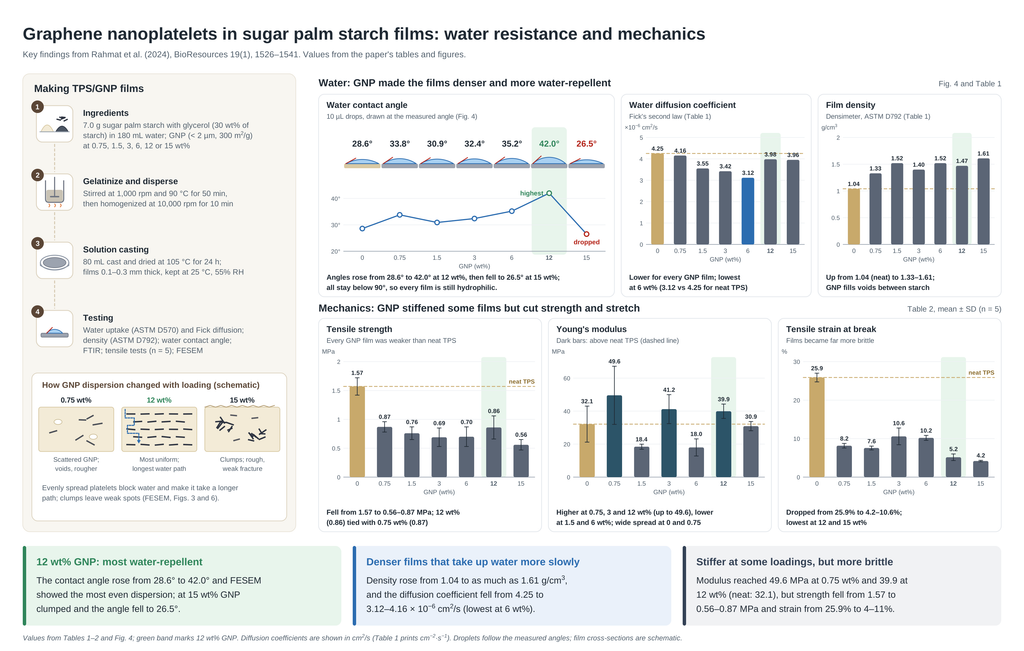
Recent research by Dr. Noor Fadhilah, investigated how adding microscopic carbon flakes (graphene nanoplatelets) to sugar palm starch affects the physical properties of the resulting plastic-like films. The researchers discovered that mixing in these flakes generally made the starch films denser and significantly slowed down how quickly they absorbed water. They found a specific “sweet spot” at a 12% mixture, where the flakes spread out the most evenly to create the highest level of water repellency. However, pushing the mixture to 15% caused the carbon flakes to clump together, which created weak spots and actually worsened the material’s ability to repel water. Despite the improvements in blocking moisture, adding these carbon flakes came with significant physical trade-offs; every mixed formulation tested resulted in a film that was structurally weaker and far more brittle than the pure starch version. While the flakes made the films stiffer at certain mixture levels, they severely ruined the material’s natural ability to stretch, causing its overall flexibility to plummet from nearly 26% down to as low as 4%.
Please read our article here:
Enhancing the electrochemical properties of biopolymer composites using starch‐graphene nanoplatelets. Polymer Composites.
Authors: Rahmat, N.F., Sajab, M.S., Afdzaluddin, A.M., Chia, C.H. and Ding, G.