

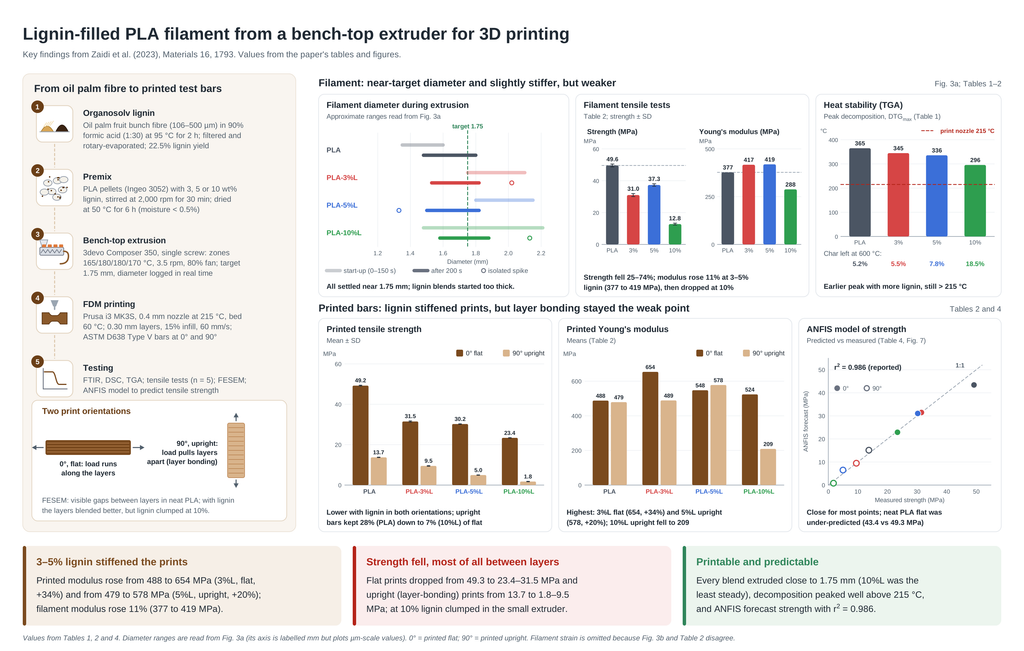
Recent research by Siti Aisyah Syazwani, explored blending natural lignin extracted from oil palm waste with standard 3D printing plastic (PLA) to create new printing threads. The study found that adding a small amount of this lignin, specifically between 3% and 5%, successfully made both the printing threads and the final 3D-printed parts noticeably stiffer. However, this increased stiffness came with a significant trade-off in overall strength, particularly in how well the individual printed layers bonded to one another; parts printed upright, which rely heavily on layer adhesion, became drastically weaker when lignin was introduced. Furthermore, pushing the mixture to 10% lignin proved to be too much, causing the natural material to clump together inside the small manufacturing machine, which resulted in uneven printing threads and a severe drop in the material’s structural integrity. Despite these mechanical challenges, the researchers demonstrated that the combined material could still withstand typical 3D printing temperatures without burning, and they even successfully used a mathematical modeling tool to highly accurately predict how strong the resulting printed parts would be.
Please read our article here:
Evaluating the Stability of PLA-Lignin Filament Produced by Bench-Top Extruder for Sustainable 3D Printing. Materials, 16(5), 1793.
Authors: Zaidi, S. A. S., Kwan, C. E., Mohan, D., Harun, S., Luthfi, A. A. I., & Sajab, M. S. (2023).