

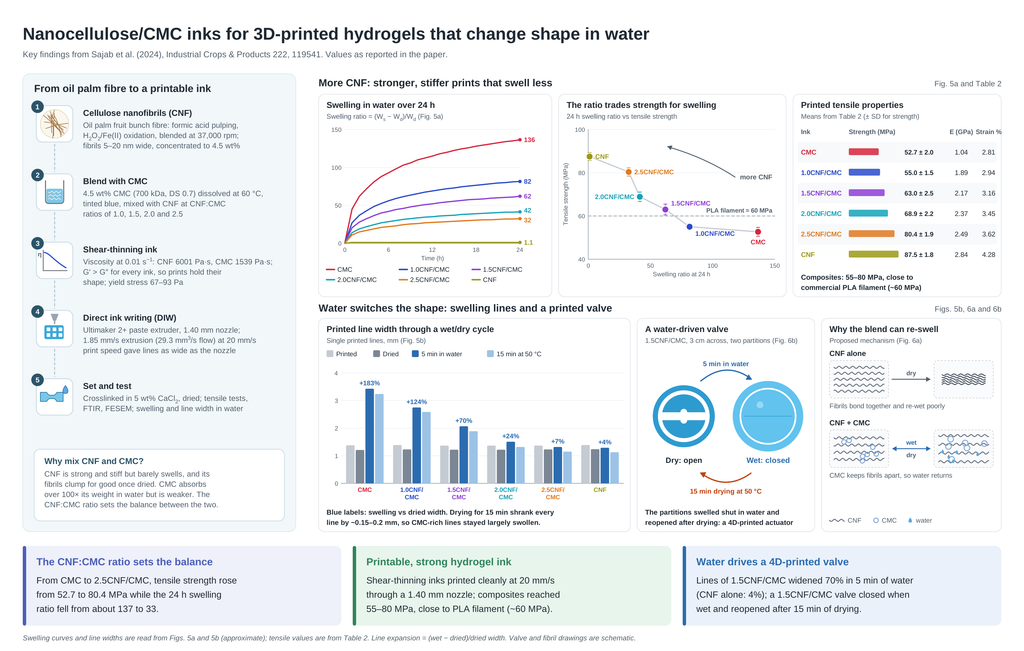
Recent research by Dr. Denesh Mohan, demonstrated how blending two natural materials—strong cellulose fibers from oil palm waste (CNF) and a highly water-absorbent plant derivative (CMC)—creates a printable gel that can physically change its shape when exposed to moisture. On its own, the cellulose is very strong but permanently clumps together once it dries, whereas the absorbent CMC swells massively in water but lacks structural strength. By mixing them together, the researchers discovered that the CMC acts as a microscopic spacer, keeping the strong cellulose fibers apart so they can repeatedly absorb water and dry out without losing their structure. This specific blend allows for highly customizable 3D printing materials; increasing the cellulose makes the printed parts nearly as strong as standard commercial plastic, while adding more CMC increases how much the material can expand. To prove this shape-shifting “4D printing” concept, the team printed a smart valve that automatically swells shut within five minutes of getting wet and opens back up as it dries, offering exciting possibilities for creating environmentally friendly, water-responsive devices.
Please read our article here:
Nanocellulose-based composites for 3D printed stimuli-responsive swelling hydrogel. Industrial Crops and Products, 222, p.119541.
Authors: Sajab, M.S., Mohan, D., Ling, T.T., Kaco, H., Ishak, W.H.W. and Ding, G., 2024.