

INTRODUCTION
Students enrolled in the Statistics programme, are exposed to thorough knowledge on theoretical as well as the applications.The students learn a variety of problem solving techniques and data analysis. Students are also provided with the knowledge in defining problems, understanding stated problems, identifying the methods of data collection and interpreting results of data analysis. This would shape the students creativity in handling the techniques of problem solving, data collection and interpretation of the results obtained.
PROGRAMME EDUCATIONAL OBJECTIVES (PEO)
To produce skilled and knowledgeable graduates in the field of statistics, competent in soft skills, possess awareness towards environment and able to contribute to other various disciplines in order to give impact to the national and global development.
UKM Bachelor of Science (Statistics) Programme aims at producing graduates who are:
POE1 Have high caliber and ethics, and competitive-spirit;
POE2 Able to translate and synthesize their understanding of the world, mankind and development;
POE3 Have the awareness about the environment and support sustainable development;
POE4 Able to use the statistical solving techniques such as analysis, modelling, programming, and statistical software in tackling development issues and current changes;
POE5 Practice scientific methods in generating and sharing knowledge of inter- and cross-discipline; and
POE6 Possess highly creative and innovative minds that contribute ideas for policy making, decision making and development implementation.
PROGRAMME OUTCOMES (PO)
PO1 Able to obtain and use basic statistical knowledge.
PO2 Able to obtain information, select and use suitable statistical techniques,
programming and softwares to solve problems.
PO3 Able to understand and assess the implications of statistical concepts and
techniques in solving various real problems.
PO4 Practice ethical principles, professionalism and noble values in life and career based on the belief in God.
PO5 Communicate effectively in relaying information, ideas and solutions to experts and non-experts.
PO6 Able to identify, formulate and analyze problems that need statistical approach.
PO7 Able to collect and manage information and recognize the needs for and practice life-long learning.
PO8 Possess managerial and entrepreneurial skills.
Statistics Programme Structure
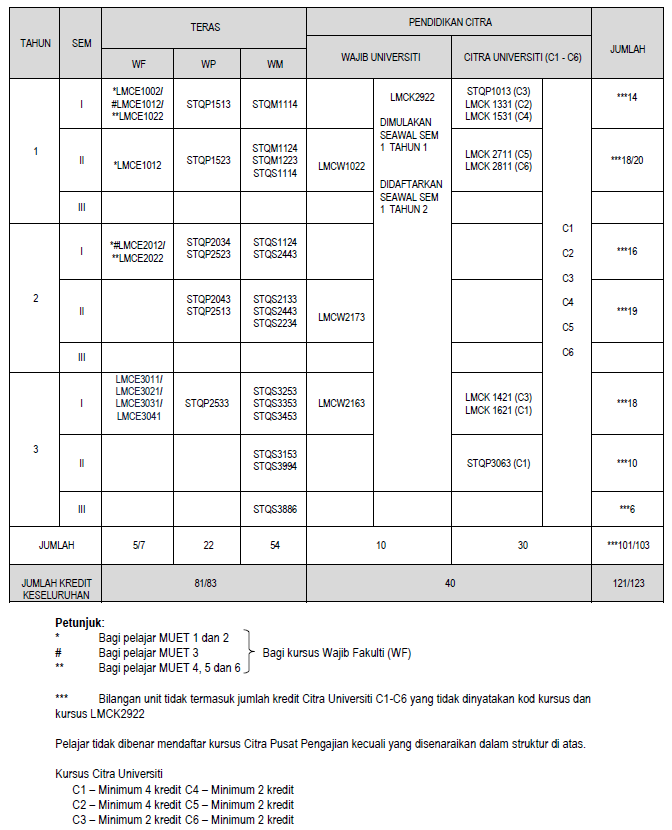
LIST OF COURSES
School Courses Programme
STQP1013 Computer Programming
STQP1513 Basic Economics I
STQP1523 Basic Economics II
STQP2034 Numerical Methods
STQP2043 Operational Research
STQP2513 Introduction to Business Management
STQP2523 Introduction to Insurance and Takaful
STQP2533 Basic Accounting and Finance
STQP3063 History and Philosophy of Mathematical Sciences
Statistics Programme
STQS1114 Statistics I
STQS1124 Statistics II
STQS2133 Statistical Inference
STQS2234 Statistical Modelling
STQS2243 Survey and Sampling
STQS2443 Industrial Statistics
STQS3163 Stochastic Processes
STQS3253 Multivariate Methods
STQS3353 Design of Experiment and Analysis
STQS3453 Medical and Social Statistics
STQS3994 Final Year Research Project
STQS3886 Industrial Training
Mathematics Programme Compulsory Courses
STQM1114 Calculus I
STQM1124 Calculus II
STQM1223 Linear Algebra
Citra Course offered by School of Mathematical Sciences
STQP1013 Computer Programming (C3)
STQM1823 Elementary Biomathematics (C3)
STQM1913 Mathematical Techniques I (C3)
STQS1913 Applied Statistics (C3)
STQP2513* Introduction to Business Management (C4)
STQA2133+ Financial Mathematics (C3)
STQP3063 History and Philosophy of Mathematical Sciences (C1)
STQA3233 Issues in Actuarial Science (C1)
* WP for Mathematics and Statistics students.
+ WM for Actuarial Sciences students.
• Students may choose any suitable Citra courses offered by other schools or faculties.
• Students are advised to consult with their respective Head of Programme regarding the Citra course.