

INTRODUCTION
Students enrolled in the Mathematics programme, are exposed to thorough knowledge on theoretical as well as the applications. The students will be exposed to a variety of problem solving techniques, both analytically and numerically. Students are also provided with the knowledge in defining problems, understanding the stated problems, and this will shape the students’ creativity in handling the techniques of solving and proving.
PROGRAMME EDUCATIONAL OBJECTIVES (PEO)
PEO1 To produce students with high caliber, ethics and competitiveness;
PEO2 To equip the students with the ability to translate and synthesize their understanding of the world, mankind and development;
PEO3 To equip the students with the awareness on the environment and support sustainable development;
PEO4 To equip the students with the ability to use mathematical solution methods such as analysis, modelling, programming and mathematical softwares in tackling the development issues and current changes;
PEO5 To equip the students with scientific approaches in generating and sharing knowledge of inter- and cross-disciplines; and
PEO6 To equip the students with highly creative and innovative minds that contribute ideas for policy making, decision making and development implementation.
PROGRAMME OUTCOMES (PO)
PO1 Able to adsorb mathematical knowledge in various aspects of life.
PO2 Able to analyze and interpret solutions obtained and generate new ideas based on the solutions.
PO3 Able to think and argue maturely with stable emotional state and social responsibility towards the society and environment.
PO4 Possess moral, ethical and professional values.
PO5 Able to communicate effectively, with leadership and teamwork skills.
PO6 Able to identify methods of solutions which are suitable for the problems encountered.
PO7 Able to obtain, to manage, to use and to disseminate information as well as to be involved in life-long learning.
PO8 Able to execute management and entrepreneurship principles.
MATHEMATICS PROGRAMME STRUCTURE
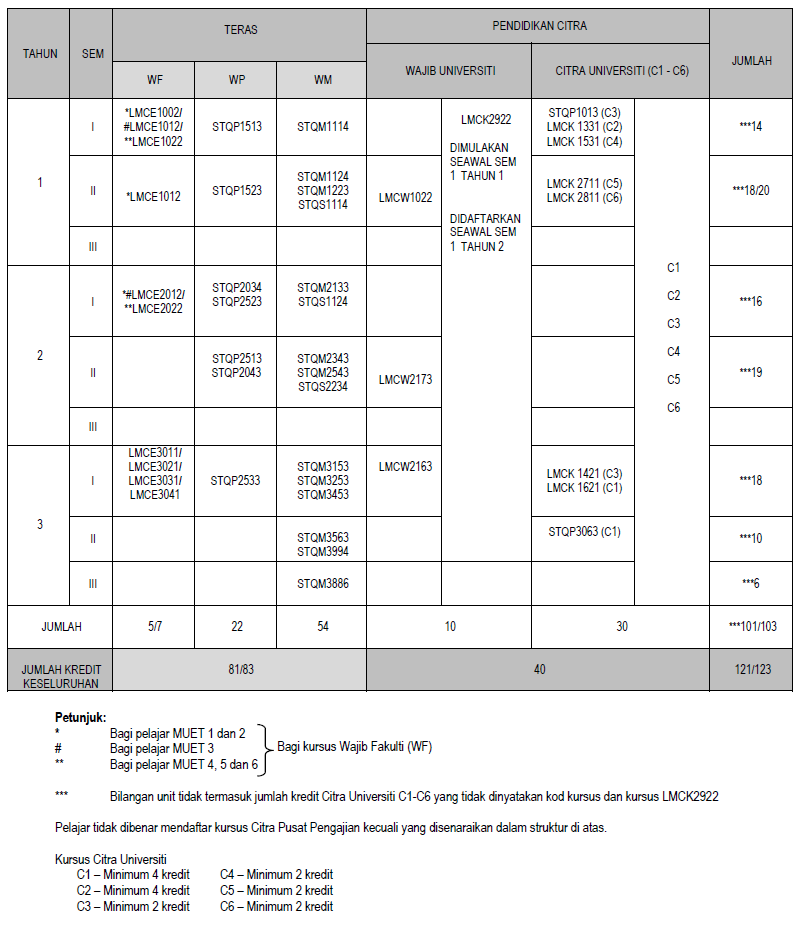
LIST OF COURSES
School Courses Programme
STQP1013 Computer Programming
STQP1513 Basic Economics I
STQP1523 Basic Economics II
STQP2034 Numerical Methods
STQP2043 Operational Research
STQP2513 Introduction to Business Management
STQP2523 Introduction to Insurance and Takaful
STQP2533 Basic Accounting and Finance
STQP3063 History and Philosophy of Mathematical Sciences
Mathematics Programme
STQM1114 Calculus I
STQM1124 Calculus II
STQM1223 Linear Algebra
STQM2133 Calculus of Complex Variables
STQM2343 Difference and Differential Equations
STQM2543 Classical and Quantum Mechanics
STQM3153 Real Analysis
STQM3253 Algebraic Structures
STQM3453 Strategy and Control
STQM3563 Several Selected Issues in Industrial Mathematics
STQM3994 Final Year Research Project
STQM3886 Industrial Training
Statistics Programme Compulsory Courses
STQS1114 Statistics I
STQS1124 Statistics II
STQS2234 Statistical Modelling
Citra Course offered by School of Mathematical Sciences
STQP1013 Computer Programming (C3)
STQM1823 Elementary Biomathematics (C3)
STQM1913 Mathematical Techniques I (C3)
STQS1913 Applied Statistics (C3)
STQP2513* Introduction to Business Management (C4)
STQA2133+ Financial Mathematics (C3)
STQP3063 History and Philosophy of Mathematical Sciences (C1)
STQA3233 Issues in Actuarial Science (C1)
* WP for Mathematics and Statistics students.
+ WM for Actuarial Sciences students.
• Students may choose any suitable Citra courses offered by other schools or faculties.
• Students are advised to consult with their respective Head of Programme regarding the Citra course.