By Khairatul Nadia Ramli
Photos by Faculty of Medicine
CHERAS – A Universiti Kebangsaan Malaysia (UKM) lecturer has contributed to a promising new strategy to protect the heart after a heart attack, offering hope for improved treatment worldwide.
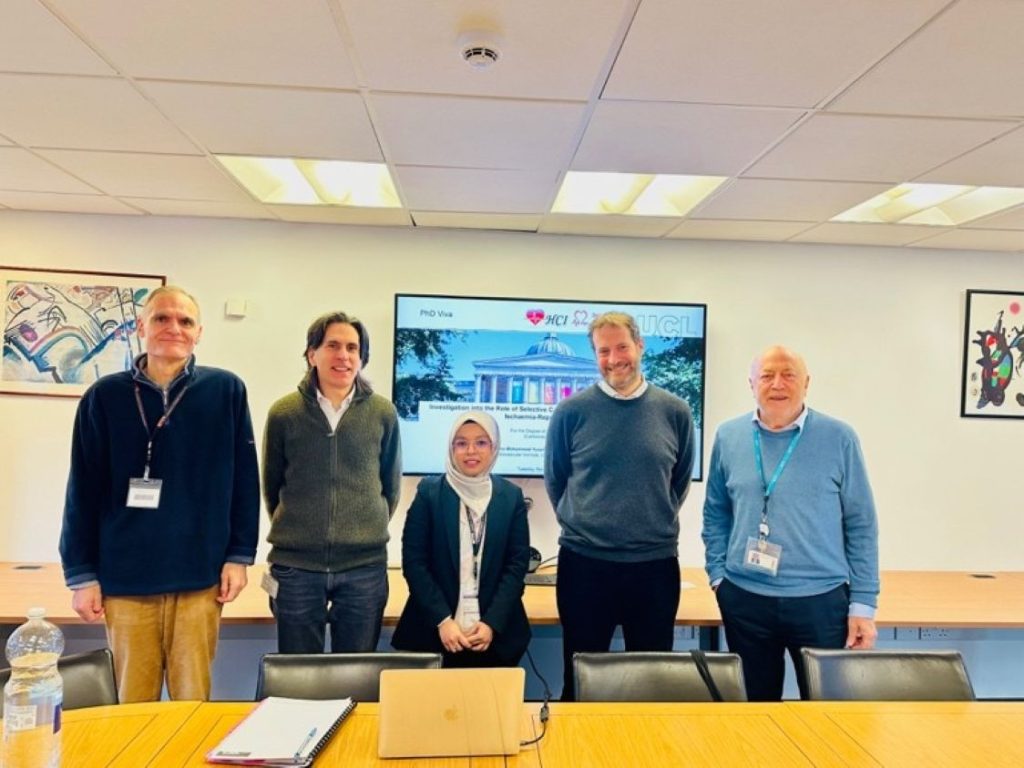
Dr. Nur Liyana Mohammed Yusof from the Department of Pharmacology, Faculty of Medicine, UKM conducted this research during her PhD in Cardiovascular Sciences at University College London (UCL) in 2024.
Her work focused on a long-standing challenge in heart attack treatment — the damage caused when blood flow is restored after a blockage, known as ischaemia-reperfusion (IR) injury.
“Restoring blood flow is critical, but the sudden rush of oxygen can paradoxically damage the heart and trigger hypercontraction, a destructive process where heart cells contract so forcefully that they burst,” she explained.
Dr. Nur Liyana discovered that a class of drugs called selective cardiac myosin inhibitors, originally developed for hypertrophic cardiomyopathy, could help reduce this damage.
These drugs — mavacamten and aficamten — have already been approved by the US Food and Drug Administration (FDA) and in the UK for other heart conditions.
“This work is a classic example of drug repurposing. We have tested whether these drugs can protect the heart in a completely different scenario – a heart attack.
“The results are very encouraging,” said Dr. Nur Liyana.
She added that laboratory experiments have shown that the drugs mavacamten and aficamten are able to prevent the hypercontraction of heart cells, with aficamten proving to be particularly effective, even at very low doses.
“In animal models, both drugs, administered shortly before blood flow was restored, significantly reduced the size of damaged heart tissue.
“Crucially, aficamten achieved this without affecting the normal pumping function of the heart in healthy subjects, indicating a large safety margin,” she said.
While the results are promising, the Dr Nur Liyana emphasized that this is a preclinical phase of study.
“Further research is needed to validate these findings in more complex models and ultimately in human clinical trials.
“If successful, these drugs could one day be used alongside standard procedures like angioplasty to improve recovery for heart attack patients globally,” she said.
Dr. Nur Liyana described the project as the cornerstone of her PhD when thinking about her path.
“I am keen to continue this research and inspire the next generation of Malaysian scientists. Our findings open up a new way to protect the heart in the critical moments after a heart attack,” she said.
The research, supported by Yang di-Pertuan Agong Scholarship grant and the British Heart Foundation research grant, was carried out under the direction of Professor Sean M. Davidson and Professor Derek M. Yellon at UCL’s Hatter Cardiovascular Institute.
The results have been published in two leading journals, Cardiovascular Drugs and Therapy and Basic Research in Cardiology.