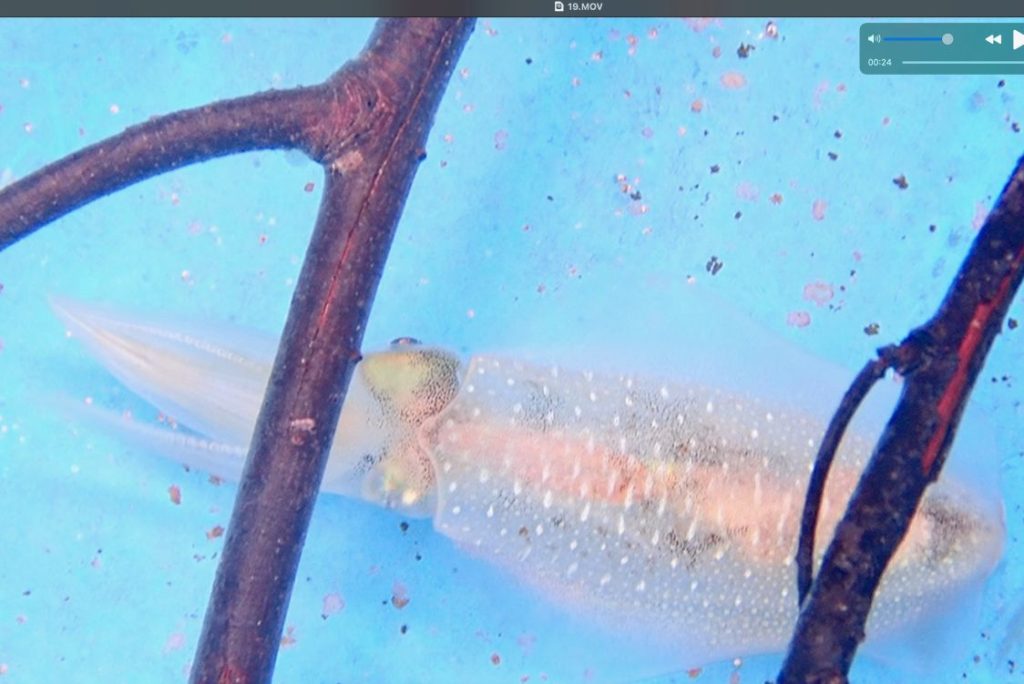
BANGI, 28 November 2025 – A Universiti Kebangsaan Malaysia (UKM) researcher has played a key role in a groundbreaking international study that uncovers the sophisticated camouflage mechanisms of squids.
Ts. Dr. Wee Hin Boo from the Institute of Climate Change (IPI) was part of the team that discovered how the oval squid (Sepioteuthis lessoniana)—a species commonly found in coastal waters—uses complex “motionless camouflage” patterns to blend seamlessly with its surroundings and evade predators.
The groundbreaking study, titled “Situational motionless camouflage of a loliginid squid,” was led by researchers from the Okinawa Institute of Science and Technology Graduate University (OIST) in Japan. The project brought together a global team of scientists from Japan, Malaysia, the United States, and Italy, underscoring UKM’s integral role in high-impact global research collaborations.
The team documented how squids masterfully produce disruptive, uniform, and mottled body patterns to blend seamlessly with their surroundings—a critical survival tactic to evade predators.
As the principal data analyst, Ts. Dr. Wee Hin Boo was instrumental in translating visual observations into robust scientific evidence. Using high-resolution imagery from OIST, Dr. Wee applied rigorous statistical analyses to quantify the characteristics of the squid’s camouflage patterns.
A key finding from his work was the identification of a specific colour and brightness contrast threshold that defines the squid’s “disruptive” pattern, a technique that visually breaks up the animal’s outline to make it unrecognisable against complex backgrounds.
Dr. Wee’s contribution to this high-impact international research was crucial in decoding the complex visual language of these incredible marine animals.
This collaboration not only advances our understanding of the natural world but also highlights UKM’s commitment to fostering global partnerships and producing world-class research.
The study’s findings have significant potential applications. Understanding the neural mechanisms behind this rapid, adaptive camouflage could inspire next-generation technologies in material science and biomimicry, such as advanced adaptive camouflage for military and industrial use.
Furthermore, as squid are a vital part of the marine food web and a major fishery resource, deeper knowledge of their survival strategies is essential for effective marine conservation and sustainable management.
Reflecting on his role, Ts. Dr. Wee said: “It was a fascinating challenge to quantify what the eye sees.
“The squids’ ability to change their appearance is stunning, and my role was to find the underlying mathematical patterns in their behaviour.
“By analysing the data, we were able to confirm the different strategies they use to vanish into the background.
“It is an honour to collaborate with leading scientists from OIST and other institutions, and I am thrilled that UKM could be a part of this discovery,” he said.