
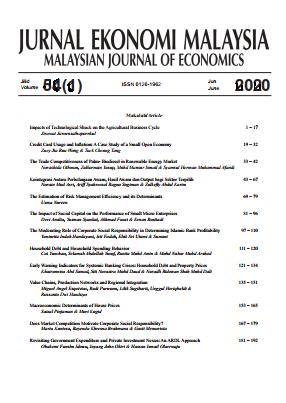
Jurnal Ekonomi Malaysia
Faculty of Economics and Management
Universiti Kebangsaan Malaysia
43600 UKM Bangi, Selangor, MALAYSIA.
Faculty of Economics and Management
Universiti Kebangsaan Malaysia
43600 UKM Bangi, Selangor, MALAYSIA.
Abstract
This study investigates the phased evolution and critical bottlenecks of high-quality economic development (HQED) in China’s Central Region from 2012 to 2020. Methodologically, it integrates the CRITIC method with the obstacle degree model to diagnose development constraints, complemented by Principal Component Analysis for cross-method validation. The results reveal that while the Central Region exhibits a steady upward trend in HQED, significant regional disparities and growth fluctuations persist across different phases. Crucially, both deficiency and variance-driven perspectives converge to identify energy consumption, foreign investment utilization, and educational expenditure as the primary bottlenecks hindering HQED. To unlock regional economic potential, policymakers should prioritize innovation-driven green transitions and structural industrial adjustments. This study offers new insights into regional economic dynamics and presents a scalable diagnostic framework for coordinated regional development in China and globally.
Keywords

Similar Articles
- Corporate Income Tax Incentives and R&D Investment in Digital Companies: A New Evidence from China
- Stock Market Linkage between China and ASEAN-6 Countries: Integration Perspective
- China’s Free Trade Zone Policy and High-Quality Economic Development (HQED) in Coastal and Inland Cities
Bibliography
Chen, WenJie and Mohd Saukani, Mohd Nasir
@article{chen2026analyzing,
title={Analyzing the Progress and Barriers to High-Quality Economic Development in China’s Central Region},
author={Chen, WenJie and Mohd Saukani, Mohd NasirChen, WenJie and Mohd Saukani, Mohd Nasir},
journal={Jurnal Ekonomi Malaysia},
volume={60},
number={2},
pages={–},
}
Receive updates when new articles are published.