
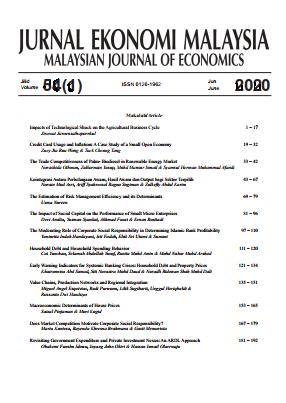
Jurnal Ekonomi Malaysia
60 (1) 2026 43 – 57
Faculty of Business and Management
Universiti Teknologi MARA (UiTM)
Cawangan Negeri Sembilan
71300 Rembau, Negeri Sembilan, MALAYSIA.
School of Business and Economics
Universiti Putra Malaysia (UPM)
43400 Serdang, Selangor, MALAYSIA.
School of Business and Economics
Universiti Putra Malaysia (UPM)
43400 Serdang, Selangor, MALAYSIA.
School of Business and Economics
Universiti Putra Malaysia (UPM)
43400 Serdang, Selangor, MALAYSIA.
Decision Management Department
CIMB Bank Berhad
50740 Kuala Lumpur, MALAYSIA.
Abstract
There exists a practicality issue with firms’ Social Performance (SP), where there is no uniformity in measuring a firm’s Environment, Social, and Governance (ESG) performance. This issue creates an Information Asymmetry (IA) problem for fellow stakeholders in the capital market. Hence, this study’s objectives are (1) to develop a new and uniform firm’s SP measurement, ESG efficiency (Technical Efficiency (TE)), and (2) to assess the practicality of TE by examining the moderation effect on the relationship between Country Characteristics (CC) and IA in capital markets. This study focuses on ESG firms of Malaysia and Singapore between the years 2010 and 2019. Notably, Malaysia and Singapore were selected as they are ASEAN leaders in ESG development, yet still face firm inefficiency and high IA in their capital markets. TE is developed using Data Envelopment Analysis (DEA), and its moderation effect is investigated using stepwise regression analysis. For the first objective, DEA findings reveal that Malaysia’s ESG firms are slightly more ESG efficient compared to Singapore’s. Moreover, it reveals that firms in both countries are purely inefficient in managing their financial returns for stakeholders’ ESG contributions. For the second objective, findings on TE moderation effects are mixed and exclusive to each country. Malaysia records both weakening and strengthening moderation effects, while Singapore records only a strengthening moderation effect towards the CC-IA association. The study contributes to the scant areas of ESG literature, such as SP measurement. The study uses an efficient production function in relation to a firm’s ESG performance measurement, TE. The study presents evidence that TE demonstrates the ability to mitigate the capital market’s IA. It calls for policymakers to regulate new laws that accentuate compulsory ESG commitment from listed firms, which would result in increased capital market transparency and investor protection.
Keywords

Similar Articles
- The Estimation of Risk Management Efficiency and its Determinants
- Firm Efficiency and Board Busyness: Empirical Evidence in Southeast and Northeast Asia
- Moral Hazard Behaviors and Mitigation Strategies: A Systematic Review
Bibliography
Ali, Muhammad Hafiz and Abdul Rahim, Norhuda and Yahya, Mohamed Hisham and Kamarudin, Fakarudin and Ali, Ayuniza
@article{ali2026does,
title={Does ESG Efficiency Moderates the Asymmetric Information of Malaysian and Singaporean Capital Markets},
author={Ali, Muhammad Hafiz and Abdul Rahim, Norhuda and Yahya, Mohamed Hisham and Kamarudin, Fakarudin and Ali, AyunizaAli, Muhammad Hafiz and Abdul Rahim, Norhuda and Yahya, Mohamed Hisham and Kamarudin, Fakarudin and Ali, Ayuniza},
journal={Jurnal Ekonomi Malaysia},
volume={60},
number={1},
pages={43–57},
}
Receive updates when new articles are published.