By Murniati Abu Karim
Photos by Shahiddan Saidi
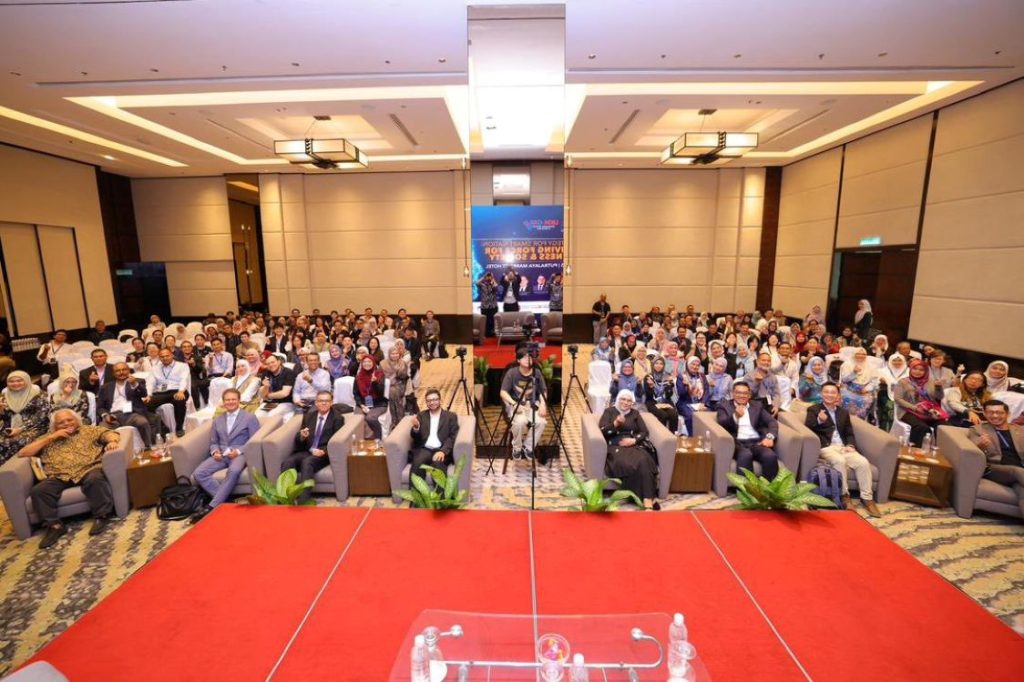
PUTRAJAYA, 22 September 2025 – Universiti Kebangsaan Malaysia (UKM), through the RHB-UKM Endowment, UKM-Graduate School of Business organised a seminar on how artificial intelligence (AI) can empower governments, industries, and communities.
The seminar, themed Smart Strategy for Smart Nation – AI as a Driving Force for Business and Society, brought together thought leaders, innovators, policymakers, academics, and aspiring professionals to exchange ideas on AI’s transformative role in shaping business and society.
The seminar was designed to share insights from industry, academia, and the wider community on how AI is reshaping business and society, including its opportunities, challenges, and ethical implications.
It also aims to foster knowledge exchange and best practices by providing a platform for researchers, practitioners, and students to present studies, showcase technologies, and discuss strategies for effective AI adoption in the context of building a smart nation.
The seminar was officiated by Acting Deputy Vice-Chancellor (Industry and Community Partnerships Affairs), Prof. Ts. Dr. Faizal Mohamed.
According to Prof Faizal, AI is no longer a futuristic concept but it has becoming a national priority which central to our aspirations under the Malaysia MADANI framework.
“Malaysia’s path toward becoming a smart nation is guided by the strategic framework such as the National Artificial Roadmap, the MyDigital initiative and the12th Malaysia Plan.
“These blueprints recognise that AI is more than a tool for efficiency – it is a catalyst for economic resilience, public sector innovation and social progress,” he said.
Prof. Faizal added that artificial intelligence is no longer confined to research labs or speculative fiction but has become a transformative force embedded in the way people live, work, learn, and lead.
However, he said that its rapid advancement also presents complex challenges, including data ethics, algorithmic bias, cybersecurity, privacy, and equitable access, which must be addressed through ethical, inclusive, and strategic approaches.
“These are not only technical issues but deeply societal ones, requiring strategic, inclusive, and ethical approaches.
“This is where smart strategy becomes essential. A smart nation is not built by technology alone – it is built by vision, governance, and collaboration.
“It is built by strategies that are holistic, forward-thinking, inclusive, and grounded in ethical responsibility,” he said.