
About the Journal
The Journal of Contemporary Islamic Law was established in 2016 with the aim of promoting the study and research of Islamic law and its contemporary applications. With a double-blind peer review policy in place, the journal provides a platform for academics, scholars, and researchers to share their insights, research findings, and opinions on various aspects of Islamic law and its impact on modern societies. This policy ensures the quality and integrity of its publications by providing a fair and objective assessment of each article submitted for publication. The journal’s focus on contemporary issues and its multilingual publication in Malay, English, and Arabic offers a diverse and insightful perspective on Islamic law and its role in shaping the legal systems of various societies. The journal’s emphasis on interdisciplinary research and collaboration between scholars from different fields provides a nuanced and comprehensive understanding of the complex relationship between Islamic law and its broader social, political, and economic context. The Journal of Contemporary Islamic Law provides a valuable resource for scholars, students, and professionals interested in Islamic law. Its unique focus on contemporary issues, multilingual publication, and interdisciplinary approach sets it apart from other academic journals in this field, and it is a must-read for anyone looking to gain a deeper understanding of Islamic law and its impact on modern societies.
| Journal Title | Journal of Contemporary Islamic Law |
| Editor-in-Chief | Dr. Nurul Ilyana Muhd Adnan   |
| DOI | 10.26475/jcil |
| ISSN | ISSN 2976-3916; eISSN 0127-788X |
| Frequency | 2 issues per year (January-June and July-December) |
| URL | https://www.ukm.my/jcil/ |
| editorjcil@ukm.edu.my | |
| Language | Malay; English; Arabic |
| Licensing | Attribution-NonCommercial 4.0 International |
| Managing Style | Open Access Journal |
| Publishing System | Open Journal System |
| Publisher | Research Centre for Sharia, Faculty of Islamic Studies, Universiti Kebangsaan Malaysia |
| Citation Analysis | MySitasi | UDL EDGE | Google Scholar | Crossref | Dimensions | |
| Address | Research Centre for Sharia, Faculty of Islamic Studies, Universiti Kebangsaan Malaysia, 43600 Bangi, Selangor, Malaysia |
| Publication Fee | MYR400 (Local) / USD100 (International) |
The Journal of Contemporary Islamic Law implements a double-blind peer review policy to ensure the quality and integrity of its publications. Under this policy, the authors and the reviewers are anonymous, and their identities are kept confidential throughout the review process. The double-blind peer review process is designed to provide a fair and objective assessment of the articles submitted to the journal. The objective of the review is to ensure that articles are of high quality, meet academic standards, and are suitable for publication in the journal. Upon receipt of an article submission, the editorial team will conduct an initial review to determine its suitability for publication in the journal. If the article is deemed suitable, it will then be assigned to two independent peer reviewers who are experts in the relevant field. The reviewers will assess the article based on its content, methodology, and contribution to the academic discourse on Islamic law. The reviewers will provide their written assessments and recommendations to the editorial team, who will then make a final decision on the article’s suitability for publication. The editorial team may request revisions from the author or reject the article if it does not meet the journal publication standards. The double-blind peer review policy at the Journal of Contemporary Islamic Law ensures the quality and credibility of its publications by providing a fair and objective assessment of each article submitted for publication. The policy helps to maintain the academic standards of the journal and contributes to the ongoing advancement of the field of Islamic law.
Call for Article Submissions
Journal of Contemporary Islamic Law (JCIL)
Volume 11, Issue 2 — December 2026
The Journal of Contemporary Islamic Law (JCIL) invites scholars, researchers, academicians, postgraduate students, and practitioners to submit original scholarly articles for consideration in Volume 11, Issue 2, scheduled for publication in December 2026. JCIL welcomes submissions related to contemporary issues in Islamic law, including but not limited to Islamic jurisprudence, halal studies, Islamic family law, Islamic finance, maqasid al-shariah, legal reform, Muslim consumer protection, and other current developments in Shariah and law. Submitted manuscripts must be original, unpublished, and not under consideration by any other journal. All submissions will undergo the journal’s editorial screening and peer-review process.
Authors are invited to submit their manuscripts through the JCIL online submission system: e-Journal UKM (Journal of Contemporary Islamic Law)
For author guidelines and manuscript preparation requirements, please refer to: Author Guidelines
Submission deadline: September 1, 2026
For further inquiries, please contact:
editorjcil@ukm.edu.my
We look forward to receiving your scholarly contributions.
eISSN 0127-788X
ISSN 2976-3916
Indexed & Abstracted by:





Published by:
Research Centre for Sharia,
Faculty of Islamic Studies,
Universiti Kebangsaan Malaysia,
43600 Bangi, Selangor,
MALAYSIA.
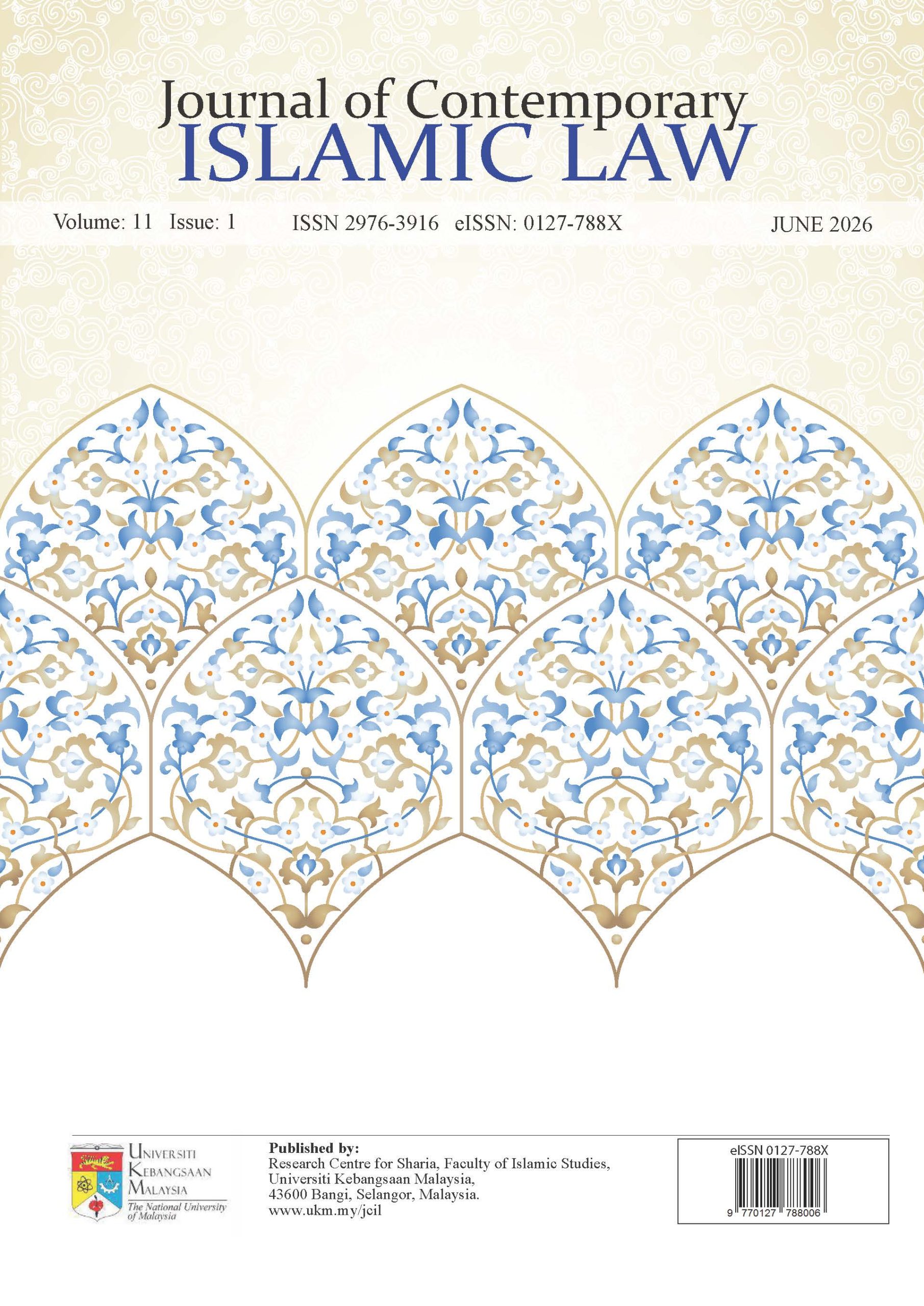
Current Issue
June 2026 Volume 11(1)
The Journal of Contemporary Islamic Law covers a wide range of fields related to Islamic law and its contemporary applications. This issue has been available online since December 15th, 2025. All articles in this issue were written or co-written related to some of the key fields covered by the journal include Islamic Law (Shariah), Fiqh (Islamic Jurisprudence), Comparative Law between Civil and Islamic Systems, Islamic Commercial Jurisprudence (Fiqh Muamalat), Islamic Economy and Finance, Islamic Banking and Finance, Islamic Family Law and Personal Status, Islamic Criminal Law and Penal Code, Islamic Environmental Law and Ethics, Islamic Human Rights, Islamic Constitutional Law and Governance, Islamic Law Philosophy and Epistemology, Islamic law in History and Civilization, Islamic Law Culture and Society, Islamic Ethics and Morality.
DOI: https://doi.org/10.26475/jcil.2026.11.1
Published: 2026-06-15
Parliamentary Oversight of the Performance of the Executive Authority in Light of Islamic Sharia Positive Constitutional Systems: A Comparative Analytic Study
Jarrah Ehfa Alazemi, Muhammad Nazir Alias  & Anwar Fakhri Omar
2026, Vol. 11(1), pp. 1-10. | PDF
Received: Sept 13, 2025 | Revised: April 5, 2026 | Accepted: June 3, 2026 | Published: June 15, 2026
DOI: https://doi.org/10.26475/jcil.2026.11.1.01
Perlindungan Undang-Undang Terhadap Tanggungjawab Filial Di Malaysia
Legal Protection of Filial Responsibility in Malaysia
Nur Aisyah Jalalemping & Nur Farahiyah Mohd Nasir
2026, Vol. 11(1), pp. 11-22. | PDF
Received: Oct 15, 2025 | Revised: April 10, 2026 | Accepted: June 3, 2026 | Published: June 15, 2026
DOI: https://doi.org/10.26475/jcil.2026.11.1.02
Hukum Penggunaan Harta Luqatah Berasaskan Kaedah al-Masalih al-Mursalah
The Legal Ruling on the Use of Lost Property Based on the Principle of al-Masalihal-Mursalah
Muhammad Mu’izz Abdullah, Muhammad Nawir Farhan Mahdzir, Mohammad Zaini Yahaya , Mohd Zamro Muda & Muhammad Mukhlis Muhammad Rosli
2026, Vol. 11(1), pp. 22-36. | PDF
Received: Aug 10, 2025 | Revised: Jan 16, 2026 | Accepted: April 14, 2026 | Published: June 15, 2026
DOI: https://doi.org/10.26475/jcil.2026.11.1.03
Penetapan Had Masa Tuntutan Harta Sepencarian Selepas Kematian Pasangan: Kajian Kes di Mahkamah Tinggi Syariah Johor Bahru
Determination of The Time Limit of Matrimonial Property ‘After the Death of a Spouse’: A Case Study at the Syariah High Court of Johor Bahru
Nur Hanis Shafinaz Mahat, Norhoneydayatie Abdul Manap & Rahmawati
2026, Vol. 11(1), pp. 37-49. | PDF
Received: Aug 4, 2025 | Revised: May 22, 2026 | Accepted: June 3, 2026 | Published: June 15, 2026
DOI: https://doi.org/10.26475/jcil.2026.11.1.04
Penyalahgunaan Media Sosial dalam Kalangan Suami Isteri: Analisis Implikasi di Malaysia
Social Media Misuse Among Husbands and Wives: An Analysis of Implications in Malaysia
Ummie Natasya Zaini & Zuliza Mohd Kusrin
2026, Vol. 11(1), pp. 50-60. | PDF
Received: Jan 5, 2026 | Revised: Jan 27, 2026 | Accepted: June 3, 2026 | Published: June 15, 2026
DOI: https://doi.org/10.26475/jcil.2026.11.1.05
Analisis Retrospektif Karya Berkaitan Penggunaan Kamus Sebagai Alat Bantu Mengajar Ilmu Falak
A Retrospective Analysis of Scholarly Works on the Use of Dictionaries as Teaching Aids in Falak Studies
Mohamad Fauzan Mohd Razali, Mohd Hafiz Safiai & Muhd Rasywan Syarif
2026, Vol. 11(1), pp. 61-67. | PDF
Received: Jan 5, 2026 | Revised: Feb 3, 2026 | Accepted: June 3, 2026 | Published: June 15, 2026
DOI: https://doi.org/10.26475/jcil.2026.11.1.06
Analisis Kajian Literatur Uruf Dalam Penetapan Zakat Perhiasan Emas
Analysis of Literature on Urf in The Determination of Zakat on Gold Jewellery
Muhamad Azizi Fauzi & Shofian Ahmad
2026, Vol. 11(1), pp. 68-75. | PDF
Received: Jan 5, 2026 | Revised: Jan 22, 2026 | Accepted: June 3, 2026 | Published: June 15, 2026
DOI: https://doi.org/10.26475/jcil.2026.11.1.07
Cabaran Pengurusan Harta Pusaka Mualaf dalam Masyarakat Majmuk di Malaysia
Challenges in The Administration of Muallaf Estates in a Pluralistic Society in Malaysia
Maryam Aabidah Nordin , Zaini Nasohah & Fikri
2026, Vol. 11(1), pp. 76-82. | PDF
Received: Jan 5, 2026 | Revised: Jan 22, 2026 | Accepted: June 3, 2026 | Published: June 15, 2026
DOI: https://doi.org/10.26475/jcil.2026.11.1.08
Permohonan Poligami: Kajian Di Mahkamah Tinggi Syariah Shah Alam
Application for Polygamy: A Study at the Shah Alam Syariah High Court
Nur Hurin Batrisyia Mohd Sham & Norhoneydayatie Abdul Manap
2026, Vol. 11(1), pp. 83-89. | PDF
Received: Jan 5, 2026 | Revised: Jan 27, 2026 | Accepted: June 3, 2026 | Published: June 15, 2026
DOI: https://doi.org/10.26475/jcil.2026.11.1.09
Signifikan Semakan Status Tanah Wakaf
The Significance of Reviewing the Status of Waqf Land
Md Yazid Ahmad , Muhammad Adam Zulfakar Affandi, Ahmad Nizam & Akhmad Jalaluddin
2026, Vol. 11(1), pp. 90-97. | PDF
Received: Jan 5, 2026 | Revised: Jan 26, 2026 | Accepted: June 3, 2026 | Published: June 15, 2026
DOI: https://doi.org/10.26475/jcil.2026.11.1.10
Pensijilan Halal di Malaysia: Pengaruh Pengetahuan Pengguna Muslim Terhadap Sikap dan Tingkah Laku Pemilihan Makanan Halal di Bandar Baru Bangi
Halal Certification in Malaysia: The Influence of Muslim Consumers’ Knowledge on Attitude and Halal Food Selection Behavior in Bandar Baru Bangi
Anis Zulaikha Mohamad Azhar & Mohd Izhar Ariff Mohd Kashim
2026, Vol. 11(1), pp. 98-106. | PDF
Received: Jan 5, 2026 | Revised: May 20, 2026 | Accepted: June 3, 2026 | Published: June 15, 2026
DOI: https://doi.org/10.26475/jcil.2026.11.1.11
Faktor Peningkatan Kes Keganasan dan Penderaan Rumah Tangga di Malaysia dari Perpspektif Mangsa: Suatu Sorotan Literatur
Factors Contributing to the Increase in Domestic Violence and Abuse Cases in Malaysia from the Victim’s Perspective: A Literature Review
Nur Haziqah Sahira Hamzah , Wafaa’ Yusof & Fitriyani
2026, Vol. 11(1), pp. 107-112. | PDF
Received: Jan 5, 2026 | Revised: Feb 3, 2026 | Accepted: June 3, 2026 | Published: June 15, 2026
DOI: https://doi.org/10.26475/jcil.2026.11.1.12
Buli Siber: Satu Kajian Netnografi Berasaskan Maqasid Syariah
Cyberbullying: A Netnographic Study Based on Maqasid Syariah
Nurul Shafiqah Ilias & Anwar Fakhri Omar
2026, Vol. 11(1), pp. 113-120. | PDF
Received: Jan 5, 2026 | Revised: Feb 3, 2026 | Accepted: June 3, 2026 | Published: June 15, 2026
DOI: https://doi.org/10.26475/jcil.2026.11.1.13
Kewajaran Golongan Gelandangan Sebagai al-Riqāb
The Justification of the Homeless as al-Riqāb
Abdul Mu’ti Idris & Amir Fazlim Jusoh Yusoff
2026, Vol. 11(1), pp. 121-125. | PDF
Received: Jan 5, 2026 | Revised: May 5, 2026 | Accepted: June 3, 2026 | Published: June 15, 2026
DOI: https://doi.org/10.26475/jcil.2026.11.1.14
Cadangan Garis Panduan Kebebasan Bersuara di Media Sosial Menurut Perspektif Islam
Proposed Guidelines for Freedom of Speech on Social Media According to Islamic Perspective
Ahmad Syakir Mohd Nor Ilman & Zuliza Mohd Kusrin
2026, Vol. 11(1), pp. 126-136. | PDF
Received: Sept 29, 2025 | Revised: May 18, 2026 | Accepted: June 3, 2026 | Published: June 15, 2026
DOI: https://doi.org/10.26475/jcil.2026.11.1.15
Implikasi Perkahwinan Tidak Berdaftar terhadap Pengiktirafan Perkahwinan dan Status Anak dalam Undang-Undang di Malaysia
Implication of Unregistered Marriage on Marriage Recognition and Child Status under Malaysian Law
Nur Faizah Aqilah Asahari & Nurbazla Ismail
2026, Vol. 11(1), pp. 137-150. | PDF
Received: Jan 5, 2026 | Revised: May 5, 2026 | Accepted: June 4, 2026 | Published: June 23, 2026
DOI: https://doi.org/10.26475/jcil.2026.11.1.16