

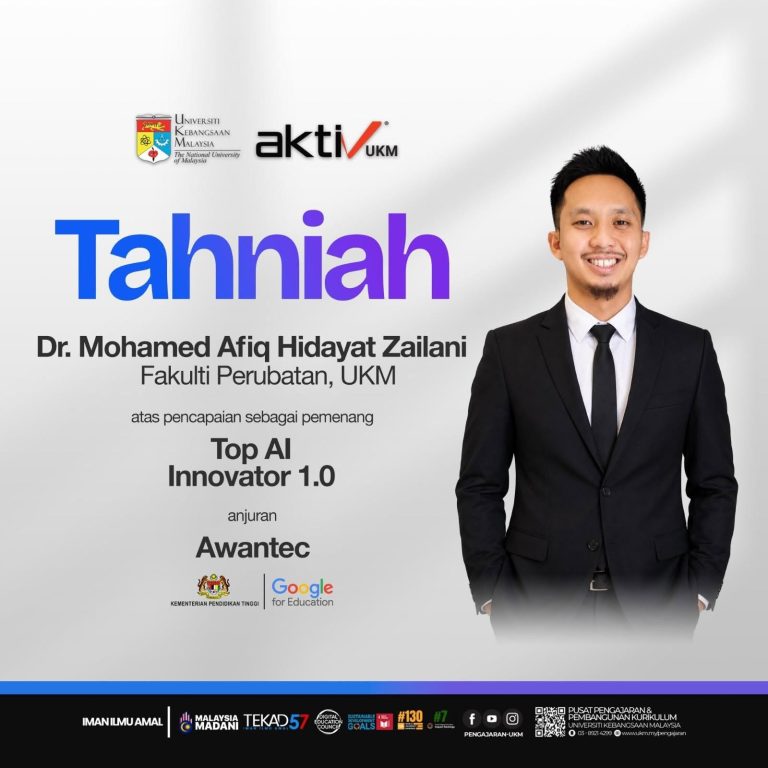
KUALA LUMPUR — Dr. Mohamed Afiq Hidayat Zailani, a Senior Lecturer in the Department of Pathology at the Faculty of Medicine, Universiti Kebangsaan Malaysia (UKM), has been named one of the top five winners in the nationwide Top AI Innovator 1.0 competition, organized by Awantec Sdn Bhd and Google for Education Malaysia. The initiative celebrated exceptional educational use cases leveraging the Gemini Pro artificial intelligence (AI) application, rewarding the winners with an immersive learning journey to Google Singapore.
Dr. Mohamed Afiq competed under the Best Use Case for Lecturer category and was recognized for his innovative project entitled “Redesigning Lecture Materials for Cardiac Pathology”. The innovation was inspired by the challenge of delivering complex medical concepts to undergraduate medical students. He harnessed generative AI to transform dense pathology content on Ischaemic Heart Disease into clear and engaging learning resources.
“Medical education involves some highly complex concepts, and I believe our responsibility as educators is to make these concepts easier for students to understand without compromising scientific accuracy. I see AI as a valuable tool to enhance, rather than replace, the role of educators,” said Dr. Mohamed Afiq.
Beyond static lecture slides, his innovation extended to dynamic revision aids. He further refined the materials and developed Virtual Takeaway Notes (VTN), a four-minute instructional summary video featuring an AI-generated voiceover and avatar. Students can instantly access these brief revision modules for post-lecture reinforcement, helping to strengthen their understanding and memory retention.
“One of my main objectives was to make learning more accessible and engaging, even after students leave the lecture hall. I hope to encourage students to revisit and reinforce what they have learned at their own pace,” he added.
The award highlights how educators can seamlessly integrate Gemini Pro to establish new benchmarks for innovation, visual clarity, and learning efficiency in medical education. For Dr. Mohamed Afiq, this recognition also reinforces the potential of AI-driven innovation in shaping the future of teaching and learning. “I believe this is just the beginning. There is tremendous potential for AI to transform medical education, and I hope to continue exploring innovative approaches that make learning more meaningful and impactful for future healthcare professionals,” he concluded.