

TRACING ANCIENT FOOTSTEPS: SECRETS OF PREHISTORIC HUMAN SKELETONS UNVEILED AT UKM
By Associate Prof. Ts. Dr. Wong Sok Kuan


“Have you ever wondered what life was like for our ancestors thousands of years ago?”
“What was their health like and what secrets are hidden within the bones that have endured through the ages?”
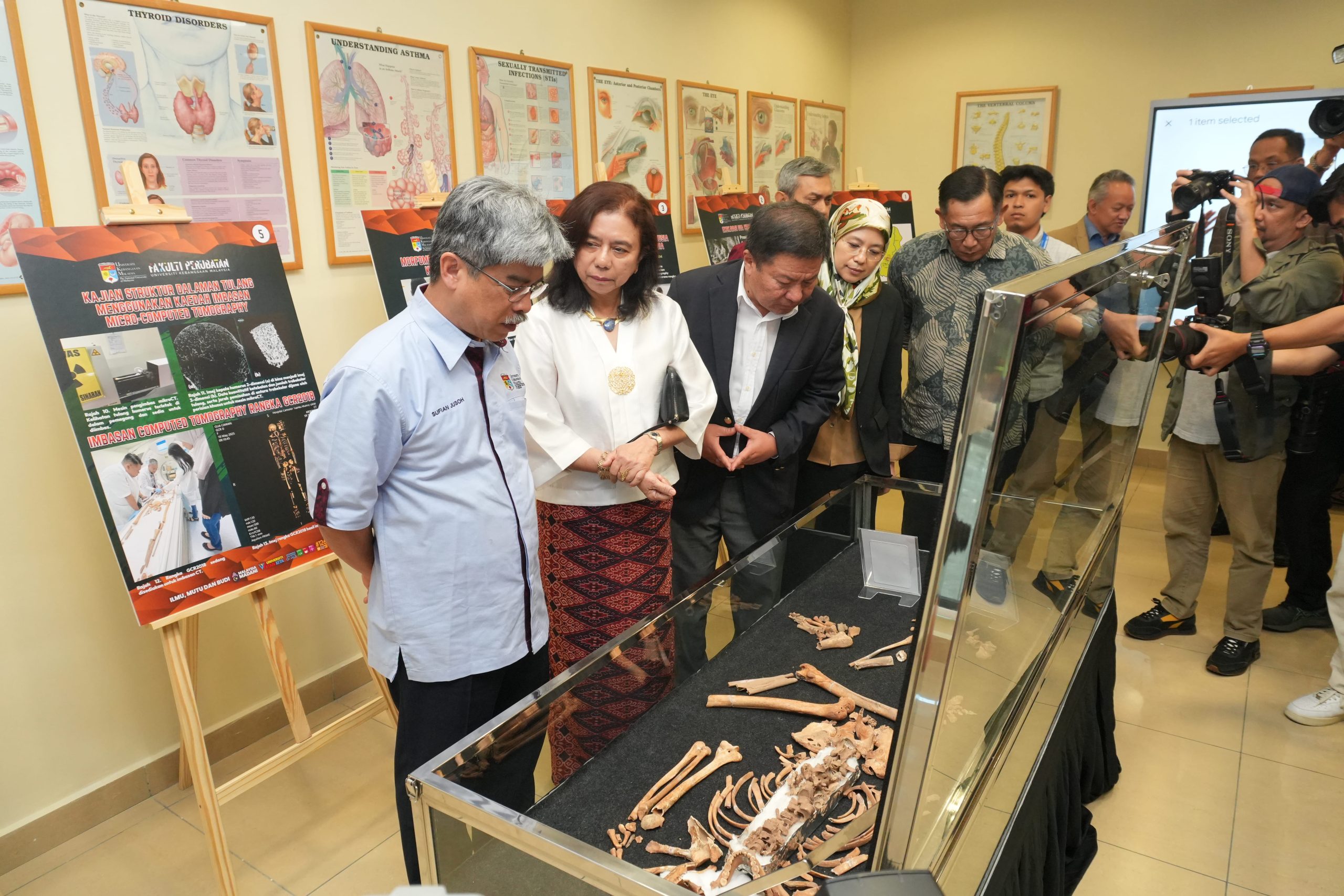
Kuala Lumpur – On 13th January 2026, the Faculty of Medicine Universiti Kebangsaan Malaysia (UKM) opened a “time machine” through the Opening Ceremony of the Prehistoric Human Skeleton Exhibition, themed “Recognising the Story of Ancient Humans.” This event was held at Lecture Hall 2, Preclinical Building. The prestigious ceremony was officiated by the Vice-Chancellor of UKM, Professor Dato’ Dr. Sufian Jusoh. High-level leadership from UKM also attended the event, including the Deputy Vice-Chancellor of Research and Innovation, Professor Dr. Ismanizan Ismail, the Pro Vice-Chancellor of the Kuala Lumpur Campus, Professor Dato’ Dr. Hanafiah Harunarashid, and the Dean of the Faculty of Medicine, Professor Datin Dr. Marina Mat Baki. It was more than just a typical display that served as a bridge connecting modern anatomical science with ancient human history.
Incredible Discoveries from Gua Chawan
The star attraction of this exhibition features four human skeletons discovered at Gua Chawan. These remains were painstakingly excavated between 2018 and 2023 by archaeology expert Assoc. Prof. Dr. Zuliskandar Ramli from the Institute of the Malay World and Civilization (ATMA), in collaboration with the Department of National Heritage.Carbon dating analysis has revealed the remarkable age of these individuals, placing them between 7,000 to 9,200 BP (Before Present). Through expert analysis of forensic odontology conducted by Dr. Nor Atika Md. Ashar of UKM, the identities of these individuals began to emerge:
Composition: The group consists of one woman and three men.
Estimated Age: They were between 24 and 40 years old at the time of death.
Mirrors of the Past
These skeletons were subsequently brought to theFaculty of Medicine, UKM for advanced research on bone health. This study was led by Professor (Honorary) Dr. Ima Nirwana Soelaiman and working alongside a dedicated team of expert researchers: Associate Prof. Dr. Elvy Suhana Mohd. Ramli, Associate Prof. Dr. Chin Kok Yong, AssociateProf. Ts. Dr. Wong Sok Kuan, and Dr. Fairus Ahmad. The findings offer a fascinating look at our biological heritage. Despite the vast passage of time, the research revealed that these ancient individuals are remarkably similar to us:
Physique and Stature: No difference in bone morphometry or height between these prehistoric humans and modern humans.
Bone Quality: No difference in bone density or internal structure of the bones when compared to people today.
Biological Connection: Humans from 7,000 to 9,200 years ago belong to the same species as we do, which is Homo sapiens.
Health Implications: Since their bone characteristics are closely resembling our own, it suggests that the bone health status of prehistoric humans was not much different from that of modern humans.
More Than Just Bare Bones
This exhibition offers a unique opportunity for visitors to get up close with actual specimens used in anthropological and anatomical studies. Why is this significant?
Public Awareness: It provides education on the lifestyle, health, and living environment of prehistoric humans through the analysis of surviving bones and teeth.
Science and History: It brings together modern research techniques and deep historical narratives regarding prehistoric society.
Future Contributions: The data obtained not only aids archaeologists but also has the potential to support modern healthcare research.
Currently, three of these prehistoric skeletons are on display for the public at the Medical Museum of Anatomy and Pathology, Faculty of Medicine UKM.
“Through the bones and teeth that have survived until today, we learn about human resilience across time.”
“Don’t miss the chance to see this historical legacy for yourself and understand the evolution of human health through the lens of prehistoric science!”