Keynote Speakers
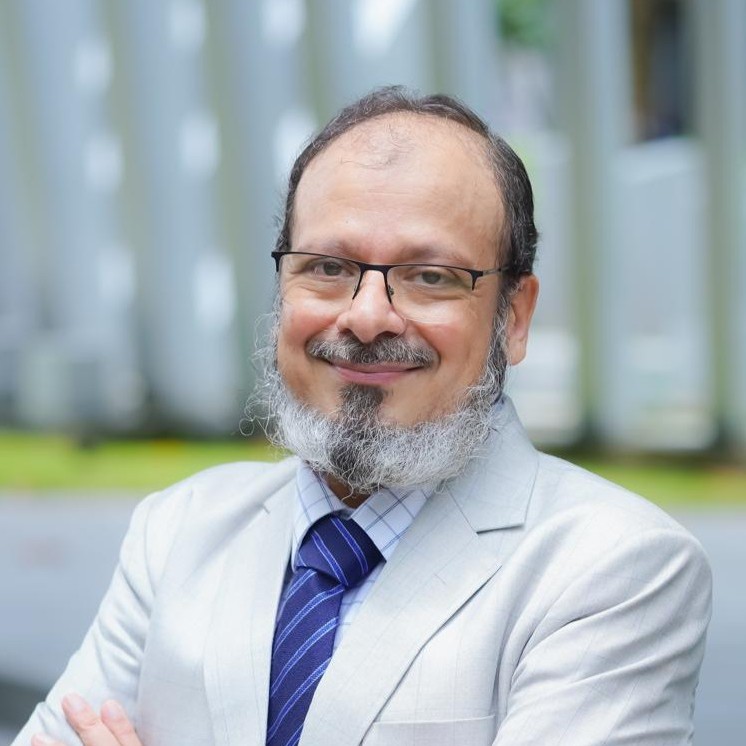
PROF. DR. SHABBIR H. GHEEWALA
- Professor and Head,
Life Cycle Sustainability Assessment Lab Joint Graduate School of Energy and Environment (JGSEE),
King Mongkut’s University of Technology Thonburi (KMUTT), Bangkok, Thailand
- Distinguished Adjunct Professor,
Asian Institute of Technology (AIT), Thailand
Title: Sustainability, net-zero targets, and planetary health — Quo vadis?
The planetary boundaries framework identifies nine critical Earth-system processes—climate change, biosphere integrity, land-system change, freshwater use, biogeochemical flows, ocean acidification, atmospheric aerosol loading, stratospheric ozone depletion, and novel entities—that regulate the planet’s stability and resilience. These define a “safe operating space” for humanity, where we can thrive without risking abrupt, irreversible shifts. Recent assessments show that seven of nine boundaries are now transgressed, with ocean acidification newly breached and worsening trends across most others. Crossing these interconnected thresholds heightens risks of cascading crises, from biodiversity collapse to disrupted monsoons and weakened carbon sinks. Net-zero targets, aiming to balance greenhouse gas emissions with removals by mid-century, represent a vital response to the climate boundary. Anchored in Paris Agreement ambitions and IPCC pathways, they drive decarbonization across energy, industry, transport, and land use, promising co-benefits like cleaner air and healthier ecosystems. Yet net zero alone is not sufficient if pursued in isolation. Narrow carbon-focused strategies risk transgression of other boundaries, e.g., large-scale bioenergy or poorly designed offsets could intensify land-system change, freshwater stress, or biodiversity loss. True sustainability requires embedding net-zero efforts within the broader planetary boundaries framework: respecting all limits holistically, prioritizing nature-positive transitions, equitable development, and systemic transformations that safeguard human well-being alongside Earth’s life-support systems. This is also an opportune time to rethink ambitions — not as endless growth, but as thriving within safe boundaries. By aligning aggressive net-zero action with planetary safeguards, we can forge resilient, just pathways that honor both human potential and Earth’s resilience.
Shabbir H. Gheewala is a professor at the Joint Graduate School of Energy and Environment (JGSEE), Thailand where he teaches Life Cycle Assessment and has led the Life Cycle Sustainability Assessment Lab for almost 25 years. His research focuses on sustainability assessment of energy systems; sustainability indicators; circular economy; and certification issues in biofuels and the agro-industry. He is a national expert on life cycle inventory as well as product carbon and water footprinting in Thailand. He mentors the research network on sustainability assessment and policy for food, fuel and climate change in Thailand. Along with graduate teaching and research, Shabbir has worked extensively with industry in Thailand providing training and consultancy to scores of companies with aspirations towards improvements in sustainability.
In 2025, he was invited to join the International Resource Panel. He has been ranked as one of the world’s top 1000 most influential climate scientists (Reuter’s Hot List 2021) and the world’s top 1% of the most-cited researchers in environmental sciences during 2020-2025. He was awarded the “Mahidol Science Environment & Sustainability Award” in 2022. With over 400 papers in peer reviewed journals and a Scopus h-index of 62, he is the Specialty Chief Editor of Quantitative Sustainability Assessment at Frontiers in Sustainability, and on the editorial boards of Sustainable Production and Consumption (Elsevier), Energy Nexus (Elsevier), International Journal of Life Cycle Assessment (Springer), and a host of other journals.

PROF. DATUK TS. DR. RAMZAH DAMBUL
Chief Executive Officer (CEO)
Institute of Development Studies (Sabah)
Title: Climate Change: Science to Policy
Climate change is no longer a distant scientific concern; it is a present reality shaping economies, ecosystems, and societies across the world. While the science of climate change has advanced significantly over the past decades, a persistent gap remains between scientific knowledge and effective policy implementation.
This keynote explores how scientific understanding can be translated into practical and responsive public policy. The discussion ranges from atmospheric dynamics and climate modelling to regional climate observations.
The address highlights the importance of evidence-based policymaking, interdisciplinary collaboration, and the integration of local knowledge with global climate science. Particular attention is given to the challenges faced by developing and climate-vulnerable regions, where climate risks intersect with development priorities.
Ultimately, addressing climate change requires more than scientific certainty; it demands political will, institutional coordination, and societal engagement. Bridging the gap between science and policy is therefore essential to ensure that climate knowledge meaningfully informs decisions that safeguard communities, ecosystems, and future generations.
Datuk Dr. Ramzah Dambul is the Chief Executive Officer of the Institute for Development Studies (IDS) Sabah, a think tank for the Sabah State Government that provides evidence-based policy analysis and recommendations to support the state’s socioeconomic development.
He is originally from Ranau, Sabah, and holds a Doctor of Philosophy (PhD) in Synoptic Climatology from the University of East Anglia, United Kingdom. He also earned a Master’s degree in Physical Geography from Universiti Kebangsaan Malaysia and a Bachelor of Science in Physical Geography from Universiti Malaya, in addition to a Certificate in Learning and Teaching in Higher Education from the University of East Anglia.
Throughout his professional career, he has held several key leadership positions, including serving as Deputy Vice-Chancellor (Research and Innovation) at Universiti Malaysia Sabah (UMS) from 2019 to 2022. He also served as Deputy Secretary-General (Science, Technology and Innovation) at the Ministry of Science, Technology and Innovation (MOSTI). At the international level, he was appointed as an Expert and Visiting Fellow at the Center of Excellence for Climate Change Research at King Abdulaziz University in Jeddah, and was awarded a Chevening Postdoctoral Fellowship in the United Kingdom.
As a prolific researcher, Datuk Dr. Ramzah has led numerous high-impact research projects related to climate change, food security, and natural resource management, funded by agencies such as the Ministry of Higher Education, WWF, and the British Council. His scholarly contributions are extensive, including publications in international journals, book chapters, and anthologies on geography focusing on climate systems and socioeconomic issues in Borneo. His expertise has also been recognized through various research and innovation awards, including winning a gold medal in a university-level innovation competition for developing Borneo climate scenarios.