Home/ Instrumentation/ Automatic Polarimeter (POL)

UKM research instrumentation

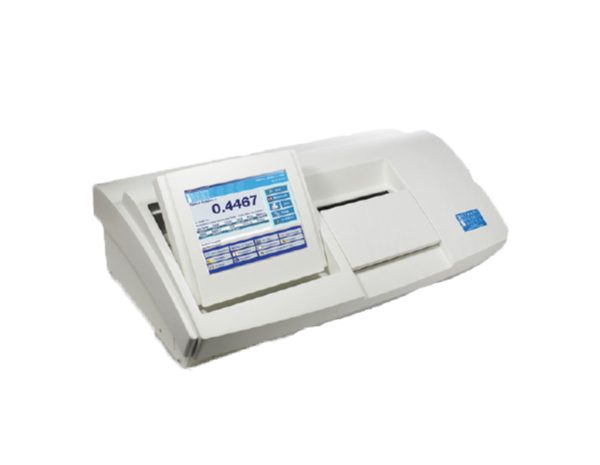
Automatic Polarimeter (POL)

BrandRudolph Research Analytical
ModelAUTOPOL VI
LocationLevel 1, i-CRIM Centralised Lab, Centre for Natural and Physical Laboratory Management UKM (ALAF-UKM), Research Complex UKM
StatusEnquiries welcome

Overview

Wavelength Range : 365nm, 405nm, 436nm, 546nm, 589nm, 633nm

  • To measure the angle of rotation caused by passing polarized light throughan optically active substance.
  • Some chemical substances are optically active, and polarized (uni-directional) light will rotate either to the left (counter-clockwise) or right (clockwise) when passed through these substances. The amount by which the light is rotated is known as the angle of rotation. The angle of rotation is basically known as observed angle.

Applications

For mixtures of chiral organic molecules in pure or diluted form, polarimetry provides a rapid, reliable, quality check that eliminates conventional analysis like liquid chromatography which can take an hour to do what the polarimeter accomplishes in minutes. Chemists use polarimetry to test the effectiveness of catalysts and asymmetric synthetic processes.

a. Pharmaceutical industry
• Monitoring chemical process
• Purity control and determination of concentrations
• Characterisation of new synthetic substances

b. Chemical industry
• Purity control and determination of concentrations
• Analysis of optically-active components (qualitative and quantitative)
• Determination of changes in the configuration
• Monitoring chemical processes

c. Sugar industry
• Quality control of original and end product
• Determination of fructose and glucose
• Sugar concentrations in refined beet and cane sugar, molasses and beet pulp

d. Food industry
• Determination of concentration
• Purity control
• Quality control

Sample Requirements

  • 1

    Solid or liquid that soluble in organic solvents

Typical Result

PRICE LIST

Analysis Code Type of Analysis UKM Non-UKM
POL 01 Optical/ Specific Rotation for compound chirality determination RM50/analysis RM100/analysis
[gravityform id="7" title="true"]

[reblex id=’7149′]

Element List for ICPMS Analysis

  • Environmental Standard Elements

    Cr Mn Fe Cu Se Ni Zn As Ag Cd Sn Sb Ba Pb

  • Rare Earth Standard Elements

    Sc Y Ce La Nd Pr Eu Sm Tb Dy Er Yb Lu Gd Tm

  • Full Scan Elements

    Li Be B C N F Ne Na Mg Al Si P S Cl Ar K Ca Sc Ti V Cr Mn Fe Co Ni Cu Zn Ga Ge As Se Br Kr Rb Sr Y Zr Nb Mo Ru Rh Pd Ag Cd In Sn Sb Te I Xe Cs Ba La Ce Pr Nd Sm Eu Gd Tb Dy Ho Er Tm Yb Lu Hf Ta W Re Os Ir Pt Au Hg Tl Pb Bi Th U

T&C Bulk Payment