Product Details
UKM research instrumentation
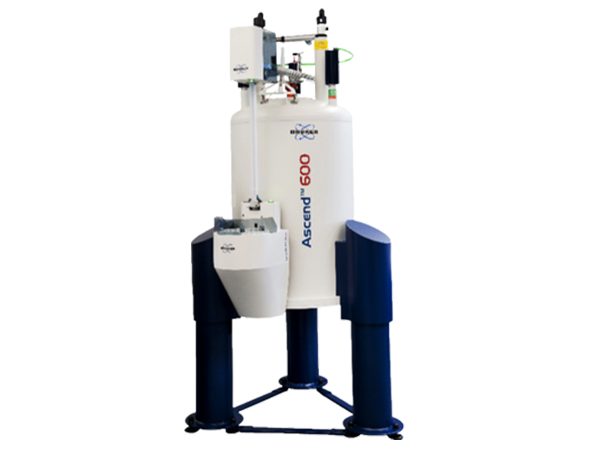
Fourier Transform Nuclear Magnetic Resonance (FT-NMR) 600 MHz with Cryoprobe
Instrument information
Applications
Fourier Transform Nuclear Magnetic Resonance (FT-NMR) is an analytical technique used to analyse the structure of molecules range from a small organic molecule or metabolite, to a mid-sized peptide or a natural/synthetic product, all the way up to proteins of several tens of kDa in molecular weight.
Attached cryoprobe offers high sensitivity which allows measurement of minute amount of sample while triple resonance channel facilitate the NMR structure analysis of biological macromolecules.
NMR works based on magnetic properties which are called “Spin” in active nuclei such as Hydrogen and Carbon. A typical compound might consist of carbon, hydrogen and oxygen atoms.
In its simplest form, an NMR experiment consists of three steps:
1. Place the sample in a static magnetic field.
2. Excite nuclei in the sample with a radio frequency pulse.
3. Measure the frequency of the signals emitted by the sample.
4. From the emitted frequencies, the information about the bonding and arrangement of the atoms in the sample is recorded as Free Induction Decay or FID. By using mathematical calculation, Fourier Transform, the FID data is converted to spectra.
Instrument information
Applications
Instrument information
Sample Requirements
Instrument information
Typical Results
Instrument information
Price List
| Analysis Code | Type of Analysis | UKM | Non-UKM |
|---|---|---|---|
| NMR6 01 | 1H (includes Deuterium solvent - Acetone/ Methanol/ Chloroform/ DMSO/ D2O) | RM100/analysis | RM150/analysis |
| NMR6 02 | 13C (includes Deuterium solvent - Acetone/ Methanol/ Chloroform/ DMSO/ D2O) | RM100/analysis | RM150/analysis |
| NMR6 03 | 2D (includes Deuterium solvent - Acetone/ Methanol/ Chloroform/ DMSO/ D2O) | RM100/analysis | RM150/analysis |