
Authors retain copyright of their work. Articles published in IJIT are distributed under the Creative Commons Attribution 4.0 International License
(CC BY 4.0)
visitors since 01 June 2012
IJIT | International Journal of Islamic Thought


e-ISSN 2289-6023 | ISSN 2232-1314
Volume 22, (December) 2022
Ade Yamin, Mufliha Wijayati, Ana Maria Fatimah Parera & Rahmawansyah Sahib
The Tradition of Pilgrimage to the Grave of Muslim Missionaries in Misool Island, Papua
Page: 1-11 • DOI: https://doi.org/10.24035/ijit.22.2022.234
Abstract: The aim of this article is to reveal the meaning behind the grave considered sacred by the community. This paper attempts to explain the relationship between the pilgrimage tradition at the sacred grave and the fulfilment of the necessities of life, as well as the strong influence of traditional and religious values in determining the standards of values and norms prevailing in community on Misool Island, Raja Ampat. Through ethnographic works by tracing the existence of old grave on Misool Island, Raja Ampat, and by carefully listening to the explanations of community leaders verbally describing the history of the tomb, there are enough reasons to explain the close relationship between the values believed and practiced in the life of Misool society and the sacredness of some existing graves. This study explains the importance of the position of grave in connecting people’s hope to the noblest Essence. The symbolizing of the grave as something extraordinary in this society also turns out to be a way to maintain the continuity of people’s hope with the reality that many cultural and structural obstacles are encountered.
Keywords: Sacred, Islamic Grave, Misool Raja Ampat
Ahmad Syauqi
Retracing Jihad: A Comparative Study Between Said Nursi and Seyyed Hossein Nasr
Page: 12-23 • DOI: https://doi.org/10.24035/ijit.22.2022.235
Abstract: The dialogue about jihad has become a phenomenon that continuously fuels public conversation ubiquitously. Stigmatization of Islam as a vile religion and jihad as an act of terror are detrimental consequences of two factors: distortion by propagandists and abusing the concept of jihad by extremist-literalists. This article is an attempt at an overview of Nursi and Nasr’s thoughts on the highly contentious issue of jihad. These two prominent Muslim thinkers are worth our attention, given the enormous influence that their thoughts have had on intellectual discourse and Muslim social movements in innumerable places all over the globe. Study shows both Nursi and Nasr share a common conviction that jihad has a prodigious essence which cannot be reduced to just military activity, and they repudiate all violence and coercive actions in the name of religion. Nevertheless, their thoughts do exhibit some differences particularly regarding the nature of jihad and the implementation of jihad in the modern era.
Keywords: Badiuzzaman Said Nursi, Seyyed Hossein Nasr, Jihad
Antiga Pashayeva
Religion and Law: The Ratio of Law and Morality in Islam
Page: 24-31 • DOI: https://doi.org/10.24035/ijit.22.2022.236
Abstract: Religious, legal, and moral norms, which are an integral part of culture, have always existed. Islam has approached the rights, ethical norms of all living beings from different angles and paid special attention to these issues. According to Islam, rights are given to a person from the moment of his creation, not later. Normative rights, which covering human life, are also united with moral norms. Because there are moral norms at the root of any rule, and if there are no such norms, there can be no legal norm. That is why, when Islam speaks of human rights, it emphasizes morality, especially the principles of justice, and creates a link between law and justice. From the Islamic point of view, law and morality, justice; one of the main features of morality, are the main factors in the formation of a person as a social figure. Because law, morality and justice cover the issues that are necessary in the life of every person, which today we call it as Human Rights. The article focuses on the legal and moral norms of Judaism, Christianity and Islam, their proportions, social impact, and prestige, as well as the principles of human rights law and justice, other issues related to law and morality, and the differences between them. Research and analysis of some legal and philosophical aspects have been carried out here, referring to the authentic and authoritative works of both Islamic lawyers (faqih) and philosophers, as well as Western lawyer-philosophers (legal philosophers).
Keywords: Islam, Islamic law, human, morality, justice, norm
Hafirda Akma Musaddad, Zairy Zainol & Selamah Maamor
Ibn Taimiyyah’s Thought on Price Regulation in Housing Affordability
Page: 32-39 • DOI: https://doi.org/10.24035/ijit.22.2022.237
Abstract: Housing affordability concerns are particularly widespread in lower- and middle-income households in most major Malaysian cities, with most of them having trouble purchasing a home. This research therefore seeks to highlight certain related issues of housing affordability and discuss the concept of price regulation according to Ibn Taimiyyah. This study finds that one of the key challenges raised is the sensitivity of housing affordability which is caused by developers’ tendency to boost price to maximize profit, resulting in increasing house prices. In terms of the price notion, Ibn Taimiyyah places a greater focus on a fair price, which indicates that the worth of an item’s price is acceptable and proportionate with the commodities supplied at a given location and time. Ibn Taimiyyah divides pricing into two categories namely injustice and elemental tyranny. Thus, price regulation is permitted in Islam for the benefit of the welfare state. The originality of this study is it highlights several important issues relating to price regulation in housing affordability that are not widely discussed among researchers. Therefore, it is hoped that it will be able to contribute to the ground knowledge and understanding of the importance of price regulation in housing affordability.
Keywords: Housing Affordability, Price Regulation, Islamic Economy, Ibn Taimiyyah, Government Intervention
Ibrahim Olatunde Uthman
Women and the Public Space in Muslim Majority Countries and the West
Page: 40-49 • DOI: https://doi.org/10.24035/ijit.22.2022.238
Abstract: The increasing visibility of Muslim women in the public space in the Muslim majority countries and the West has led to incidences of religious condemnation and even, in some cases, violence against these women. Many fatāwā (Islamic legal verdicts) have been issued against some of these women, which have contributed to various acts of violence. Many Islamic scholars have been blamed for creating the fertile grounds for religious fanaticism, and espousing violence against women. This has brought to the front burner the feminist activism of these women in both Muslim majority countries and the West as they contest the outcry and violence against their female agency and sexual orientation, hence, the need for this study. It aims at the interrogation of the role of five women in Muslim majority countries and the West in resisting the religious opposition and violence against them. Secondary data drawn from extant literature, interviews and internet sources is used to interrogate the discourse of the purposively selected women in the context of their resistance against the opposition to their agency and choices. It adopts the intersectional and colonial/postcolonial theories to analyse the arguments of the women within the complex contexts of modernity and feminisms as illustrated by the women’s lives in contemporary societies. Whereas the women under study make no claims to any Islamic piety movements and in fact, mostly reject them; their feminist activism can still resonate with women in Islamic piety movements’ opposition to the gender arrangements supervised by the religious authorities. The study, thus, encourages us to see how both Islamic scholars and Muslim feminists can unite in their deprecation of the use of Islam in supporting the perpetuation of Muslim women’s subjugation and, thereby, call for a synergy between Muslim feminists and Islamic authorities in addressing the legitimate feminist concerns among women.
Keywords: Muslim feminists, binary division, female agency, Sharīʿah, Ḥisbah
Mohamad Saifudin Mohamad Saleh, Sharafa Dauda, Tan Kwang Shean & Nik Norma Nik Hasan
Islamic Environmental Reporting and News Sources in Malaysian Newspapers
Page: 50-58 • DOI: https://doi.org/10.24035/ijit.22.2022.239
Abstract: Islamic environmental reporting is getting its toll worldwide including in Malaysia. News on Islamic environmental research on environmental journalism and news sources in Malaysia exist but the role of news sources on Islamic environmental news are largely unknown. Therefore, this study examines the roles of news sources and journalists in Islamic environmental news coverage in Malaysia, a country with an Islamic-oriented news media. By analysing the content of news articles and interviewing journalists at two mainstream Malaysian newspapers (Utusan Malaysia and Berita Harian), this study found that news sourcing judgements at Utusan Malaysia compromised western and Islamic news values of public interest by preferring sources with knowledge on environmental issues rather than sources with Islamic knowledge; while Berita Harian cited more sources related to Islam. Arguably, preference for sources with Islamic knowledge in reporting Islamic environmental news serves readers’ interest best and will guarantee audience rights and interests.
Keywords: Islam, religion, Malaysian press, environmental news reporting, news sources
Mohammad Kazem Elmi Sola, Tooba La’l Sahebi & Amir Rastin Toroghi
Considering Inheritance as One of the Consequences of the Soul-Body Relationship in Aquinas, Avicenna, and Mulla Ṣadra
Page: 59-68 • DOI: https://doi.org/10.24035/ijit.22.2022.240
Abstract: Inheritance is one of the most important issues that has been discussed empirically in genetics since the late nineteenth century. One proper philosophical context of such issue can be traced back in the body-soul relationship debate. This paper goes through the position of Aquinas, Avicenna, and Mulla Sadra, as three different Aristotelian philosophers, to examine how their thought in the issue of soul-body relationship can open a window to the matter of inheritance and which one can better prepare a philosophical ground for such empirical topic. According to Aristotle, the soul is the form of the body, and the body is the soul’s matter. This necessitates a mutual relationship. Although accepting this relationship, both Avicenna and Aquinas disagree with Aristotle on the problem that how the soul can be an immaterial component. But according to Mulla Sadra, basically, the matterform relationship deepens and even indicates a kind of unity in a graded reality. This means that it is a longitudinal relationship–the soul is the continuation of the existence of its own body and is its higher level, not something strange and independent. Therefore, whatever exists in the body, exists in the soul and hence, the role of matter in inheritance becomes more meaningful.
Keywords: body-soul relationship, heredity, potentiality, matter-form relationship
Muhamed Çitaku
The Mosque in Albanian Folk Literature
Page: 69-83 • DOI: https://doi.org/10.24035/ijit.22.2022.241
Abstract: The mosque had a significant role in all the Muslim community. This religious institution has played a key role in the Albanians since the 14th century when the people accepted Islam and up to the present day. The significant role of the mosque has been reflected through several folkloric works, which serve as a memory for the deeds, worries, and problems of the Albanian people throughout their history. The main goal of this paper is then to put to the fore the image of the mosque on the Albanian folklore at different stages and times. The mosque in Kosovo has been examined from different historical, religious, and geographical perspectives, including the architecture and ornaments – the image by which the mosque is presented on the Albanian folklore, fulfils the current landscape with new data and promotes a deeper understanding of the mosque on its own. In this paper, we understand the role of the mosque in establishing the Islamic identity of Albanians, organization of Albanian society, education, culture, the Albanian state building, protection from national assimilation, and its great resistance during invasion. The results shown have been obtained using a statistical and hermeneutic approach.
Keywords: Mosque, Albanian folk, intertextuality, Islam.
Noor Alaudin Abdul Wahab, Najihah Mohamad, Muhammad Fida’iy Nazi Nadin & Nazrul Anuar Nayan
Investigating The Effects of Dhikr Stimulation on Auditory Brainstem Response: A Case Study of a Healthy-Normal Hearing Adult
Page: 84-92 • DOI: https://doi.org/10.24035/ijit.22.2022.242
Abstract: Dhikr has been studied to a limited extent in its impact on human auditory brainstem response. The article describes the processes involved in preparing Dhikr stimuli and analysing the auditory brainstem waves produced. A total of 18 words of ‘Allah’ recited by male and female Muslims were saved as 16 bit WAV files with sampling rates of 30,000 Hertz (Hz) and 1.09227 seconds (sec) with a sampling rate of 16 bits. Nevertheless, we calibrated and installed only six stimuli in Eclipse EP25 software. A healthy 23-year-old male underwent routine audiological examinations, including click ABR tests, for the purpose of ensuring normal hearing and brain stem function. To produce Dhikr-ABR waves, the subject listened to all six stimuli, initially presented at 100 dB peSPL to the left and right ear. Later, the tester reduced the intensity level and determined whether there were any significant peaks, namely DI, DIII, and DV, as well as IPLs and IALDs. There were robust waves associated with each stimulus. A few waves, however, displayed early peaks. Depending upon the presence or absence of peaks, the IPLs for DI-DIII, DIII-DV, and DI-DV would be about 2.0, 2.0, and 4.0 milliseconds, respectively. A reduction in intensity alters the amplitude and absolute latency of the waves.
Keywords: Auditory, Dhikr, Brainstem, Spiritual, Electrophysiology
Nunu Burhanuddin
Sirhindi’s Criticism of the Wahdah Al-Wujud in Ibn ‘Arabi Course
Page: 93-104 • DOI: https://doi.org/10.24035/ijit.22.2022.243
Abstract: This article describes Sirhindi’s critique of the Wahdat al-Wujud Ibn ‘Arabi concept. The method used is the content analysis based on the book Al-Maktubat li-al-Imam al-Alim al-Robbani al-Mujaddid al-Sirhindi. The results of the study state that, first, Ibn ‘Arabi’s view of the universe as imagination clashes with the concept of creation which calls God the Creator. The mention of the concept of creation is considered very important because this idea can direct humans to the concept of retribution and punishment. Second, the experience of fana’’ and baqa’’ does not mean involvement in the divine life, but is like a dream state, like a dream of becoming a king who in reality is not a king. Third, Maqam ‘abdiyyah (servitude) as the highest level among the other three stages, namely the unity of Essence (Wahdat al-Wujud), shadow (dzilliyat), and servanthood (‘abdiyyat). The mention of the three stages is intended to show the truth about the Supreme Godhead, as well as mystical criticism to the Sufis which starts from the first stage (al-jam’) and then stops at the second stage (farq ba’da al-jam’), and not paying attention to the stages of slavery, which asserts that God is very different from creatures. Fourth, Sirhindi’s critique of Wahdat al-Wujud is complemented by the submission of the concept of Wahdat al-Shuhud which is based on the highest Sufi experience of divine transcendence by the teachings of the Prophets. Thus, the world is not one with God, nor is it in his form. God is one Essence, and the world is another in which the two will have nothing in common.
Keywords: Sirhindi, Wahdat al-Wujud, Ibn `Arabi, Fana’, Baqa’
Omar Gomaa & Mehmet Ozalp
Why Did We Disown the Muslim Brotherhood?
Page: 105-113 • DOI: https://doi.org/10.24035/ijit.22.2022.244
Abstract: Islamic movements had seemed to be ubiquitous, but a little work had profoundly looked at the internal issues of those movements that marked their increase and influence. Some Islamic movements are reckoned as intermediate, missionary, or terrorist Islamic groups. However, in this research paper, we ascertained that giving much attention to one of the most influential Islamic movements globally, the Muslim Brotherhood “Ikhwanul Muslimin”, will conceivably provide ample information for the literature regarding, not just Ikhwanul Muslimin. But generally, Islamic movements such as Ikhwanul Muslimin are considered the mother and fulcrum of political Islam and the emergence of Islamic movements. Conclusively, this research paper interviewed the exmembers of Ikhwanul Muslimin in exile to investigate why they disowned Ikhwanul Muslimin? Moreover, to closely understand the current role of those ex-members in society and whether they joined other Islamic movements, for instance. This research paper ascertained that Ikhwanul Muslimin leaders would likely play a business role by launching schools and companies in Turkey instead of leading the Egyptian opposition against al-Sisi.
Keywords: The Muslim Brotherhood, Ikhwanul Muslimin, Coup, Politics
Tamsila Naeem
Muslims as Terrorists: Hate Speech against Muslims
Page: 114-124 • DOI: https://doi.org/10.24035/ijit.22.2022.245
Abstract: This study aims to analyze the diplomatic use of hate speech acts against Muslims by Western communities, who is to establish their power over Muslims, declare Muslims as terrorists, extremists and fundamentalists in their media, literature and political debates. They have prejudice against Muslims, which is reflected in their socio-political behavior. Muslims all over the world get psychologically disturbed, since such derogatory speeches, abusive titles and bigotry practices against them deconstruct their archetypal identity as peace loving community to terrorists. The hypothetical framework functional in this study is based on the Judith Butler’s Theory of Excitable Speech, promoted by her in 1997. The study is both quantitative and qualitative centered on a mixed survey method, which comprises 25 close-ended questions along with the views of the selected respondents. The outcomes of the research demonstrate that antiIslamic forces try to suppress Muslims in order to psychologically subjugate them. The study recommends that appropriate consideration should be given to uphold Muslim identity. Additionally, all the communities need to confiscate differences among them to cultivate a culture of peace in the world.
Keywords: Hate Speech, Terrorism, Islam, Diplomatic Approaches of West, Subversion of Muslim Identity
Wan Haslan Khairuddin
Ateisme dalam Wacana Ilmu Kalam
Atheism in the Discourse of Kalam
Page: 125-137 • DOI: https://doi.org/10.24035/ijit.22.2022.246
Abstract: Atheism, which is an ideology or belief that does not acknowledge the existence of God, is increasingly becoming a discourse among Malaysian society when there are Malay individuals who openly on social media profess to leave the religion, choose to be atheists or free thinkers. In the face of life in the era of globalization or today’s borderless world, the early symptoms towards atheism such as skepticism, agnosticism, materialism, and atheism need to be given due attention in order to deal with it appropriately. This article will discuss Atheism in the discourse of Kalam (‘Ilm al-Kalam or Islamic scholastic theology). The writing of this article is based on a qualitative study with the application of content analysis methods to Islamic texts as well as primary sources in the literature of Kalam by scholars Ahl al-Sunnah wa al-Jama‘ah (Al-Asha‘irah and al-Maturidiyyah). The main issues discussed in this article are: [i] etymology, terminology and definition of atheism; [Ii] atheism in the literature of the Islamic tradition; and [iii] issues and objections to atheism. In conclusion, ‘Ilm al-Kalam is suitable for its purpose, which is to convict the Islamic faith (ithbat al-‘aqa’id al-diniyyah) and reject any doubt (daf ‘alshubah) is a medium such as in the face of confusion of thought whether a group that does not believe in the existence of god (atheism) ) or idolatrous groups (polytheism).
Keywords: Kalam, theology, atheism, polytheism, monotheism
Yusri Mohamad Ramli
Tinjauan Literatur Terkemudian Tentang Wahdat al-Adyan
A Subsequent Review of Later Literatures on the Unity of Religions
Page: 138-145 • DOI: https://doi.org/10.24035/ijit.22.2022.247
Abstract: In spite of the very enigmatic nature of the figurative passages and wondrous stanzas of the Sufis, scholars from all over the world intrigued to get acquaintance with the meanings between the lines. Above all, one who indulges in inquiring “the unity of religions” would find rather perplexing, let alone “the unity of Being”. The Sufi conception of religious diversity is what its greatest adversary Ibn Taymiyyah considered as the apex of their heresies. Initial disclosure by scholars during the 19th century was filled with revelation and astonishment. Nevertheless, the highest ever tolerance portrayed by the Sufis later yet again denounced. But even so, traditional advocacy is far from being diminished with an addition of progressive inclination towards social reform, thus shaping new development of dynamic contour of the discourse.
Keywords: literature review, religious pluralism, Sufism, unity of religions, wahdat aladyan
Zaini Nasohah, Zurul Iman Zakaria & Zuliza Mohd Kusrin
Cabaran Penyeragaman Undang-Undang Jenayah Syariah di Malaysia
Challenges of Standardization of Sharia Criminal Law in Malaysia
Page: 146-159 • DOI: https://doi.org/10.24035/ijit.22.2022.248
Abstract: Sharia Criminal law has long been implemented in every state in Malaysia. However, the implementation of the law often receives negative perceptions and views from the society. One of the issues raised regarding the shariah criminal law is that the law is not standardize and is varied among the states. This difference may cause injustice to the accused those involved in a sharia criminal offences. A significant difference can be seen from the aspects of types and categories of offences, texts, nature and level of punishment even though it refers to the same offence. Efforts towards the standardization of sharia criminal law has long been sought, but has yet to be materialised due to some issues and challenges faced by the Department of Islamic Development Malaysia (JAKIM), an agency which is responsible to coordinate and standardise the sharia law in Malaysia. This article aims to analyse the challenges face in the effort to uniform the sharia criminal law in Malaysia. This study is a qualitative study which utilises documents analysis approach in its data collection process. The study found that there are three major challenges to uniform the sharia criminal law in Malaysia which include the jurisdiction, politics and social. Therefore, further studies should be undertaken to assist the religious authorities in finding the best method to address these issues and challenges in order to standardize the sharia criminal law in Malaysia.
Keywords: administration, sharia criminal offences, standardization, enforcement, Sharia Court
Hasse Jubba , Zuly Qodir & Ahmad Sunawari Long
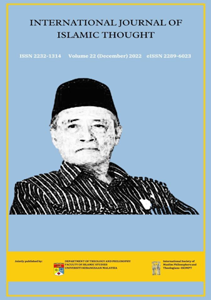
In Memoriam of Buya Ahmad Syafii Maarif (1935-2022)
Page: 160-163 • DOI: https://doi.org/10.24035/ijit.22.2022.249
PROFESSOR DR. AHMAD SUNAWARI LONG
ijit@ukm.edu.my

COMMITTEE ON PUBLICATION ETHICS
An international scholarly journal on Islamic thought and contemporary Muslim issues.
Indexed in Scopus and Web of Science–ESCI.
Fully open access with global readership.
Published twice a year (June and December).
All submissions undergo double-blind peer review.
Accepts English manuscripts only.
Requires IMRaD writing structure.
Uses APA citation and formatting style.
Committed to COPE’s ethical publishing standards.
Published by the National University of Malaysia (UKM) in partnership with Wisdom Academia Venture.








Authors retain copyright of their work. Articles published in IJIT are distributed under the Creative Commons Attribution 4.0 International License
(CC BY 4.0)
visitors since 01 June 2012
Published by
DEPARTMENT OF THEOLOGY AND PHILOSOPHY
Faculty of Islamic Studies
Universiti Kebangsaan Malaysia
(the National University of Malaysia)
43600 Bangi, Selangor
MALAYSIA
and
WISDOM ACADEMIA VENTURE
Kuala Lumpur