Ijazah Doktor Perubatan (Tahun 4)
DEPARTMENT OF PAEDIATRICS
FACULTY OF MEDICINE, UKM
(FF4127)
_________________________________________
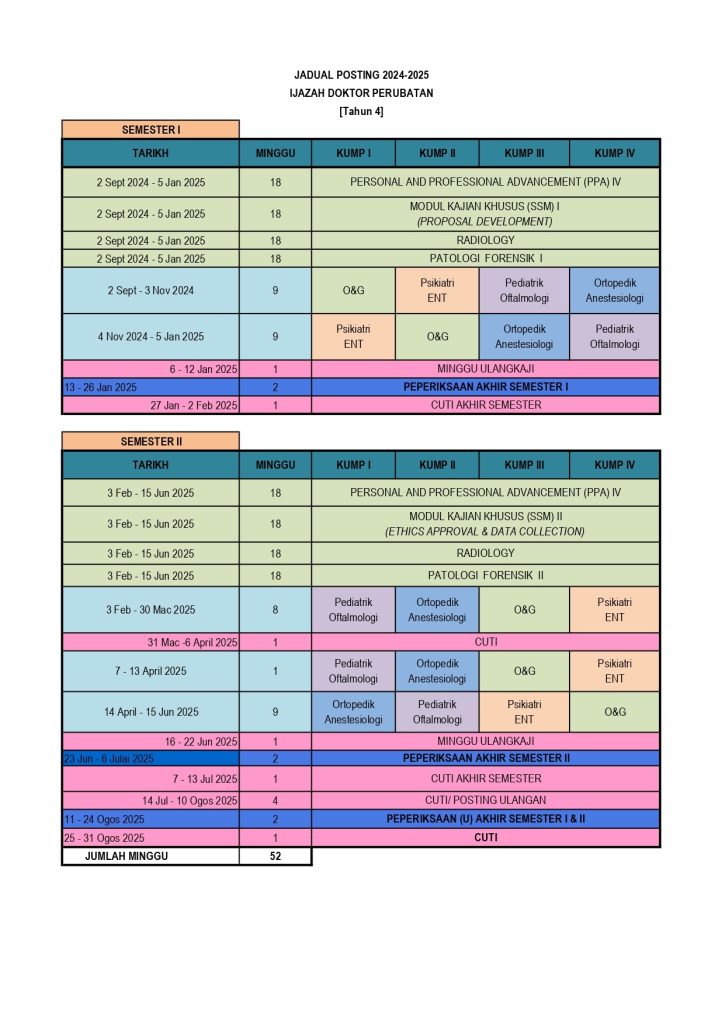
YEAR 4, GROUP 4, SESSION 2024/2025
Date: 14 APRIL 2025 – 16 JUN 2025
- LECTURERS/SPECIALISTS
- AP Dr. Shareena Ishak
- AP Dr. Adli Ali
- Doris Lau Sie Chong
- Joyce Hong Soo Synn
- Nur Azah Mohd Isa
- Shyahlini Devi
- Wan Nurulhuda Wan Md Zin
- Wan Syanaz Wan Ghazali
- Yang Wai Wai
- Leela Mariappen
- Farin Masra
- INTRODUCTION
During this 7-week paediatric posting, the students will be exposed to various aspects of clinical training in paediatric and neonatology including history taking, physical examination and assessment of developmental milestones.
- PRE-REQUISITES
- Good understanding of basic biomedical sciences
- Basic history taking skills
- Basic physical examination skills
- COURSE LEARNING OUTCOMES
- General Paediatric Posting
At the end of the posting, the students should be able to:
- Demonstrate the ability to take an adequate history
- Realize and understand that history taking in paediatrics is usually from a care-giver rather than the patient.
- Appreciate the importance and relevance of other aspects of the history such as birth, perinatal, developmental, immunisation, feeding, social and family histories.
- Perform clinical examination of a child competently
- Appreciate the need to modify the systematic examination depending on their age and ability to understand/cooperate.
- Appreciate the relevance of clinical signs at different ages.
- Applying and improving the basic clinical skills.
- Demonstrate how basic growth parameters (weight, height/length and head circumference) are measured and how to interpret growth charts.
- Discuss normal growth patterns and common growth problems.
- Discuss the principles of infant nutrition and breast-feeding practices.
- Describe the importance of developmental assessment in a child, the patterns of development (gross motor, fine motor and vision, hearing and speech/language, social and emotional) – to perform an appropriate and adequate developmental assessment and interpret the assessment appropriately.
- Discuss the rationale of the current expanded programme for immunisation, describe the current immunisation schedule, routes of immunisation, side-effects and contraindications to immunisation.
- Formulate provisional and differential diagnoses based on information obtained from the history and physical examination.
- Correlate the clinical diseases with the knowledge of pathophysiology acquired.
- Illustrate the importance of social aspects of disease – the child as a member of a family and community.
- Utilize relevant investigations; interpret common laboratory results and radiological studies to confirm the diagnosis.
- Formulate principles of management based on current evidence.
- Demonstrate effective communication skills and convey information in a way that is understood by parents and the child.
- NICU Posting
- Perform newborn screening examination.
- Discuss normal primitive reflexes in a newborn.
- Able to approach and manage common neonatal problems e.g. respiratory distress in term and pre-term newborns, jaundice, problems associated with infant of diabetic mothers, birth injuries, infection, cyanotic baby, convulsion, etc.
- Discuss about infant feeding i.e. breastfeeding vs. formula feeding, feeding of term vs. preterm infants
- Observe common procedures (e.g. blood sampling, lumbar puncture, insertion of umbilical venous and arterial catheters, instillation of surfactant) and explain briefly the (i) indications/contraindications, (ii) risks and (iii) preparation prior and after procedure.
- Describe briefly how to operate and manage certain equipments, e.g. standard incubators, phototherapy, CPAP.
- FOCUSED HISTORY TAKING
10.00 am – 11.00 am (after seminar)
Venue: Seminar Room 3, 3rd Floor, HPKK
|
Cases |
Dates |
Supervisors |
|
A child with prolonged fever |
30/11/2023 |
Dr. Wan Nurulhuda WMZ |
|
A child with gross motor delay |
07/12/2023 |
Dr. Nur Azah MI |
|
A child with puffy eyes |
14/12/2023 |
Dr. Doris Lau |
|
A child with bloody diarrhoea |
21/12/2023 |
AP Dr. Adli Ali |
Selected students will be given a scenario during the workshop. They are expected to perform a focused history taking from a simulated patient within a set time frame under direct observation by the supervisor-in-charge.
- SEMINARS
Venue: Seminar Room 3, 3rd Floor, HPKK
Students are required to prepare the presentations for the topics.
|
Topics |
Date |
Time |
Supervisors |
|
1. Childhood immunisation |
23/11/2023 |
8.00-9.30 am |
Dr. Shyahlini Devi |
|
2. Principles of infant nutrition and breastfeeding (TBL) |
30/11/2023 |
8.00-9.30 am |
Dr. Joyce Hong |
|
3. Normal development |
01/12/2023 |
9.30-11.00 am |
Dr. Wan Syanaz Wan Ghazali |
|
4. Common respiratory problems |
07/12/2023 |
8.00-9.30 am |
Dr. Nur Azah Mohd Isa |
|
5. A child with gross motor delay |
08/12/2023 |
9.30-11.00 am |
Dr. Tan Jen Ern |
|
6. Renal problems * (Monday) |
11/12/2023 |
10.00-11.30 am |
Dr. Leela Mariappen |
|
7. The pale child (TBL) |
14/12/2023 |
8.00-9.30 am |
Dr. Doris Lau |
|
8. Vomiting & diarrhoea, assessment of dehydration/shock * |
15/12/2023 |
9.30-11.00 am |
Dr. Lee Pei Chuen |
|
9. Viral exanthems |
21/12/2023 |
8.00-9.30 am |
AP Dr. Adli Ali |
|
10. Neonatal jaundice (TBL) |
22/12/2023 |
9.30-11.00 am |
Dr. Farin Masra |
*Case-based seminars
TBL – team-based learning
- WEB-BASED ONLINE E-LEARNING MODULE
Access the online e-learning website of “Early Nutrition eAcademy Southeast Asia” via https://enea-sea.med.lmu.de/. Register online for a log-in access to:
- Breastfeeding and Complementary Feeding module: This module is to be completed prior to the “Principles of infant nutrition and breast-feeding” seminar. Upon completion of this self-learning module, a certification shall be generated from the website. The certificate (printed)/e-certificate (on mobile) will be verified on the day of the seminar.
- Breastmilk Substitutes module: This module is self-directed learning and can be completed during the NICU rotation.
- WORKSHOP ON SKILLS IN COMMUNICATION
Venue: Seminar Room 3, 3rd Floor, HPKK
Date/Time: 24/11/2023 (9.30 AM – 12.00 PM)
Lecturer: Dr. Wan Syanaz / Dr. Yang Wai Wai
SEMINAR TOPICS
Childhood immunization
Learning outcomes:
- Recognise the importance of immunisation.
- Discuss the types of immunity – active versus passive.
- Explain the concept of herd immunity.
- Explain the types of vaccines (e.g. live, killed, attenuated).
- Describe the Malaysian Expanded Programme of Immunisation (EPI).
- Discuss the rationale and timing of the various vaccines in the EPI.
- Describe the routes of immunisation.
- Discuss the contraindications (relative and absolute) to immunisation.
- Discuss the side-effects of immunisation.
Normal development
Learning outcomes:
- Explain the principles of development.
- Describe normal childhood development (0-5 years old with emphasis on the first 2 years of life).
- Discuss the factors that affect development.
- Demonstrate the developmental assessment of a child.
** Video to be shown by students.
- List the developmental assessment methods available.
Viral exanthems
Learning outcomes:
- Describe the following aspects of common childhood exanthems with regards to:
- aetiological agents
- incubation period
- infectious period
- method of transmission
- clinical features
- associated complications
- management
- preventive measures
in the following diseases:
- measles
- mumps
- rubella
- varicella
- hand-foot-mouth
- roseola infantum
- erythema infectiosum (fifth disease)
Please include photographs of the relevant rash in your presentation.
Neonatal jaundice (TBL)
Learning outcomes:
- Describe bilirubin metabolism.
- Discuss the causes of conjugated and unconjugated hyperbilirubinaemia.
- Define prolonged jaundice and list the causes.
- Plan a systematic diagnostic approach to a neonate with jaundice from the history, physical examination and appropriate laboratory investigations.
- Discuss the complications of severe unconjugated hyperbilirubinaemia.
- Discuss the various methods of treatment:
- phototherapy – mechanism of treatment, principles of treatment, complications
- exchange transfusion – principles, complications
Renal problems
Learning outcomes:
- Explain the pathophysiology of oedema in nephrotic syndrome and acute glomerulonephritis.
- Discuss the following conditions with regards to the clinical features (history & physical examination) and laboratory investigations:
- nephrotic syndrome
- acute glomerulonephritis
- urinary tract infection
- Describe the complications of the diseases above. Formulate short and long-term management plans.
Principles of infant nutrition and breastfeeding (TBL)
Learning outcomes:
- Nutritional requirement of infants – volume, calorie.
- Breastfeeding
– Content and nutritional composition of breast milk
– Differences between breast milk and commercial milk
- Benefits of breastfeeding (nutritional & non-nutritional)
- How to breastfeed (when to start, how frequent)
- Problems associated with breastfeeding and how to overcome them (inadequate milk, sore nipples, etc)
- Conditions in which breastfeeding is contraindicated
- Collection & storage of breast milk
- Bottle feeding
- Content of commercial milk (infant formula)
- Milk for specific conditions (what is available, indications, special features)
- premature formula
- “anti-reflux”
- lactose-free milk
- soy-based milk
- How to prepare milk feed
- Bottle hygiene
- Complementary feeding
- When to introduce
- How to start
- What types of food should be given
* Students are reminded to complete the e-learning online (Breastfeeding and Complementary Feeding module) prior to the seminar and show their certificate of completion (printed or on mobile) when attending this seminar.
A child with gross motor delay
Learning outcomes:
- Recognise early warning signs in a child with gross motor delay.
- Identify common aetiologies of gross motor delay.
- Compare the differences in physical findings and aetiologies of UMNL and LMNL by anatomic and physiologic approach.
Common respiratory problems
Learning outcomes:
- Describe the common respiratory symptoms and signs in children:
- cough and coryza
- wheezing
- stridor
- respiratory distress
- Discuss the following conditions with regards to the definition, pathogenesis, pathophysiology, clinical features and the principles of management:
- upper respiratory tract infections
- asthma
- bronchiolitis
- pneumonia
- croup
- acute epiglotitis
Vomiting & diarrhoea, assessment of dehydration and shock
Learning outcomes:
- Identify the causes of diarrhoea and vomiting.
- Differentiate between infective versus non-infective causes.
- Classify the severity of dehydration.
- Formulate the emergency management of hypovolaemic shock.
- Determine fluid therapy after initial resuscitation (type & volume).
The pale child
Learning outcomes:
- Define anaemia and recognise that the normal range of haemoglobin values and the composition of haemoglobin in infancy changes with age and is different from adults.
- List the common causes of anaemia in children, using a systematic classification of the types of anaemia.
- Explain the relationship between the pathophysiology, clinical presentation and laboratory findings of conditions presenting with anaemia.
- Plan a systematic diagnostic approach to a child with pallor from the history, physical examination and appropriate laboratory investigations.
- Describe the effects of both the disease and its treatment. Formulate short and long-term management plans.
Prerequisites
- Students will only be eligible to sit for the end-of-posting OSCE and end-of-semester examination if their ATTENDANCE is 100% for all teaching-learning activities.
- Has submitted their log book and case report.
| Core Clinical Component | ||||||
| Continuous Assessment | Case report | 30% | ||||
| Logbook | ||||||
| Participation in group discussion | ||||||
| Seminars/TBLs | ||||||
| CBD | ||||||
| MINI-CEX | ||||||
| Theory | OBA / EMQ / KFQ | 35% | ||||
| Clinical | Unmanned OSCE | 35% | ||||
| Manned OSCE | ||||||
| TOTAL | 100% | |||||
Passing criteria
In order to pass the module, student must pass the continuous asseSSment and each component of the semester exam.
RECOMMENDED TEXTBOOKS
- Tom Lissaeur, Will Carroll (2021) Illustrated Textbook of Paediatrics; 6th edition; Elsevier.
- Mary Rudolf, Anthony Luder, Kerry Jeavons (2020) Essential Paediatrics and Child Health; 4th edition; Wiley-Blackwell.
- Sunil Sinha, Lawrence Miall, Luke Jardine (2017) Essential Neonatal Medicine; 6th edition; Wiley-Blackwell.
- Lee Way Seah, Tay Chee Geap, Lum Su Han (2019) Textbook of Paediatrics and Child Health; University of Malaya Press.
REFERENCE BOOK
- Karen J Marcdante, Robert M Kliegman, Abigail M Schuh (2022) Nelson Essentials of Pediatrics; 9thedition; Elsevier.