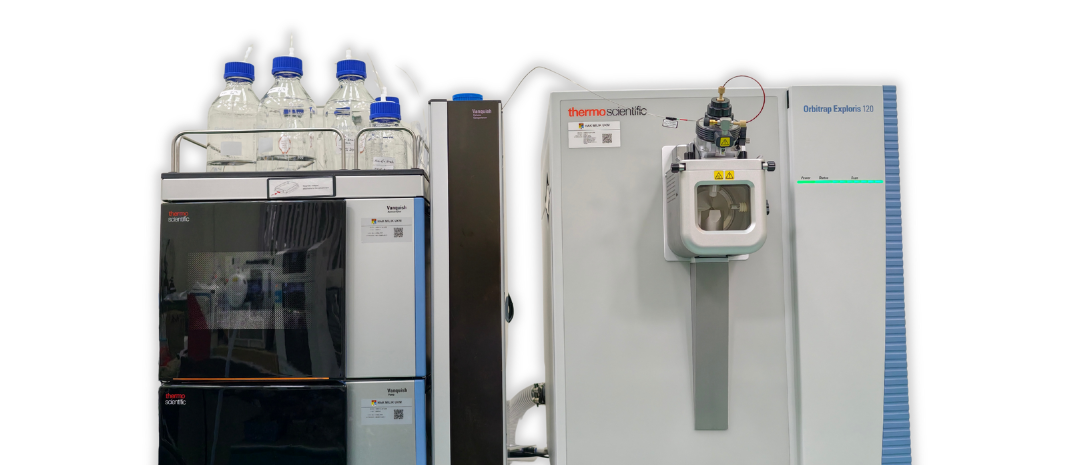
Liquid Chromatography-Mass Spectrometry (LC-MS)

Brand: Thermo Fisher Scientific
Model: Orbitrap Exploris™ 120

Specs:
• Resolution: up to 120,000 FWHM
• Mass accuracy: < 1 ppm
• Mass range: m/z 40–3000
• Scan speed: up to ~22 Hz
• High sensitivity (trace-level detection)
• Polarity switching: fast & efficient
• Dynamic range: > 5,000:1
• MS/MS capability for structural elucidation

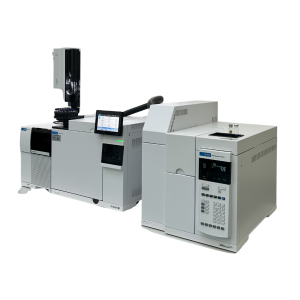
Liquid chromatography–mass spectrometry (LC-MS) using the Thermo Fisher Scientific Orbitrap Exploris™ 120 is an advanced analytical technique employed to separate, identify, and quantify compounds within complex mixtures. The system integrates high-performance liquid chromatography (HPLC) for efficient separation with Orbitrap-based mass spectrometry for high-resolution detection. In this process, the sample is introduced into a flowing liquid mobile phase and passed through a chromatographic column, where individual components are separated based on their interactions with the stationary phase.

As the separated compounds elute from the column, they are ionized and transferred into the mass spectrometer, where the Orbitrap analyzer measures their mass-to-charge (m/z) ratios with high resolution and exceptional mass accuracy. This enables precise identification and reliable quantification of analytes, even at low concentrations. The retention time obtained from the chromatographic separation, together with accurate mass measurements and fragmentation data, provides comprehensive analytical information. This technique is widely applied in pharmaceutical research, environmental monitoring, and food safety analysis due to its sensitivity, selectivity, and reproducibility.

For the analysis of complex mixtures in various matrices, liquid chromatography–mass spectrometry (LC-MS) using the Thermo Fisher Scientific Orbitrap Exploris™ 120 provides a highly sensitive, accurate, and reliable platform for compound separation, identification, and quantification. Compared to conventional techniques, this system offers high-resolution, accurate-mass (HRAM) detection that enables rapid and confident analysis of a wide range of analytes. Researchers utilize LC-MS to evaluate chemical composition, monitor processes, and perform detailed structural characterization.

  1. Pharmaceutical industry
    • Drug discovery and development studies
    • Impurity profiling and trace-level detection
    • Quantitative analysis of active pharmaceutical ingredients (APIs)
    • Metabolite identification and characterization
  2. Environmental analysis
    • Detection of pollutants and contaminants at trace levels
    • Monitoring of water, soil, and air quality
    • Screening of emerging contaminants
    • Quantitative and qualitative analysis of complex environmental samples
  3. Food safety and agriculture
    • Detection of pesticide residues and contaminants
    • Food authenticity and adulteration analysis
    • Quantification of additives and natural compounds
    • Quality control of raw materials and finished products

d. Chemical and research laboratories
• Structural elucidation of unknown compounds
• Analysis of complex mixtures in research studies
• Monitoring chemical reactions and processes
• High-resolution qualitative and quantitative analysis

  • 1

    Clean solvent (PURE H₂O / MeOH / ACN)

  • 2

    Filtered (0.2–0.45 µm)

  • 3

    Low concentration (ppb–ppm)

  • 4

    Small volume (1–10 µL)

  • 5

    Low salt / low contamination

  • 6

    Stable & LC-MS compatible (ESI)

  • 7

    Store appropriately

All enquiries please contact:

MOHAMAD IZARUL ABDUL AZIZ

B.Sc. (UiTM) Chemistry with Management

Email: zarulaziz@ukm.edu.my
Contact Number: 03-8911 8506

Location: Level 1, i-CRIM Centralised Lab, Centre for Natural and Physical Laboratory Management UKM (ALAF-UKM), Research Complex UKM