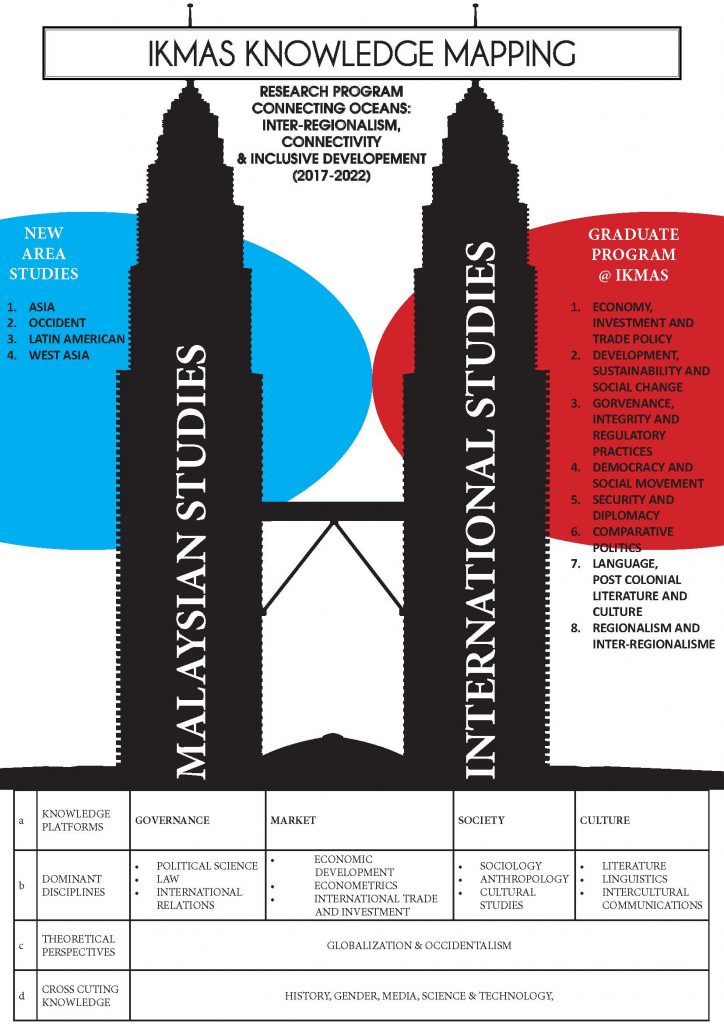
Our approach to Malaysian Studies is multidisciplinary and the context is Malaysia in the globalising world and the processes and effects of its interaction with the outside world, including influence of major powers. The impact of globalisation and occidentalism explored includes the processes of social inequalities, for example: economic differentiation and competition, as well as processes that impact class, ethic, gender, politics and identity. Studies are strengthened by linking to the possible influence of international treaties and events on Malaysia.
International Studies, on the other hand, focuses on the multiple dimensions of globalization and occidentalism (for example, inequalities, competiveness, connectivity, responses to globalisation including integration, regionalism, homogenisation and differentiation, as well as science and technology) as they impact the international community and regions such as Asia (especially Southeast Asia, Northeast Asia), the Occidents ( North America, Europe and Australia), Latin America and West Asia. The societies and states – taken as case studies – are examined not only in the framework of new area studies, but also how these societies and states are impacted by the various dimensions of globalisation. Additionally, the responses of these societies and states to the phenomena and processes of globalisation are also studied. Finally, a comparative approach is applied to understand inter-regionalism.
Knowledge in IKMAS is based on New Area Studies approach where regions can be studied from four thematic platforms (Box A) :
Market —> Governance —> Society —> Culture
This approach is different for the traditional Area Studies where studies are based on disciplines.
The IKMAS Knowledge Platform and Knowledge Mapping provides the academic basis in the execution of the graduate studies, research and publications, networking recruiting academic staff and projection.
Each knowledge platform is firmly grounded in at least two academic disciplines. (Box A)
Furthermore, studies are grounded theoretically by perspectives on Globalization and Occidentalism (Box B)
Finally, cross cutting knowledge such as History, Gender, Media and Science & Technology completes IKMAS Knowledge Mapping (Box C)
The refinement of IKMAS Knowledge Mapping was an organic process. It was firmly established by 2015 after IKMAS went through external review by eminent scholars. The report of the External Panel Review is included as Appendix 1.