

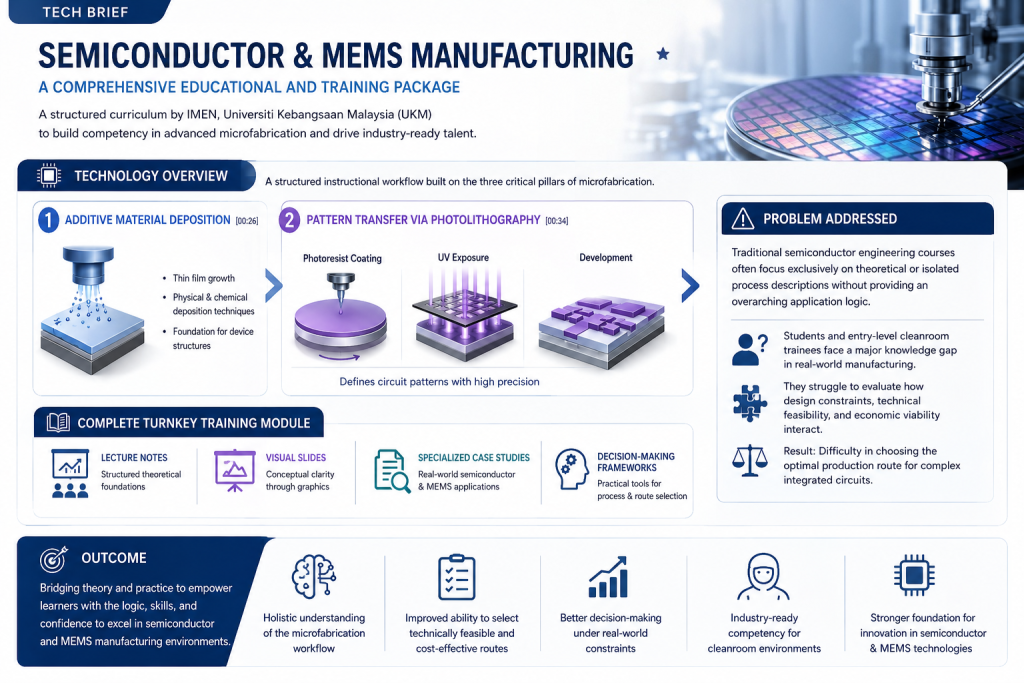
Systematic Micro/Nanofabrication Process Selection & Training Module: Integrated Learning Framework for CMOS & MEMS Manufacturing
Technology Overview
A comprehensive educational and training package developed by the Institute of Microengineering and Nanoelectronics (IMEN) at Universiti Kebangsaan Malaysia (UKM). This training curriculum establishes a structured approach to advanced semiconductor and MEMS manufacturing techniques. The core instructional workflow details the three critical pillars of microfabrication: additive material deposition [00:26], pattern transfer via photolithography (encompassing photoresist coating, UV exposure, and development) [00:34], and subtractive material etching or removal [01:08]. The complete turnkey module consists of lecture notes, visual slides, specialized case studies, and practical decision-making frameworks.
Problem Addressed
Traditional semiconductor engineering courses often focus exclusively on theoretical or isolated process descriptions without providing an overarching application logic. As a result, students and entry-level cleanroom trainees face a major knowledge gap when entering real-world manufacturing environments. They frequently struggle to evaluate how design constraints, technical feasibility, and economic viability interact when choosing an optimal production route for complex integrated circuits.
Key Innovation
The module’s core innovation is its systematic process selection methodology based on strict device “requirement lists.” Instead of treating fabrication as separate standalone stages, it unifies both CMOS and MEMS manufacturing steps into a singular, practical framework. This allows learners to balance real-world industry constraints—such as tool availability, geometric tolerances, scalability, and operational costs—directly against design specifications.
Performance Advantages
Applications
Intellectual Property Status
Copyright is fully owned by Universiti Kebangsaan Malaysia (UKM). The IP covers the structured process selection methodology, the custom instructional workflows, the learning design, and all associated training lecture materials and documentation.
Licensing & Collaboration
The module is actively available for regional and international academic licensing, deployment in commercial semiconductor training programs, and institutional integration. For licensing, institutional adoption, or partnership inquiries, please contact:
Value Proposition
A structured and industry-relevant training module that equips learners with the ability to systematically select and evaluate micro/nanofabrication processes, successfully bridging the gap between academic theory and real-world semiconductor manufacturing.
Contact
For licensing and collaboration inquiries:
Muhamad Ramdzan Buyong
Institute of Microengineering and Nanoelectronics (IMEN)
Universiti Kebangsaan Malaysia (UKM)
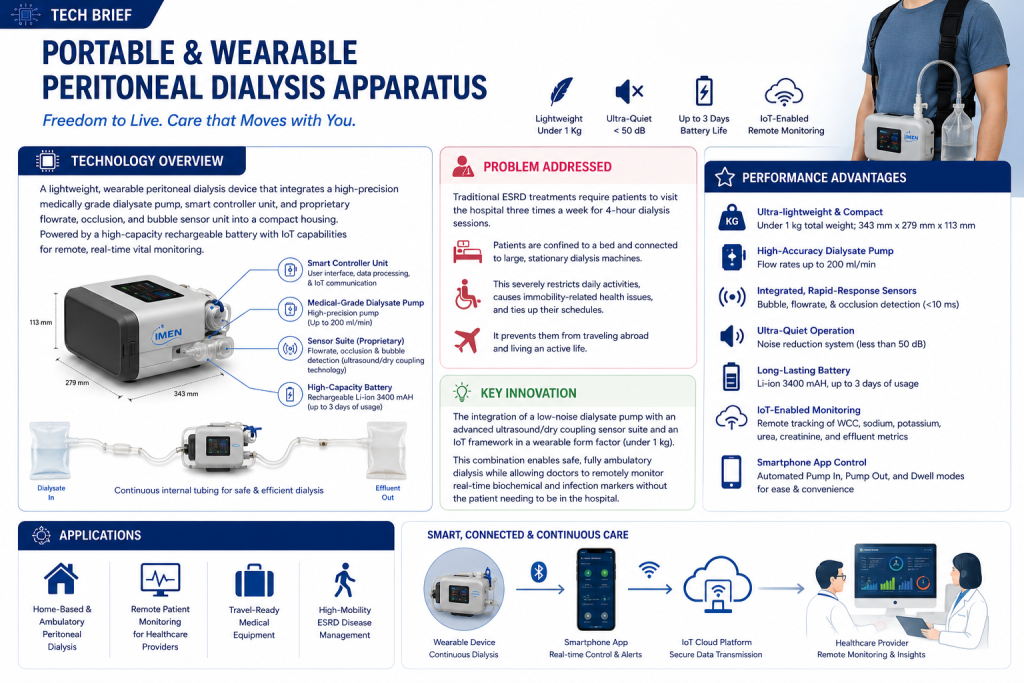
Portable and Wearable Peritoneal Dialysis Apparatus.
Technology Overview
A lightweight, wearable peritoneal dialysis device designed for patients with End Stage Renal Disease (ESRD). The system integrates a high-precision medical-grade dialysate pump, a smart controller unit, and a proprietary flowrate, occlusion, and bubble sensor unit into a compact housing. Powered by a high-capacity rechargeable battery, the apparatus features continuous internal tubing and Internet of Things (IoT) capabilities for remote, real-time vital monitoring.
Problem Addressed
Traditional ESRD treatments require patients to visit the hospital three times a week for 4-hour dialysis sessions. During these sessions, patients are confined to a bed and connected to large, stationary dialysis machines. This severely restricts daily activities, causes immobility-related health issues, ties up their schedules, and prevents them from traveling abroad.
Key Innovation
The integration of a low-noise dialysate pump with an advanced ultrasound/dry coupling sensor suite and an IoT framework in a wearable form factor (under 1kg). This combination enables safe, fully ambulatory dialysis while allowing doctors to remotely monitor real-time biochemical and infection markers without the patient needing to be in the hospital.
Performance Advantages
Applications
Home-based and ambulatory peritoneal dialysis, remote patient monitoring systems for healthcare providers, travel-ready medical equipment, and high-mobility ESRD disease management.
Intellectual Property Status
Patent filed (Ref: MY-202518-A) covering the portable apparatus structure, integrated sensor and pump mechanisms, IoT control and monitoring use, and related electronic assemblies.
Licensing & Collaboration
Available for licensing, joint development with medical device manufacturers, and healthcare provider/clinical qualification partnerships.
Value Proposition
A revolutionary wearable peritoneal dialysis system that maintains high treatment efficacy while restoring absolute freedom, mobility, and remote medical oversight to ESRD patients.
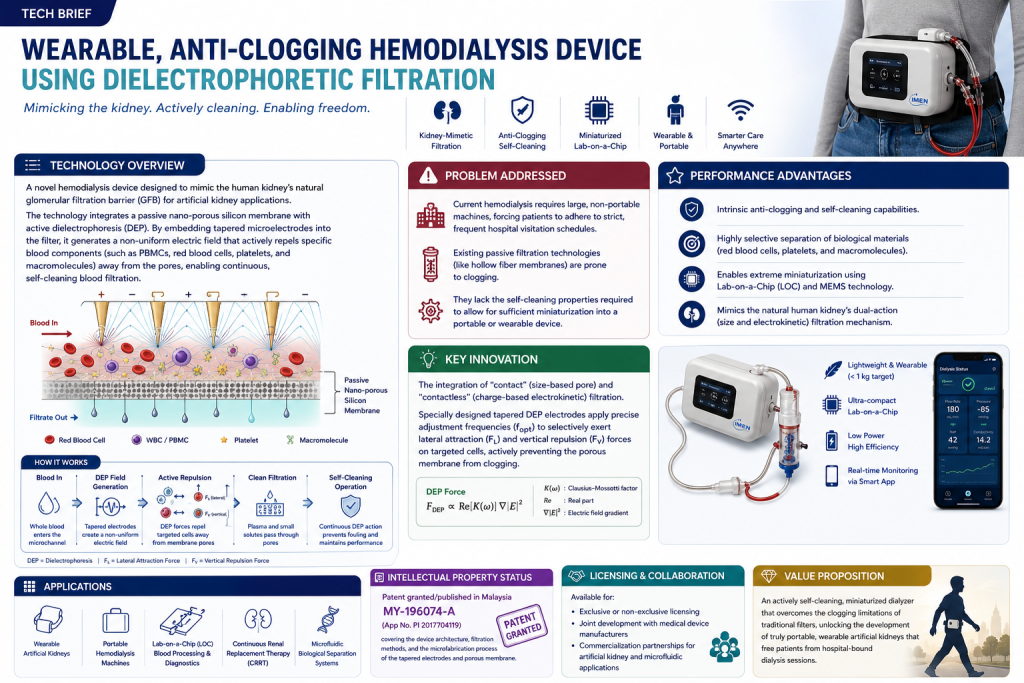
Wearable, Anti-Clogging Hemodialysis Device Using Dielectrophoretic Filtration.
Technology Overview
A novel hemodialysis device designed to mimic the human kidney’s natural glomerular filtration barrier (GFB) for artificial kidney applications. The technology integrates a passive nano-porous silicon membrane with active dielectrophoresis (DEP). By embedding tapered microelectrodes into the filter, it generates a non-uniform electric field that actively repels specific blood components (such as PBMCs, red blood cells, platelets, and macromolecules) away from the pores, enabling continuous, self-cleaning blood filtration.
Problem Addressed
Current hemodialysis requires large, non-portable machines, forcing patients to adhere to strict, frequent hospital visitation schedules. Existing passive filtration technologies (like hollow fiber membranes) are prone to clogging and lack the self-cleaning properties required to allow for sufficient miniaturization into a portable or wearable device.
Key Innovation
The integration of “contact” (size-based pore) and “contactless” (charge-based electrokinetic) filtration. Specially designed tapered DEP electrodes apply precise adjustment frequencies () to selectively exert lateral attraction and vertical repulsion forces ( and ) on targeted cells, actively preventing the porous membrane from clogging.
Performance Advantages
Applications
Wearable artificial kidneys, portable hemodialysis machines, Lab-on-a-Chip (LOC) blood processing and diagnostics, continuous renal replacement therapy (CRRT), and microfluidic biological separation systems.
Intellectual Property Status
Patent granted/published in Malaysia (MY-196074-A / App No. PI 2017704119) covering the device architecture, filtration methods, and the microfabrication process of the tapered electrodes and porous membrane.
Licensing & Collaboration
Available for exclusive or non-exclusive licensing, joint development with medical device manufacturers, and commercialization partnerships for artificial kidney and microfluidic applications.
Value Proposition
An actively self-cleaning, miniaturized dialyzer that overcomes the clogging limitations of traditional filters, unlocking the development of truly portable, wearable artificial kidneys that free patients from hospital-bound dialysis sessions.
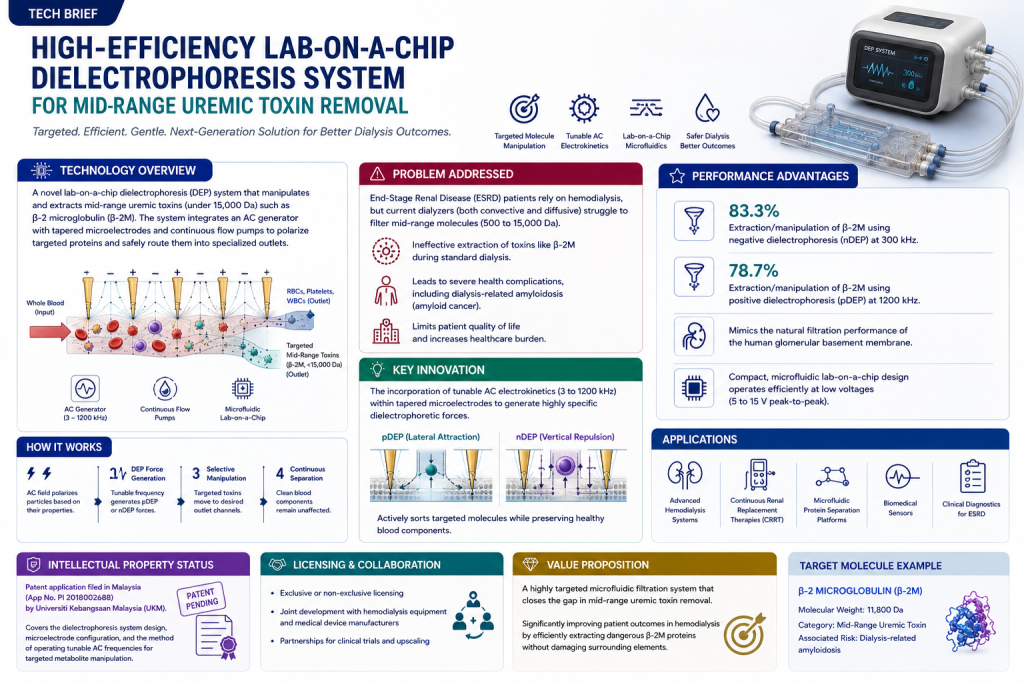
High-efficiency lab-on-a-chip dielectrophoresis system for mid-range uremic toxin removal.
Technology Overview
A novel lab-on-a-chip dielectrophoresis (DEP) system designed to manipulate and extract targeted human metabolites, specifically mid-range uremic toxins (under 15,000 Da) like β-2 microglobulin (β-2M). The technology integrates an alternating current (AC) generator with tapered microelectrodes and continuous flow pumps to polarize and safely route targeted proteins into specialized channel outlets.
Problem Addressed
End-Stage Renal Disease (ESRD) patients rely on hemodialysis, but current dialyzers (both convective and diffusive) struggle to filter mid-range molecules (500 to 15,000 Da). The ineffective extraction of toxins like β-2M during standard dialysis can lead to severe health complications, including dialysis-related amyloidosis (amyloid cancer).
Key Innovation
The incorporation of tunable AC electrokinetics (between 3 to 1200kHz) within tapered microelectrodes to generate highly specific dielectrophoretic forces. This allows the system to actively sort targeted molecules using lateral attraction (pDEP) or vertical repulsion (nDEP), dynamically routing them away from healthy blood components.
Performance Advantages
Applications
Advanced hemodialysis systems, continuous renal replacement therapies (CRRT), microfluidic protein separation platforms, biomedical sensors, and clinical diagnostics for End-Stage Renal Disease (ESRD).
Intellectual Property Status
Patent application filed in Malaysia (App No. PI 2018002688) by Universiti Kebangsaan Malaysia (UKM). Covers the dielectrophoresis system design, microelectrode configuration, and the method of operating tunable AC frequencies for targeted metabolite manipulation.
Licensing & Collaboration
Available for exclusive or non-exclusive licensing, joint development with hemodialysis equipment and medical device manufacturers, and partnerships for clinical trials and upscaling.
Value Proposition
A highly targeted microfluidic filtration system that closes the gap in mid-range uremic toxin removal, significantly improving patient outcomes in hemodialysis by efficiently extracting dangerous β-2M proteins without damaging surrounding elements.
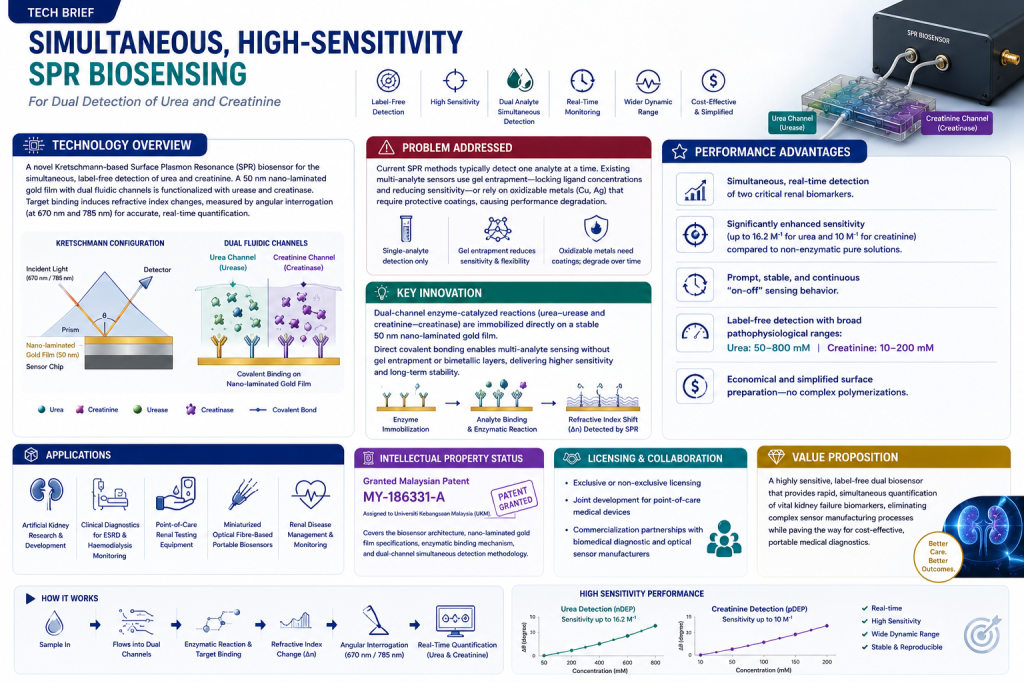
Simultaneous, high-sensitivity SPR biosensing for dual detection of urea and creatinine.
Technology Overview
A novel Kretschmann-based Surface Plasmon Resonance (SPR) biosensor designed for the simultaneous label-free detection of urea and creatinine. The technology utilizes a highly optimized 50 nm-thick nano-laminated gold film configured with dual fluidic channels. By introducing specific enzyme mixtures (urease and creatinase) into these channels, the biosensor captures strong covalent bindings that trigger measurable refractive index shifts via angular interrogation (at 670 nm and 785 nm), enabling accurate, real-time quantification of both kidney failure biomarkers.
Problem Addressed
Monitoring urea and creatinine levels is critical for diagnosing and managing End Stage Renal Disease (ESRD) and kidney failure. Existing SPR sensing methods generally detect only a single analyte at a time. Furthermore, prior multi-analyte sensors rely on complex gel entrapment techniques—which permanently lock in ligand concentrations and reduce sensitivity—or utilize highly oxidative metals like copper and silver that require secondary protective coatings, leading to performance degradation over time.
Key Innovation
The integration of a dual-channel enzyme-catalyzed reaction (urea-urease and creatinine-creatinase) directly onto a stable 50 nm nano-laminated gold film. This method achieves multi-analyte sensing through direct covalent bonding on the gold surface, completely bypassing the need for sensitivity-reducing gel entrapment or easily oxidized bimetallic layers.
Performance Advantages
Applications
Artificial kidney research and development, clinical diagnostics for ESRD and haemodialysis monitoring, point-of-care renal testing equipment, and miniaturized optical fibre-based portable biosensors.
Intellectual Property Status
Granted Malaysian Patent (MY-186331-A) assigned to Universiti Kebangsaan Malaysia (UKM). The patent covers the biosensor architecture, the nano-laminated gold film specifications, the specific enzymatic binding mechanism, and the dual-channel simultaneous detection methodology.
Licensing & Collaboration
Available for exclusive or non-exclusive licensing, joint development for point-of-care medical devices, and commercialization partnerships with biomedical diagnostic and optical sensor manufacturers.
Value Proposition
A highly sensitive, label-free dual biosensor that provides rapid, simultaneous quantification of vital kidney failure biomarkers, eliminating complex sensor manufacturing processes while paving the way for cost-effective, portable medical diagnostics.
Project Management Training Module with ProjectLibre Integration: Structured Team-Based Learning Framework for Practical Project Execution
Technology Overview
A comprehensive training and facilitation package designed to deliver a hands-on, team-based project management learning experience. The module blends structured pedagogical methodology with the active utilization of free, open-source project management software (ProjectLibre). The complete turnkey training suite consists of a structured project management syllabus, facilitator-led presentation materials, step-by-step software installation and usage guides, and a comprehensive course evaluation and assessment framework. Core instructional competencies focus on teaching practical project planning, scheduling, task allocation, teamwork coordination, and real-time tracking using Gantt charts and project simulation exercises.
Problem Addressed
Traditional project management instruction relies heavily on theoretical frameworks, which often leaves a distinct gap between classroom knowledge and the practical skills required in actual industry project environments. Furthermore, introducing professional project management software into large-scale academic or corporate training initiatives typically encounters steep financial barriers due to expensive proprietary software licensing fees, limiting broad accessibility and scalability.
Key Innovation
The module innovates by integrating a structured software-based pedagogy with a collaborative, group-based learning framework (optimized for teams of 5–6 participants) using open-source freeware. By pairing facilitator-led oversight with peer-to-peer learning dynamics and real-world project simulations, the module effectively mirrors actual corporate workflows while eliminating software procurement costs.
Performance Advantages
Applications
Intellectual Property Status
Copyright is fully owned by Universiti Kebangsaan Malaysia (UKM). This copyright protects the proprietary training structure, methodology, custom teaching materials, instructional course design, collaborative learning activities, and the built-in assessment framework. (Note: ProjectLibre is an external open-source software and is not part of UKM’s intellectual property).
Licensing & Collaboration
The training program is ready for immediate market adoption and is available for:
Value Proposition
A practical, team-based project management training program that combines structured learning with real software tools—delivering industry-ready skills without software cost barriers.
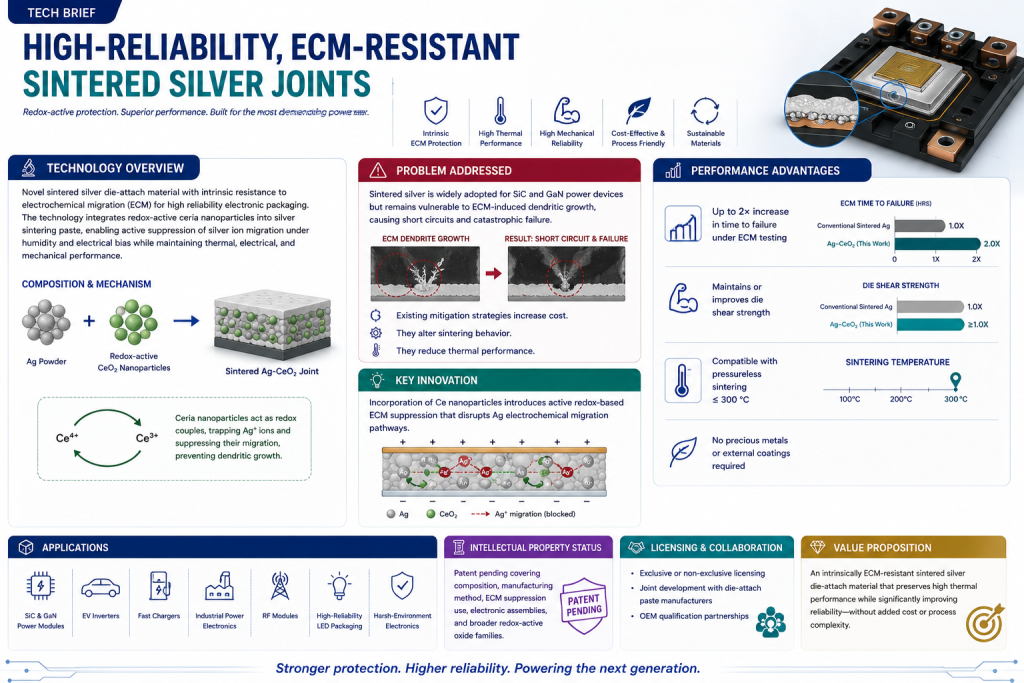
High-reliability, ECM-resistant sintered silver joints.
Technology Overview
Novel sintered silver die-attach material with intrinsic resistance to electrochemical migration (ECM) for high reliability electronic packaging. The technology integrates redox-active ceria nanoparticles into silver sintering paste, enabling active suppression of silver ion migration under humidity and electrical bias while maintaining thermal, electrical, and mechanical performance.
Problem Addressed
Sintered silver is widely adopted for SiC and GaN power devices but remains vulnerable to ECM-nduced dendritic growth, causing short circuits and catastrophic failure. Existing mitigation strategies increase cost, alter sintering behavior, or reduce thermal performance.
Key Innovation
Incorporation of Ce nanoparticles introduces active redox-based ECM suppression that disrupts Ag electro chemical migration pathways.
Performance Advantages
Applications
SiC & GaN power modules, EV inverters, fast chargers, industrial power electronics, RF modules, high-reliability LED packaging, and harsh-environment electronics.
Intellectual Property Status
Patent pending covering composition, manufacturing method, ECM suppression use, electronic assemblies, and broader redox-active oxide families.
Licensing & Collaboration
Available for exclusive or non-exclusive licensing, joint development with die-attach paste manufacturers, and OEM qualification partnerships.
Value Proposition:
An intrinsically ECM-resistant sintered silver die-attach material that preserves high thermal performance while significantly improving reliability—without added cost or process complexity.