


Tun Dr. Ismail Chair
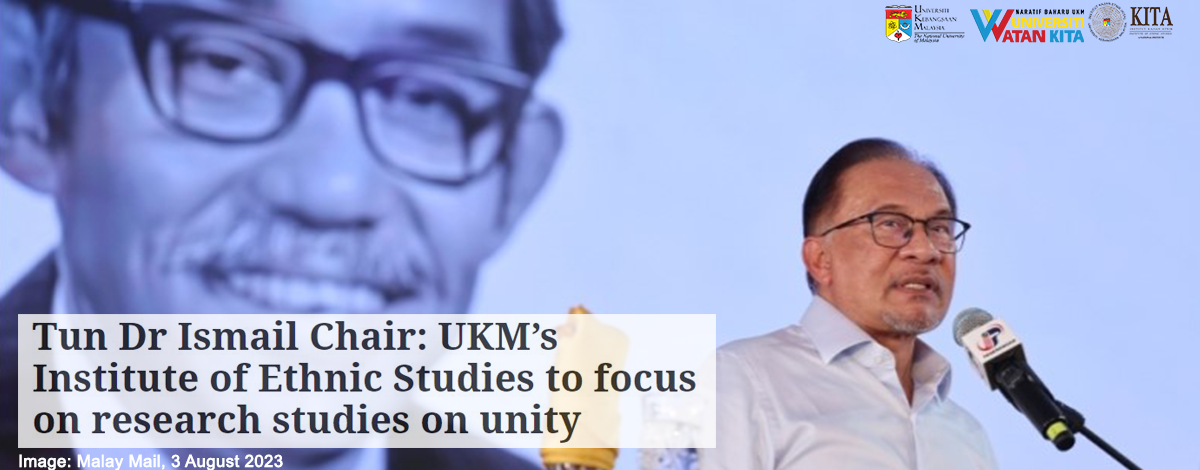
The Tun Dr. Ismail Chair at the Institute of Ethnic Studies (KITA), Universiti Kebangsaan Malaysia (UKM), was established following an announcement by the Prime Minister of Malaysia, Yang Amat Berhormat Datuk Seri Anwar Ibrahim, at the commemoration of the statesman Tun Dr. Ismail Al-Haj: Pillar of National Unity, held in conjunction with the National Month celebration in 2023 at Dataran Merdeka, Kuala Lumpur.
This establishment is a recognition of the leadership legacy and ideas of Tun Dr. Ismail, grounded in inter-ethnic unity and integration. It positions KITA as a research institute that concurrently hosts two academic chairs: the Tun Dr. Ismail Chair and the UNESCO Chair (Social Practices in Intercultural Communication and Social Cohesion).
The Chair acknowledges the contributions of Tun Dr. Ismail Al-Haj, a figure widely respected for his firmness, integrity, and commitment to national unity. It serves as a scholarly platform focused on cross-disciplinary research and functions as a research vehicle that connects academia with society, as well as with the public and private sectors. Through academic approaches, professional engagement, and public advocacy, the Tun Dr. Ismail Chair aims to generate a new narrative of unity that is fresh, critical, and grounded in contemporary social realities.
Beyond strengthening KITA’s role as a primary reference institution for national and regional studies on unity, the Chair contributes to shaping policies and social practices anchored in the values of social cohesion. Internationally, its presence highlights Malaysia’s uniqueness as a plural society that has succeeded in maintaining unity in diversity, thereby reinforcing Malaysia’s position as a global point of reference in unity studies.
With this establishment, the spirit and legacy of Tun Dr. Ismail as a symbol of national unity are elevated anew, aligning with UKM’s aspirations as a national university that continues to lead scholarly discourse, fortify national identity, and build a madani (civil, values-based) civilisation founded on unity.
As part of the national mandate to strengthen the agenda of national unity, the creation of the Tun Dr. Ismail Chair at KITA reaffirms UKM’s role as a university that is consistently proactive in championing national values, strengthening identity, and building a civilisation based on social cohesion.
Biography of Tun Dr. Ismail Al-Haj bin Datuk Haji Abdul Rahman (1915–1973)
Tun Dr. Ismail Al-Haj bin Datuk Haji Abdul Rahman was among the foremost statesmen involved in the making of modern Malaysia. Born in Johor Bahru in 1915, he came from a Malay aristocratic family that emphasised education and service to society. From an early age, Tun Dr. Ismail was known to be disciplined, firm, and principled; qualities that would define his life and struggles.
He pursued medical studies at Queen’s College, University of Melbourne, Australia, and in 1945 became the first Malay medical doctor to graduate from the university. His six years in Australia helped shape his open and pragmatic character while strengthening his knowledge-based outlook. Upon returning home, he served as a medical officer before becoming actively involved in national politics through the United Malays National Organisation (UMNO).
His excellence quickly became evident. He was appointed the first Ambassador of Malaya to the United States and Permanent Representative to the United Nations shortly after independence. In these roles, he played a key part in presenting the image of a new nation that was moderate and independent, and in advancing a foreign policy grounded in peace and justice.
Upon returning to Malaysia, Tun Dr. Ismail served in the cabinets of Tunku Abdul Rahman and later Tun Abdul Razak in several key posts, including Minister of Home Affairs and Deputy Prime Minister of Malaysia. In government, he was known for his steadfast adherence to the rule of law and justice. He opposed extremism in all forms and emphasised that Malay special privileges should be understood as a temporary measure towards social justice, not a tool to oppress the rights of other communities.
His role became especially prominent after the events of 13 May 1969, when he was called out of political retirement to help calm the nation. As Deputy Director of the National Operations Council (MAGERAN), he served as a moderating voice who helped restore public confidence in Malaysia’s future. His firm yet fair approach reflected a leader anchored in integrity and committed to the public interest.
Tun Dr. Ismail was often described as a ‘reluctant politician’ whose focus was administration and who regarded power as a trust. His honesty became the stuff of legend. He rejected populist moves and political rhetoric, frequently emphasising that a person should be judged by their actions.
He passed away on 2 August 1973 from a heart attack while serving as Acting Prime Minister, and later became the first individual interred at the Makam Pahlawan (Heroes’ Mausoleum) at the National Mosque. His loss was felt across the nation. In short, Tun Dr. Ismail is remembered as a pillar of national unity, a symbol of integrity, and an emblem of moderation in Malaysian politics. His legacy endures as a guide for new generations of leaders and scholars in understanding the true meaning of unity, justice, and accountability.
Contact Us
Tun Dr. Ismail Chair
Institute of Ethnic Studies (KITA)
4th Floor
Kolej Keris Mas Administration Block
Universiti Kebangsaan Malaysia
43600 UKM Bangi
Selangor
MALAYSIA
Phone: 03-8921 4641
E-mail: perpaduan@ukm.edu.my