

KITA Discourse Series No. 5/2026: Internationalizing the “Plural Society”: An Ethnographic Study of International Universities in Malaysia
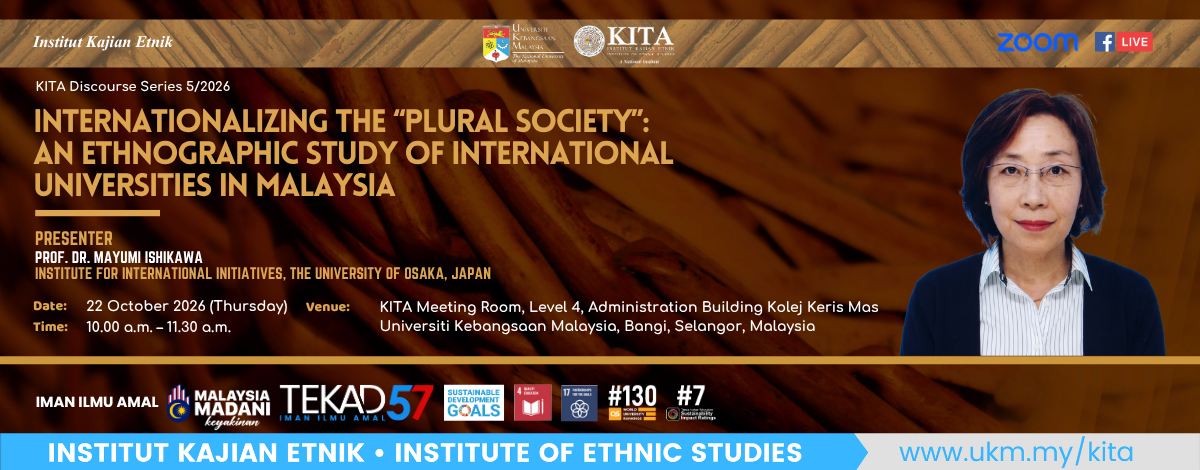
INTERNATIONALIZING THE “PLURAL SOCIETY”: AN ETHNOGRAPHIC STUDY OF INTERNATIONAL UNIVERSITIES IN MALAYSIA
By:
PROF. DR. MAYUMI ISHIKAWA
Institute for International Initiatives,
The University of Osaka, Japan
22 October 2026 (Thursday)
10:00 a.m. – 11:30 a.m.
KITA Meeting Room,
Level 4, Administration Building,
Kolej Keris Mas, Universiti Kebangsaan Malaysia,
Bangi, Selangor
Abstract
Conventional understanding of the internationalization of higher education is primarily concerned with the transnational mobility of students from Global South to Global North, or the expansion of English-language programmes modelled after Western universities. This study, based on ethnographic research of three international universities in Malaysia, analyzes the rise of an alternative model of university internationalization suited to specific post-colonial national and regional contexts. It addresses how Malaysia’s multiethnic social fabric or “plural society” (Furnivall, 1939), constructed during British colonial rule, is strategically deployed to cultivate transnational partnerships, recruit international students, and respond to emerging regional economic opportunities. The institutions studied are 1) International Islamic University Malaysia (IIUM), 2) Xiamen University Malaysia (XMUM), and 3) Manipal University College Malaysia (MUCM). They forge transnational ties with an Islamic organisation, overseas Chinese commercial networks, and a private Indian higher education provider. Together, these institutions attract students seeking high-quality international education that is sensitive to non-Western intellectual heritages, ethno-religious consciousness and regional aspirations. Their appeal is reinforced by demand for Islamic education, linkage to Chinese economic networks, and private medical education. Malaysia promotes international education as part of its national development strategy. The plural society thus has become a leverage to respond to the emerging needs of students, families, communities and policymakers under globalisation. The study highlights the underexplored significance of Asian international universities in improving access, facilitating social mobility, and reshaping perceptions of multiethnicity in contemporary Malaysia.
Presenter’s Profile
Dr. Mayumi Ishikawa is Professor Emerita and affiliated researcher at the University of Osaka, Japan. Her research interests include the globalization of higher education and ethnographic studies of universities, the internationalization of higher education, educational migration of students and scholars, higher education and science policy, world university rankings and the emergence of hegemony in academia, and power in the construction of knowledge by focusing on Japan, East and Southeast Asia. For her research profile, please see: https://rd.iai.osaka-u.ac.jp/en/748817e38d369806.html#container_published_papers
Tentative Programme:
- Date: 22 October 2026 (Thursday)
- Time: 10:00 a.m. – 11:30 a.m.
- Venue: KITA Meeting Room, Level 4, Administration Building, Kolej Keris Mas, UKM Bangi
- Platform: Zoom
10:00 a.m.: Introduction & Welcoming Remarks by Moderator: Dr. Nurul Akqmie Badrul Hisham, KITA Research Fellow & UNESCO-UKM Chair Manager
10:05 a.m.: Presentation by Prof. Dr. Mayumi Ishikawa
11:00 a.m.: Q & A
11:30 a.m.: Closing
Disclaimer: The views expressed in the presentation(s) are those of the presenter(s) and do not necessarily represent the views of the Organizers.
Note: KITA’s involvement in the activities mentioned herein contributes towards the following SDG(s) of the UN Sustainable Development Goals: SDG4, and SDG17.
 Loading...

 Reload document
  Open in new tab