

Siri Wacana KITA Bil. 2/2026: Internationalizing the “Plural Society”: An Ethnographic Study of International Universities in Malaysia
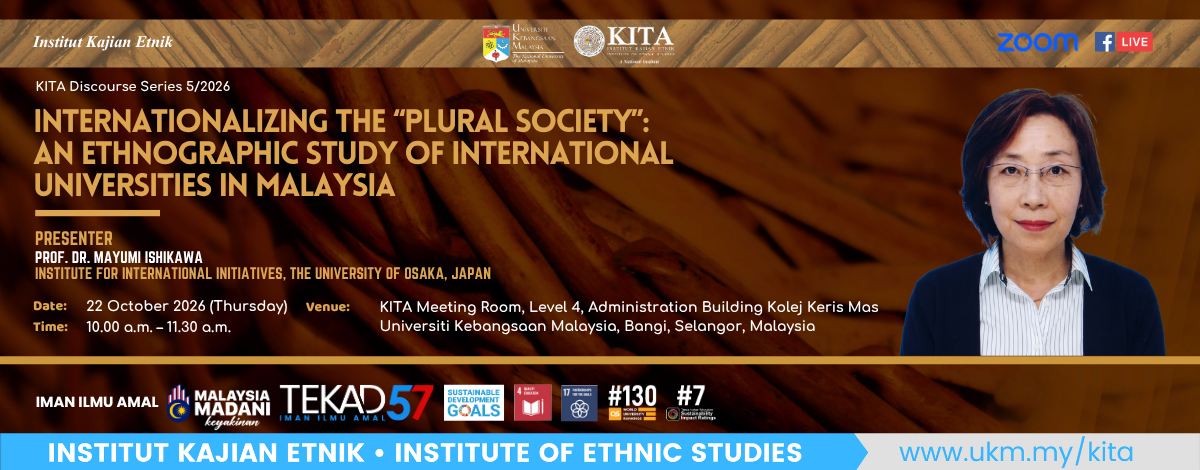
INTERNATIONALIZING THE “PLURAL SOCIETY”: AN ETHNOGRAPHIC STUDY OF INTERNATIONAL UNIVERSITIES IN MALAYSIA
Oleh:
PROF. DR. MAYUMI ISHIKAWA
Institute for International Initiatives,
The University of Osaka, Japan
22 Oktober 2026 (Khamis)
10:00 pagi – 11:30 pagi
Bilik Mesyuarat KITA,
Aras 4, Blok Pentadbiran,
Kolej Keris Mas, Universiti Kebangsaan Malaysia,
Bangi, Selangor
Abstrak
Conventional understanding of the internationalization of higher education is primarily concerned with the transnational mobility of students from Global South to Global North, or the expansion of English-language programmes modelled after Western universities. This study, based on ethnographic research of three international universities in Malaysia, analyzes the rise of an alternative model of university internationalization suited to specific post-colonial national and regional contexts. It addresses how Malaysia’s multiethnic social fabric or “plural society” (Furnivall, 1939), constructed during British colonial rule, is strategically deployed to cultivate transnational partnerships, recruit international students, and respond to emerging regional economic opportunities. The institutions studied are 1) International Islamic University Malaysia (IIUM), 2) Xiamen University Malaysia (XMUM), and 3) Manipal University College Malaysia (MUCM). They forge transnational ties with an Islamic organisation, overseas Chinese commercial networks, and a private Indian higher education provider. Together, these institutions attract students seeking high-quality international education that is sensitive to non-Western intellectual heritages, ethno-religious consciousness and regional aspirations. Their appeal is reinforced by demand for Islamic education, linkage to Chinese economic networks, and private medical education. Malaysia promotes international education as part of its national development strategy. The plural society thus has become a leverage to respond to the emerging needs of students, families, communities and policymakers under globalisation. The study highlights the underexplored significance of Asian international universities in improving access, facilitating social mobility, and reshaping perceptions of multiethnicity in contemporary Malaysia.
Profil Penceramah
Dr. Mayumi Ishikawa is Professor Emerita and affiliated researcher at the University of Osaka, Japan. Her research interests include the globalization of higher education and ethnographic studies of universities, the internationalization of higher education, educational migration of students and scholars, higher education and science policy, world university rankings and the emergence of hegemony in academia, and power in the construction of knowledge by focusing on Japan, East and Southeast Asia. For her research profile, please see: https://rd.iai.osaka-u.ac.jp/en/748817e38d369806.html#container_published_papers
Atur Cara Tentatif:
- Tarikh: 22 Oktober 2026 (Khamis)
- Masa: 10:00 pagi – 11:30 pagi
- Tempat: Bilik Mesyuarat KITA, Aras 4, Blok Pentadbiran, Kolej Keris Mas, UKM Bangi
- Platform: Zoom
10:00 pagi: Pendahuluan & Kata-kata Aluan oleh Moderator: Dr. Nurul Akqmie Badrul Hisham, Felo Penyelidik KITA & Pengurus Kursi UNESCO-UKM
10:05 pagi: Penyampaian wacana oleh Prof. Dr. Mayumi Ishikawa
11:00 pagi: Sesi soal-jawab
11:30 pagi: Tamat
Penafian: Pandangan-pandangan yang terkandung dalam pembentangan berkenaan adalah pandangan setiap penceramah yang terlibat dan tidak mewakili pandangan para penganjur.
Nota: Aktiviti ini meyumbang kepada Matlamat Pembangunan Mampan (SDG) Pertubuhan Bangsa-bangsa Bersatu dari aspek SDG4 dan SDG17.
 Loading...

 Reload document
  Open in new tab