
Culturing Cell Lines and Managing the Cell Culture Laboratory – A Short Review
Maintaining cell lines is just like taking care of a child, you have to closely monitor them every day. Cell lines need to be fed with new culture medium, washed with phosphate buffered saline (PBS) and split at a certain ratio into another flask once they become confluence. Like any other living organisms, cells need space, nutrients and a clean environment to grow and live happily. Once the cells reached confluence, if they are not to be used for further analyses, they can be cryopreserved in liquid nitrogen (-196°C) for long term storage.
The cells that grow in the flask also need a proper ‘house’ i.e. the CO2 incubator which provides ideal conditions for the temperature (37.00C), humidity and the appropriate gaseous atmosphere (5-6% CO2). The condition of CO2 incubator closely mimics that of the human body. But why 5-6% of CO2 gas? It is because about 5-6% CO2 is dissolved in the human blood circulation. Different types of cell lines usually have their own respective growth media as the nutrient source. This is usually based on the recommendations from the American Type Culture Collection (ATTC). Cells need to be fed once in every 3-4 days due to nutrient depletion. Prolonged starvation without replacement of medium will lead to changes in pH media and cell morphology. This can be monitored by the presence of phenol red in the media as an indicator of the pH change. The color of the medium will exhibit a gradual transition from yellow to red over the pH range 6.8 to 8.2. Above the pH 8.2, the phenol red will turn into a bright pink color. The changes in pH are due to the built up of lactic acid, which can be toxic to the cells and affect their growth. The cells may then be altered in terms of the morphology and the efficiency for subsequent manipulation. Therefore it is highly important that the sub-culturing process needs to be done once the cells reached 70-90% confluence. The rule of the thumb is not to leave the cells to be over-confluent. Imagine if you are standing inside a 5 feet x 5 feet room with 25 other people. It may be fun for a while but soon everyone will be very uncomfortable, right? The same goes with the cells. They are not happy at all when there is no more room to grow and expand plus the fact that the nutrients are being depleted rapidly.
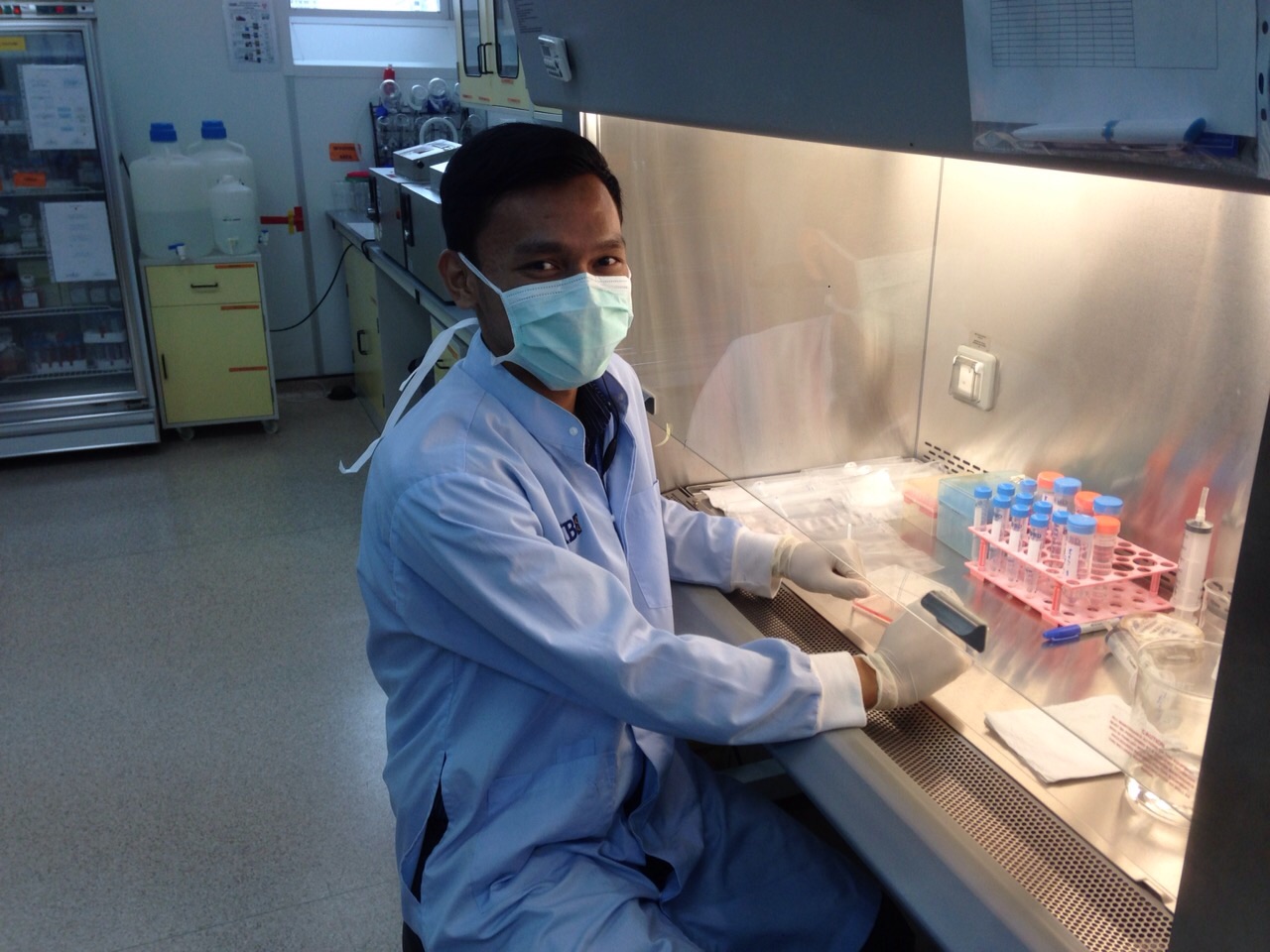
When dealing with the cells, strict aseptic techniques are highly required in order to avoid contamination. All cell culture work should be done in the Bio Safety Cabinet Class II (BSC II). Everything that goes into the BSC needs to be sprayed with ethanol. We also treat the BSCs and some of the apparatus with UV before and after each use. The UV light bulb has it own shelf life. Once it has reached its half-life, the light that came out is just a fade blue light which is not an electromagnetic radiation wave anymore. To avoid cross contamination, we handle only one type of cell line at a time. Addition of antibiotic in the growth media is usually not recommended and is an optional step. This is to prevent antibiotic resistance in the cells. If we practice good aseptic techniques, we need not worry about using antibiotics. In UMBI, our standard operating procedure (SOP) requires us to discard any contaminated cells immediately to minimize cross contamination to other cells. How about the humidity in the CO2 incubator? Water level needs to be monitored every week to ensure the humidity is optimum. We clean the incubator with ethanol and sterilize key apparatus monthly. Following the cleaning and sterilizing processes, a test control needs to be performed, as according to the SOP, before it is allowed to be used. Whether cells are of normal or disease lineage, the cells are important and useful to help scientists to understand better the diseases in terms of cellular mechanisms, in vaccine or drug development, and for discovering molecular markers of diseases.
HANIF ZULKHAIRI, Laboratory Assistant C17 UMBI.