
Tips and Tricks in Writing/Publishing: From an Early Career Researcher’s Perspective
By: Dr. Nurul Syakima Ab Mutalib (syakima@ppukm.ukm.edu.my)
Early career researchers are individuals within five to eight years of receiving their PhDs or equivalent professional training, or individuals who are within six years of their first academic appointment. Writing and publishing scientific articles have always been challenging for many researchers. Here I would like to share some tips and tricks in scientific writing and publishing.
1. Mini review
Typically consisting 3000 to 5000 words, a mini review should focus on specific gaps that have not been addressed before. The author may focus on writing about research techniques or findings. Try including at least 1 table and 1 figure. Aim for around 60 – 90 references. Below is a step-by step guide:
i. Read all related review papers.
ii. Identify similarities.
iii. Identify important issue(s) that have not been fully addressed.
iv. Do you have enough references to review that issue(s)? (At least ~8 publications)
v. Summarize the findings from no. 4.
vi. Prepare outlines – ‘frame’ for your draft.
vii. Start writing. Divide and conquer the outlines 2-3 at a time.
viii. 2-3 paragraphs will be sufficient.
Bear in mind that a mini review should not be merely stating the obvious without personal scientific insights.
2. Full-length research article
The ‘full’ manuscript. Start with a manuscript outline. Below is a step-by-step guide:
i. Introduction
• 3 + 1 paragraphs
• 1st: General statement about the studied disease. Global & local statistics, epidemiology, trends, etc
• 2nd: Entering the specific focus for the manuscript – MicroRNA? Protein? Pathway? Approach (i.e: NGS)? Connect to the 1st paragraph.
• 3rd: Problem statement + justification of study + knowledge gap. Connect to 2nd paragraph.
• 4th: Objectives/ aims of the study. Short paragraph.
Tips: Put yourself in your readers’ shoes. Will it be easy for the reader to follow your train of thought?
ii. Materials and Methods
• The easiest to write
• Keep it simple but precise
• Reproducible
• Unless you are developing new methods, there is no need for small details. Mention important information only.
iii. Results
• Arrange tables and figures accordingly
• All tables and figures must be mentioned in the main text (optional for the supplementary)
• Be creative & resourceful but not too colourful
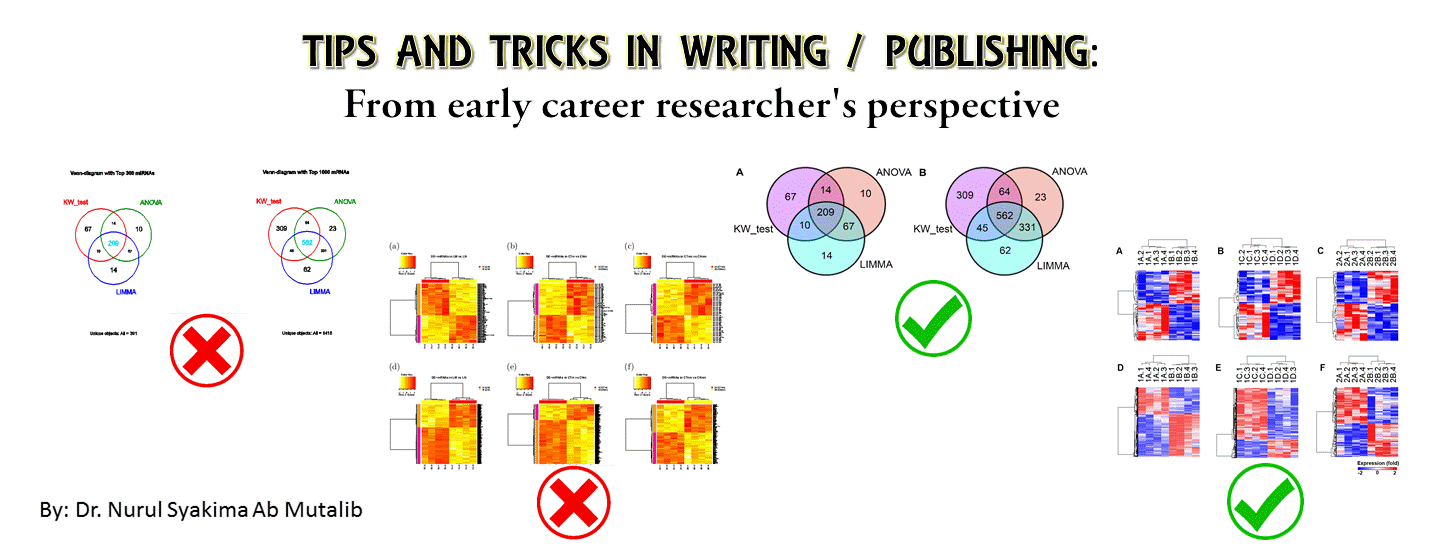
• Try to have more figures and diagrams, instead of tables and words. A picture speaks thousand words.
o www.draw.io (an online tool to create diagram)
• GraphPad Prism to create graphs, not Microsoft Excel
• Adobe Photoshop, not Paint or Microsoft Powerpoint
• Include the minimum requirement based on experiment. E.g: microarray studies need to have heatmaps
• High quality figures
iv. Discussion
• Opening paragraph with findings from other study
o Or open it with findings from your study
• Synthesize your findings
• Explain why findings are ‘in concordance’ or discordant
• Discordant results are also important
• Connect the dots – ‘flow’ is important
• Give direction for future research
v. Conclusion
• Summarize your most important findings
• Give critical insights
• Describe the gap of research
• State future directions and recommendations
vi. Others
• Keywords
• Conflict(s) of Interest
• Author Contribution
• Acknowledgements
• References – format accordingly
• Funding body – state grant identifiers
• Table and Figure legends
• Cover letter
• ABSTRACT – the last to be prepared
• Turnitin – check for plagiarism. Aim for < 30% similarity.