

UMBI Research Spotlight No.2/2026
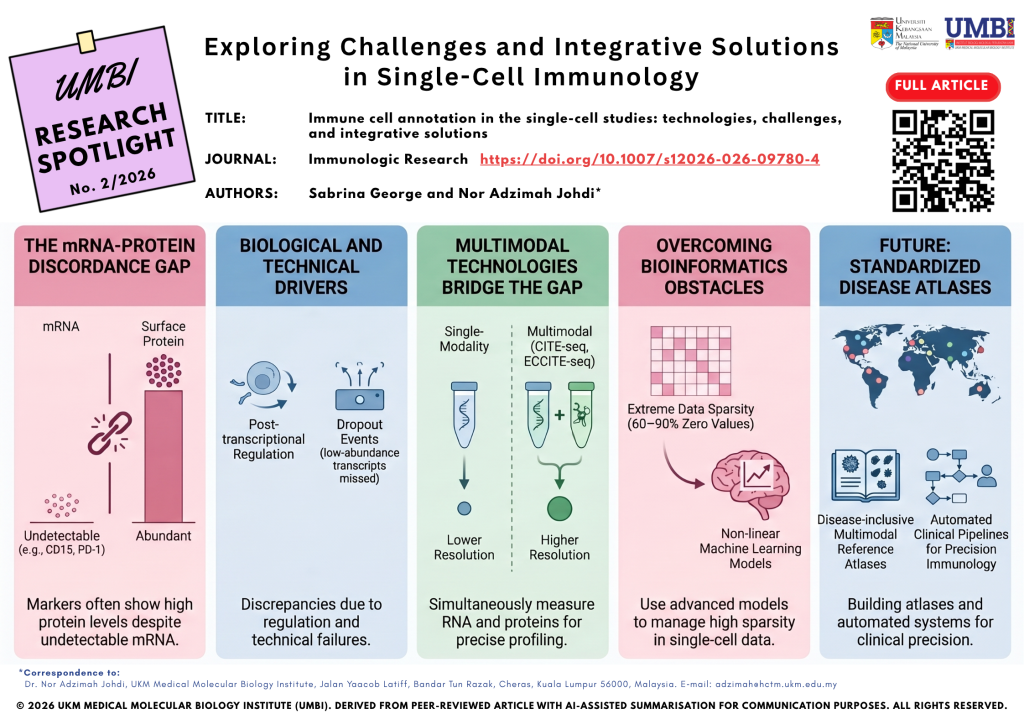
????????? ?????????? ??? ??????????? ????????? ?? ??????-???? ??????????
UMBI is pleased to share a recent review article by our researchers, led by Dr. Nor Adzimah Johdi, published in ??????????? ????????, examining current challenges and emerging approaches in immune cell annotation within single-cell studies.
??????-???? ??? ?????????? (?????-???) has significantly advanced immunology research by enabling high-resolution profiling of individual immune cells. However, accurately identifying immune cell populations remains complex, particularly when transcriptomic signals do not always correspond directly with protein expression. This review discusses how these biological and technical challenges can influence ???? ?????????????? in areas such as cancer, infectious diseases, and autoimmune disorders.
The article provides an ???????? ?? ???????? ?????????? ????????????, including CITE-seq and spatial transcriptomics, which combine transcriptomic, proteomic, and spatial information to support more reliable immune cell characterization. It also highlights ?????? ???????????? ?? ????????????? ??? ?????????????? ?????????? designed to improve the integration and interpretation of multi-omics datasets.
Why these matters?
Improving the accuracy of immune cell annotation is increasingly important for advancing precision medicine and translational research. More robust analytical approaches may contribute to better understanding of disease mechanisms, improved therapeutic stratification, and the identification of potential treatment targets.
This publication also reflects UMBI’s continued efforts to contribute to the broader scientific community through interdisciplinary research spanning immunology, genomics, and computational biology.
We invite colleagues and collaborators to explore the full review:
George, S., Johdi, N.A. Immune cell annotation in the single-cell studies: technologies, challenges, and integrative solutions. ??????? ??? ??, 46 (2026)
https://doi.org/10.1007/s12026-026-09780-4
As single-cell and multi-omics technologies continue to evolve, integrative approaches such as these may help strengthen future research in immunology and precision health.
#Research #SingleCell #Immunology #Multiomics #PrecisionMedicine #BiomedicalResearch #Bioinformatics #UMBI #UKM #Innovation
—–
SDG 3 | SDG 4 – Health/Wellbeing, Education, Quality of life