
First intravitreal injection of Aflibercept 2 mg (Yesafili) at the Department of Ophthalmology, UKM
First intravitreal injection of Aflibercept 2 mg (YesafiliTM) at the Department of Ophthalmology, UKM
7th May 2026 – Intravitreal injection of 2 mg YesafiliTM (Biocon Biologics, Ltd., India), an anti-vascular endothelial growth factor (anti-VEGF) biosimilar of aflibercept, was performed for the first time at the Department of Ophthalmology, Faculty of Medicine, UKM on 1 April 2026 by the Vitreoretinal 1 (Pink) team.
The injection was administered to a 63-year-old Chinese gentleman with branch retinal vein occlusion (BRVO) (stroke involving a branch of the main retinal vein) and refractory macular oedema (swelling in the centre of the retina nerve) in his right eye. He had been receiving various anti-VEGF agents over the preceding four years. His presenting complaint was central blurring of vision, with a best-corrected visual acuity of 6/9. Examination of the right eye retina revealed bleeding into a sector of the nerve (along the inferotemporal arcade) with involvement of the most central area (fovea). Optical coherence tomography (OCT) demonstrated multiple areas of fluid in the retinal layers (IRF) and under the retina i.e., subretinal fluid (SRF) involving the fovea, with increased central retina thickness (Figure 1). In view of persistent fluid and suboptimal treatment response, following discussion with the patient on the cost and benefit, YesafiliTM was selected with the aim of improving visual acuity, resolving IRF and SRF on OCT, and achieving a longer treatment interval.
The intravitreal injection was performed by Dr. Yap Jin Yi, Vitreoretinal Fellow at Hospital Canselor Tuanku Muhriz (HCTM) @ UKM (Figure 2). The procedure was carried out under topical anaesthesia using a sterile technique. The injection was administered 4 mm posterior to the cornea limbus, delivering 2 mg (0.05 ml) of YesafiliTM into the vitreous cavity via the pars planar. The procedure was uneventful. At one month post-injection, OCT demonstrated resolution of intraretinal fluid (IRF) and subretinal fluid (SRF), with restoration of the foveal contour (Figure 3) and corresponding improvement in visual symptoms.
YesafiliTM is a vascular endothelial growth factor (VEGF) inhibitor and biosimilar to reference aflibercept. It contains aflibercept as its active substance, acting as a fusion protein that competitively binds VEGF-A and placental growth factor with greater affinity than their native receptors, thereby blocking the activation of VEGF signalling pathways that drive pathological angiogenesis and vascular leakage.
A biosimilar is a biological product that is highly similar to an approved reference drug in terms of its chemical, physical, and biological characteristics. YesafiliTM received FDA approval in May 2024 for the treatment of diabetic macular edema, neovascular age-related macular degeneration, diabetic retinopathy, macular edema following retinal vein occlusion and retinopathy of prematurity.
Multiple studies have demonstrated clinical equivalence of YesafiliTM to the reference aflibercept 2mg in terms of efficacy, safety, and pharmacokinetics (1-4). In addition, as with other biosimilars, it offers the potential for reduced treatment costs. Offering this biosimilar agent to Malaysian patients, as per indications will broaden therapeutic options not only targeting improved visual outcomes and a longer treatment interval, but also reducing the financial burden of treatment.
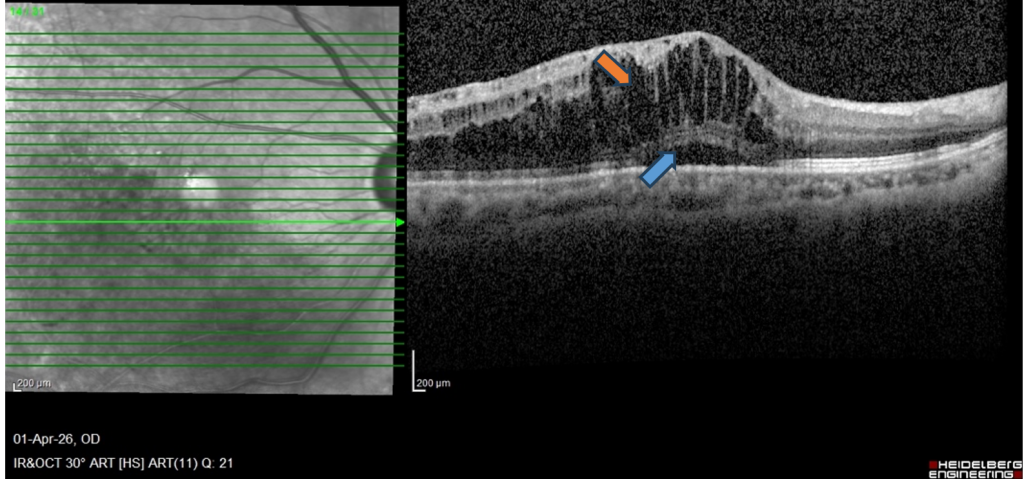
Figure 1. OCT image prior to intravitreal injection of YesafiliTM, showing persistent intraretinal fluid (IRF, orange arrow) and subretinal fluid (SRF, blue arrow)
 Figure 2. Intravitreal injection of YesafiliTM performed by Dr. Yap Jin Yi at the procedure room of Eye Clinic, HCTM
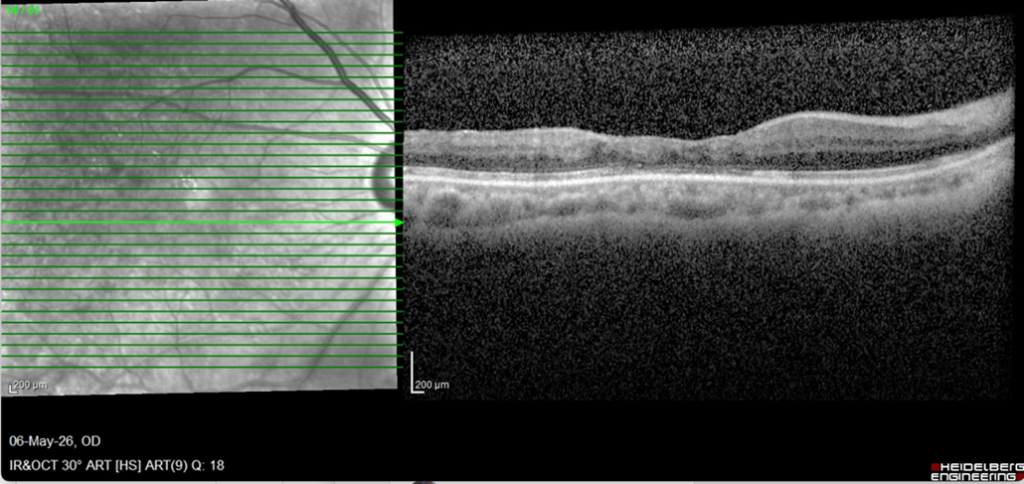 Figure 3. OCT image one month following intravitreal injection of Yesafili™, demonstrating resolution of intraretinal fluid (IRF) and subretinal fluid (SRF) with restoration of the foveal contour.
Reported by:
Dr. Triwijayanti
International fellow (Vitreoretina), Department of Ophthalmology, Faculty of Medicine, UKM
& Prof. Dr. Mae-Lynn Catherine Bastion
Senior Consultant Ophthalmologist, Department of Ophthalmology, Faculty of Medicine, UKM
- Bressler SB, Barve A, Ganapathi PC, et al. Aflibercept Biosimilar MYL-1701P vs Reference Aflibercept in Diabetic Macular Edema: The INSIGHT Randomized Clinical Trial. JAMA Ophthalmol 2024;142:952-60.
- Aljuhani HS, hubyani RA, Qedir J., Efficacy and Safety of Aflibercept Biosimilars Relative to Refernce Aflibercept Therapy for Neovascular Age Related Macular Degeneration: A Systemic Review and Meta-Analysis. Clin Ophthalmol.2025 Jun 19;19:1911–1918. doi: 2147/OPTH.S524395
- Delaney A, Kaiser PK. The Impact Potential of Aflibercept Bisimilars. Ann Eye Sci. 2025;10:33 doi:10.21037/aes-24-33
- European Medicines Agency. Yesafili(aflibercept): Summary of Product Cahracteristics. https://www.ema.europa.eu/en/documents/product-information/yesafili-epar-product-information_en.pdf