By Nurin Batrisyia Bukhari
Photos by Izwan Azman
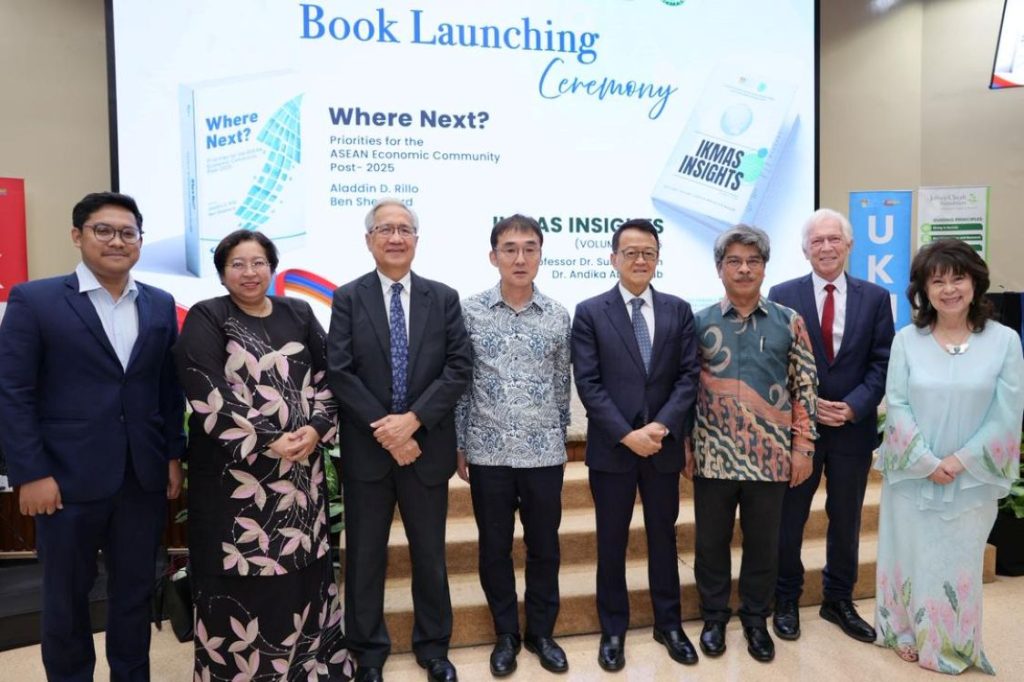
KUALA LUMPUR, 7 August 2025 – Two books titled “Where Next? Priorities for the ASEAN Economic Community Post-2025” and “IKMAS Insights (Vol. 2) 2025” were launched as an important platform in discussing ASEAN’s strategic direction post-2025.
Vice-Chancellor Prof. Dr. Sufian Jusoh emphasized that both books were timely contributions as Malaysia takes on the ASEAN Chairmanship and the region reassesses its strategic direction.
“This vision is not mere rhetoric, but a clear, comprehensive, and forward-looking political and developmental commitment to make ASEAN a resilient, inclusive, and sustainable community in an increasingly challenging world,” he explained.
The first book, “Where Next? Priorities for the ASEAN Economic Community Post-2025”, edited by Dr. Aladdin D. Rillo and Dr. Ben Shepherd and published by the Economic Research Institute for ASEAN and East Asia (ERIA), provides a comprehensive outlook on ASEAN’s future priorities.
“Interestingly, the book goes beyond traditional economic perspective to address contemporary and emerging issues such as gender inclusion, data governance and digitalisation, energy security, environmental sustainability and climate change, disaster management and resilience, as well as competition policy and institutional capacity building.
“Each chapter is contributed by experts from various fields, reflecting the multidisciplinary and interdisciplinary nature essential to understanding regional challenges and opportunities,” he stated.
Meanwhile, the second book, “IKMAS Insights (Vol. 2) 2025,” edited by UKM Vice-Chancellor, Prof. Dr. Sufian Jusoh and Dr. Andika Wahab, is an initiative of UKM’s Institute of Malaysian and International Studies (IKMAS) in response to the geopolitical and geo-economic challenges ASEAN faced as a regional bloc.
“This book brings together writings from various fields of knowledge that offer critical analysis, innovative suggestions, and deep reflection on ASEAN’s direction over the next 20 years in achieving ASEAN Vision 2045.
“What distinguishes IKMAS Insights is its ability to present voices and perspectives from Malaysia in regional discourse, a voice grounded in local realities yet regional and global in its approach.
“This highlights the vital role of higher education institutions and research centres like IKMAS in contributing to international discourse and the development of regional policy and integration,” he said.
Prof. Dr. Sufian concluded by affirming the role of academic institutions in driving policy innovation and regional collaboration.
“We need new thinking, more inclusive strategies, and cross-sectoral collaboration.
“In this regard, the two books launched today are clear evidence that scholarly discourse can and must serve as a catalyst for policy change and regional action,” he concluded.