

Achieve gender equality and empower all women and girls
SDG 5 Indicator
5.3 – Student access measures
5.3.3 – Women’s Access Schemes
Universiti Kebangsaan Malaysia (UKM) demonstrates its strong commitment to advancing gender equality and empowering women through targeted financial assistance, structured mentoring, leadership development programmes and capacity-building initiatives. These efforts aim to provide women with equitable opportunities to pursue higher education, engage in research, enhance professional competencies and participate in economic activities.
In 2025, UKM supported women’s participation in research and academic development, with 48 female recipients of Research Zamalah, 534 female Graduate Research Assistants and 204 female Research Assistants. Academic mentoring initiatives also benefited 90 female first-year students at the Faculty of Law, providing guidance and support for their academic progression. Beyond campus, the UniMADANI programme equipped single mothers and housewives with practical agricultural and entrepreneurship skills, while Project MULA provided business mentoring and financial support accessible to disadvantaged women, strengthening their economic participation and self-reliance.
Central to UKM’s commitment is the Tun Fatimah Hashim Women’s Leadership Centre (TFHWLC), which serves as a dedicated platform for advancing women’s leadership, professional development and empowerment. Through leadership webinars, mentorship programmes, scholarships, skills development activities and strategic industry collaborations, the Centre provides opportunities for women to strengthen their capabilities, expand professional networks and pursue leadership roles. In 2025, UKM further strengthened these efforts by formalising collaboration on a Professional Certificate in Women’s Leadership, reinforcing its institutional commitment to developing future women leaders.
Women’s Access Scheme in 2025
| No. | Program |
| 1. | Tun Fatimah Hashim Women’s Leadership Centre i. Program “Unite to End Digital Violence Against Women and Girls: A Multidisciplinary Perspective” |
| 2. | Mentoring Programme i. Women Entrepreneurs Mentoring Scheme a. UniMadani Programme for Single Mothers and Housewives b. Retort Product Development Workshop and Industry Mentoring Session c. Entrepreneurship Mentoring and Economic Empowerment through Project MULA d. Workshop on Gender Impacts to the AANZFTA: First Protocol in Malaysia e. Professional Certificate in Women’s Leadership ii. Mentor Mentee Program a. Mentor–Mentee Programme – Faculty of Science and Technology (FST) b. Supporting Women’s Access to Mentoring through the Faculty of Law Mentor-Mentee Programme c. Faculty of Pharmacy – Mentor–Mentee Sessions d. Grant Application Mentoring and Guidance Workshop – Faculty of Law e Department of Family Medicine, Faculty of Medicine – Mentor–Mentee System f. Faculty of Medicine – PPA Mentoring Programme |
| 3. | Scholarships and Financial Assistance i. Zamalah Scheme ii. Graduate Research Assistance (GRA) and RA Scheme |
| 4. | Other Provision i. Bicara Merdeka SUKMANITA 2025: Empowering Women as Key Contributors to National Development |
1. Tun Fatimah Hashim Women’s Leadership Centre Webinar Series
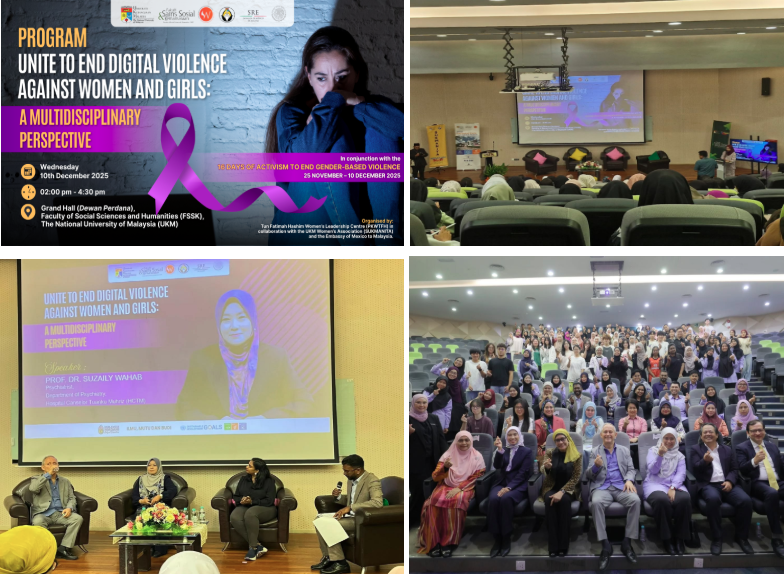
a. Program “Unite to End Digital Violence Against Women and Girls: A Multidisciplinary Perspective”
UKM through its Tun Fatimah Hashim Women’s Leadership Centre (PKWTFH), provides women-focused educational, awareness and empowerment initiatives as part of its institutional provisions to support women’s participation, well-being and development. On 10 December 2025, PKWTFH organised the programme “Unite to End Digital Violence Against Women and Girls: A Multidisciplinary Perspective”, in collaboration with the UKM Women’s Association (SUKMANITA) and the Embassy of Mexico in Malaysia. The programme was held in conjunction with the International Day for the Elimination of Violence Against Women.
The programme provided a multidisciplinary platform addressing violence against women and girls, including challenges associated with digital violence, while promoting awareness, knowledge sharing and greater protection and empowerment of women. It featured a keynote address by Tan Sri Dr. Sharifah Zarah Syed Ahmad, Member of the UKM Board of Directors and Principal Fellow of PKWTFH, who emphasised the importance of addressing violence against women and girls. The programme also brought together expertise from diplomacy, psychiatry and social work through speakers representing the Embassy of Mexico, Hospital Canselor Tuanku Muhriz and the Malaysian Association of Social Workers.
Through this initiative, UKM demonstrates its institutional commitment to providing targeted provisions that address issues affecting women and girls and strengthen their awareness, protection and empowerment. The programme complements UKM’s broader efforts through its dedicated Women’s Leadership Centre to create supportive platforms for women and advance the university’s women empowerment agenda.
2. Mentoring Programme
i. Women Entrepreneurs Mentoring Scheme
a. UniMadani Programme for Single Mothers and Housewives
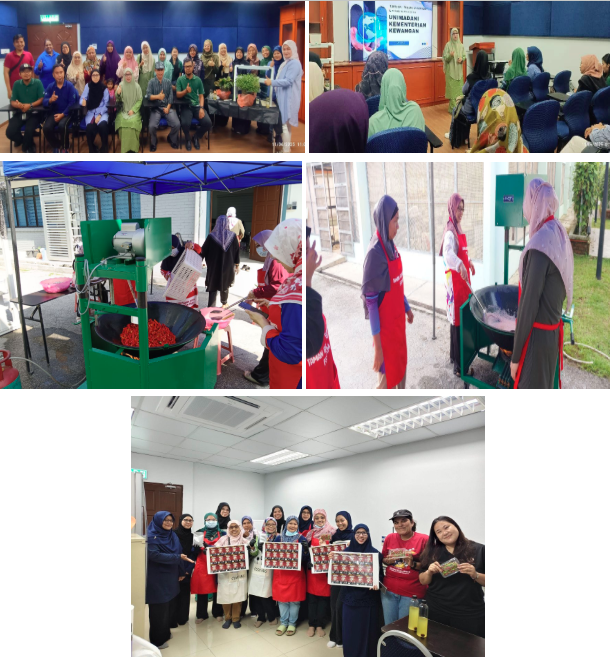
UKM, through the Bangi Botanical Garden, Faculty of Science and Technology (FST), provides targeted skills development and economic empowerment opportunities for women through the UniMADANI Programme, particularly supporting single mothers and housewives in the Bangi community.
The initiative commenced with a programme held on 11 June 2025 at the Plant House Complex, Bangi Botanical Garden, specifically involving single mothers and housewives from the surrounding community. Participants were introduced to modern agricultural practices, particularly hydroponic techniques, as an avenue for community income generation. They were also exposed to sustainable agriculture and entrepreneurship opportunities, providing them with practical knowledge that could support greater economic self-reliance.
The initiative subsequently continued through Kelab Suritani under the UniMADANI–Bangi Botanical Garden FST-UKM Programme. On 5 November 2025, participants undertook a practical food-production activity involving the preparation of sambal penyet. The activity strengthened participants’ entrepreneurial competencies through hands-on exposure to raw material selection, recipe preparation, food hygiene and safety, product packaging, labelling, and basic marketing. These practical components were designed to improve the commercial value of their products and encourage income generation through locally produced food products.
Through this sustained initiative, UKM provides a targeted women-focused skills development and economic empowerment provision, enabling single mothers and housewives to access practical agricultural, food-production, entrepreneurship and marketing skills. The programme demonstrates UKM’s institutional commitment to expanding opportunities for women by strengthening their skills, entrepreneurial capacity and pathways towards income generation and economic participation
Source: https://www.ukm.my/tamanbotanibangi/news/program-unimadani-bersama-ibu-tunggal-dan-surirumah-sekitar-bangi/
b. Retort Product Development Workshop and Industry Mentoring Session
On 20 August 2025, Universiti Kebangsaan Malaysia (UKM) conducted the Retort Product Development Workshop and Industry Sharing Session with Lifestyle Ventures Sdn. Bhd., providing participants with practical knowledge, professional guidance and direct exposure to industry expertise in food product development.
The programme aimed to strengthen participants’ understanding of retort technology and its potential applications in the food industry, while providing direct exposure to industry practitioners on product development and marketing strategies. The workshop included a technical session on Retort Technology and Food Safety delivered by Ts. Dr. Haslaniza Hashim of UKM, followed by an industry sharing session with Ms. Nurzliyana Anisha Bt Radhi of Lifestyle Ventures Sdn. Bhd. The programme was accompanied by Dr. Nurfatimah Mohd Thani.
The programme also demonstrates the participation of women in professional and industry-oriented capacity-building activities, with the programme photographs documenting women participants engaging directly in the workshop and industry sharing sessions. By connecting participants with both academic and industry expertise, the initiative provided opportunities to develop practical knowledge extending from food-processing technology and food safety to product development, marketing and commercialisation strategies.
Through such capacity-building and industry engagement, UKM provides a platform for professional guidance, knowledge transfer, skills development and exposure to industry practices, supporting participants in strengthening their knowledge and capabilities for further professional and entrepreneurial development.
Source: https://www.instagram.com/p/DNmWD7jTi7-/?stkn=MTI1bmdrcmhyOHhiNw%3D%3D
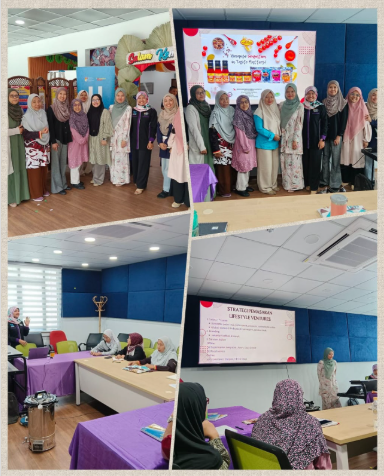
UKM in collaboration with Lifestyle Ventures Sdn. Bhd. on 20 August 2025, featuring technical presentations, interactive discussions and industry mentoring on retort technology, food safety, product development and marketing strategies to strengthen women’s entrepreneurial skills and economic empowerment.
c. Entrepreneurship Mentoring and Economic Empowerment through Project MULA
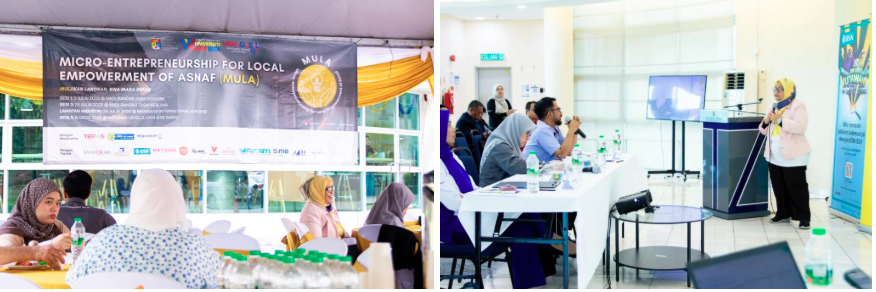
UKM, through the UKM Graduate School of Business (UKM-GSB), provides entrepreneurship development and mentoring opportunities that are accessible to women from economically disadvantaged communities. In 2025, UKM-GSB MBA students organised Project MULA (Micro-Entrepreneurship for Local Empowerment of Asnaf) in collaboration with Teraju Ekonomi Asnaf (TERAS), Lembaga Zakat Selangor (LZS) and Negarawati Tanahair. The month-long community development initiative supported five asnaf micro-entrepreneurs in strengthening their entrepreneurial capabilities and developing sustainable sources of income.
The programme provided participants with structured capacity-building opportunities through practical workshops in entrepreneurship, marketing and financial management, motivational sessions and an industry visit to Mamasab International Sdn. Bhd. Importantly, participants also received personal mentoring from successful entrepreneurs, including the Director of Mamasab International and the Executive Chairman of Authentic Venture Sdn. Bhd., providing direct guidance for developing their businesses.
The programme also provided pathways to financial and business support. Participants presented their business plans and products to a panel at UKM-GSB, with business capital of RM3,000, RM2,000 and RM1,000 awarded to the top three participants, while the fourth- and fifth-place participants received RM500 and other benefits. Additional capital assistance and training were also offered to support the sustainability of participants’ businesses.
The programme demonstrates its relevance to women’s access and empowerment through the participation of Pn. Siti Fatimah, a single mother and founder of DapoQhaseh. She described the opportunity provided by UKM-GSB as giving her renewed hope, confidence and a sense of community. Her participation demonstrates how UKM’s entrepreneurship mentoring and capacity-building provisions are accessible to women, including women from vulnerable socioeconomic backgrounds, and can strengthen their entrepreneurial skills, confidence and economic participation.
d. Workshop on Gender Impacts to the AANZFTA: First Protocol in Malaysia
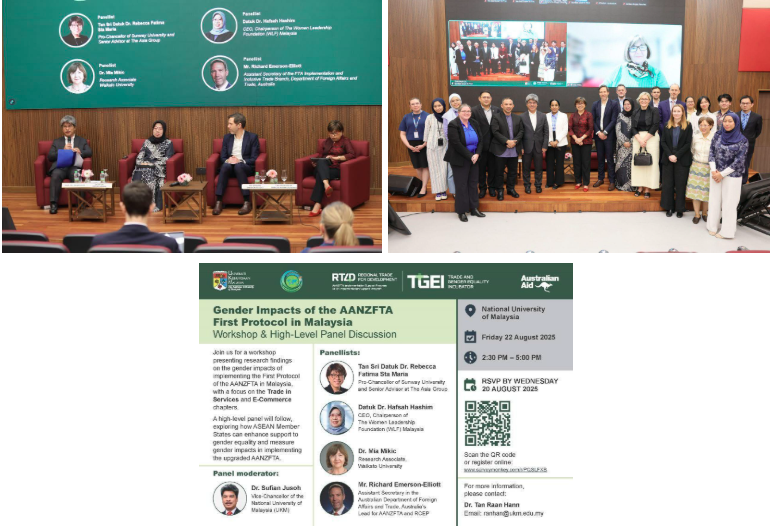
Conducted on 22 August 2025, the “Workshop on Gender Impacts to the AANZFTA: First Protocol in Malaysia” was a fully subsidized, high-level policy-advocacy event organized by the Institute of Malaysian and International Studies (IKMAS), UKM, in strategic collaboration with the Australian Department of Foreign Affairs and Trade. This impactful half-day program gathered approximately 60 participants to examine crucial research findings on how commitments in Trade in Services and E-Commerce under the ASEAN-Australia-New Zealand Free Trade Area (AANZFTA) have influenced women’s economic participation in Malaysia, particularly within high-employment sectors like healthcare and tourism. The initiative delivered a profound societal and institutional impact by actively urging ASEAN Member States to integrate gender-responsive provisions into future trade policies, enhance digital and financial inclusion for women entrepreneurs—including those with disabilities—and expand the collection of sex-disaggregated trade data. By concluding with a robust panel discussion highlighting the opportunities under the Second Protocol to support women-owned micro, small, and medium-sized enterprises (MSMEs), the workshop successfully empowered policymakers, academic staff, and community stakeholders to champion inclusive trade practices and advance the core targets of SDG 5: Gender Equality.
e. Professional Certificate in Women’s Leadership
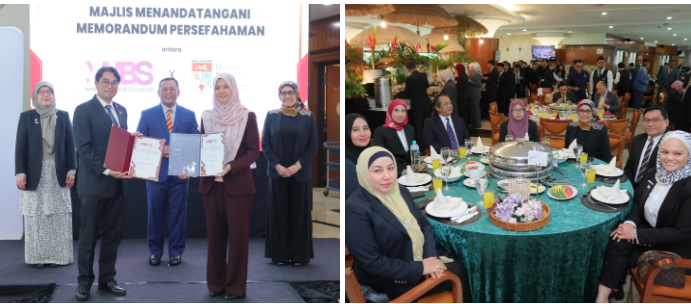
UKM, through its Tun Fatimah Hashim Women’s Leadership Centre (PKWTFH), provides targeted professional development opportunities designed to strengthen women’s leadership capacity and participation in decision-making. On 18 November 2025, UKM formalised a strategic collaboration with Wanita Berdaya Selangor (WBS) for the implementation of the Professional Certificate in Women’s Leadership under the Women’s Leadership Academy.
The initiative represents a structured and accredited professional training provision specifically designed for women’s leadership development. Through the collaboration, PKWTFH contributes its institutional expertise to the development of high-quality training modules aimed at equipping women with the knowledge, competencies and leadership capabilities required to take on greater leadership and decision-making roles.
Through this initiative, UKM provides a targeted pathway for women to access structured leadership education and professional capacity development, demonstrating the university’s institutional commitment to expanding women’s opportunities, strengthening their leadership capabilities and increasing their participation in decision-making processes.
Source:
ii. Mentor Mentee Program
a. Mentor–Mentee Programme – Faculty of Science and Technology (FST)
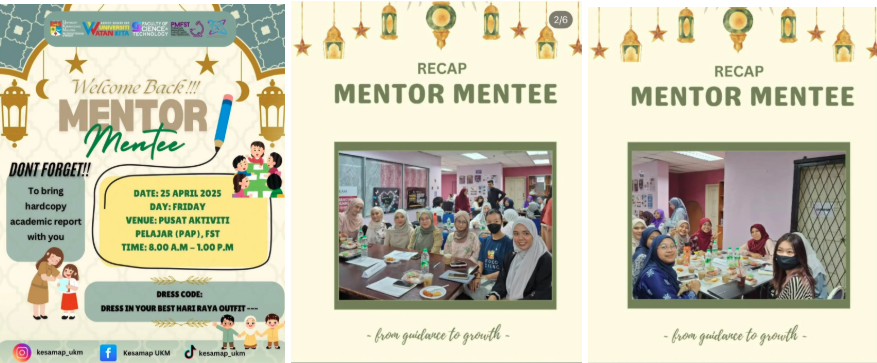
On 25 April 2025, the Food Science Students’ Association (KESAMAP), Faculty of Science and Technology, Universiti Kebangsaan Malaysia (UKM), organised a Mentor–Mentee Programme at the Student Activity Centre (PAP), FST. The programme provided students with an opportunity to meet their mentors and receive academic evaluation and guidance, supporting their academic development and progress. Through direct mentor–mentee engagement, the programme provides a structured support mechanism for students to discuss their academic performance and receive guidance from their assigned mentors.
b. Supporting Women’s Access to Mentoring through the Faculty of Law Mentor-Mentee Programme
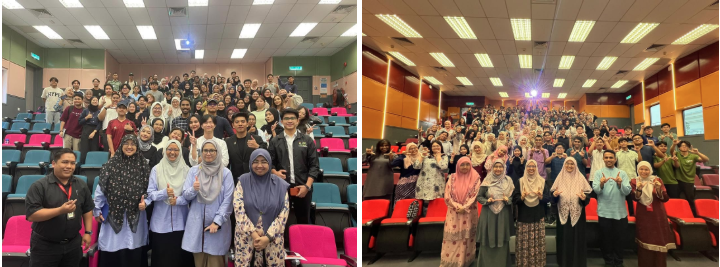
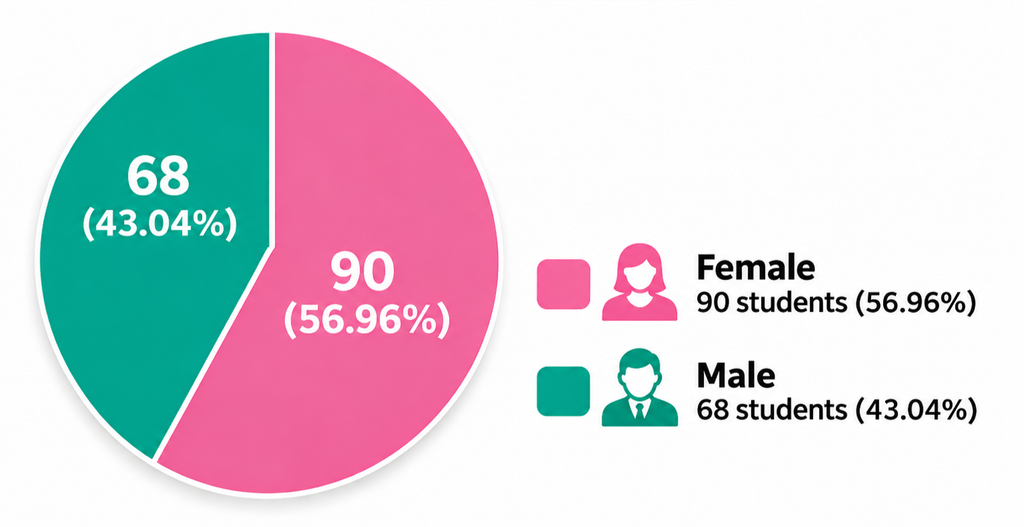
UKM, through its Faculty of Law, supports inclusive student development through the First-Year Mentor-Mentee Programme for the 2025–2026 academic session. The programme recorded 158 students, comprising 90 female students (56.96%) and 68 male students (43.04%). The strong participation of female students highlights women’s access to the university’s mentoring initiative, supporting UKM’s commitment to promoting equitable opportunities for academic guidance and personal development in alignment with SDG 5: Gender Equality.
c. Faculty of Pharmacy – Mentor–Mentee Sessions
UKM, through its Faculty of Pharmacy, provides structured mentor–mentee sessions as part of its academic and student support system. The mentoring arrangement provides students, including female students, with opportunities to engage with academic mentors who can offer guidance, academic support, advice and assistance throughout their studies.
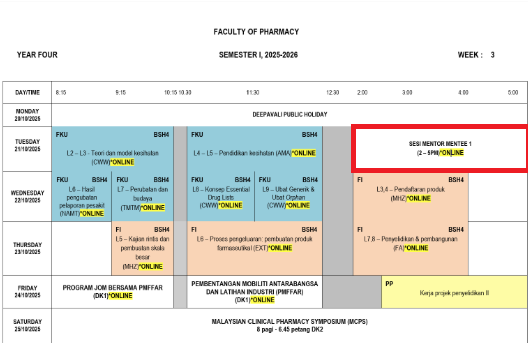
The continuation of this mentoring mechanism during the 2025/2026 academic session is demonstrated in the Faculty of Pharmacy’s official academic timetable. For Year 4 students, a dedicated “Mentor–Mentee Session 2” was scheduled on 17 December 2025 from 2.00 p.m. to 5.00 p.m. The allocation of a specific session within the official academic schedule demonstrates that mentor–mentee engagement is incorporated into the Faculty’s structured student support activities rather than being limited to an informal or one-off interaction.
Through these mentor–mentee sessions, students are provided with a dedicated platform to communicate with their academic mentors, discuss their academic development and obtain guidance concerning their progression and university experience. The mentoring structure therefore contributes to the University’s broader approach to supporting student development and retention.
Importantly, the mentoring scheme is accessible to female students enrolled in the Faculty of Pharmacy, providing them with structured access to academic mentoring and guidance. Female students participating in these sessions therefore contribute to UKM’s wider institutional provision of mentoring opportunities for women.
For the 2025 reporting year, participation records, mentor–mentee lists and/or student records from the Faculty of Pharmacy can be used to determine the number of female students participating in the mentoring scheme. These figures may subsequently be consolidated with female participation in other UKM mentoring programmes to demonstrate that at least 10% of UKM’s female student population participates in mentoring schemes, in accordance with the THE Impact Ratings indicator on women’s mentoring schemes.
Source: https://www.ukm.my/farmasi/wp-content/uploads/2025/10/TAHUN-4-JADUAL-WAKTU-PENGKULIAHAN-SEM-1-2025-2026_21-28Okt.pdf
d. Grant Application Mentoring and Guidance Workshop – Faculty of Law
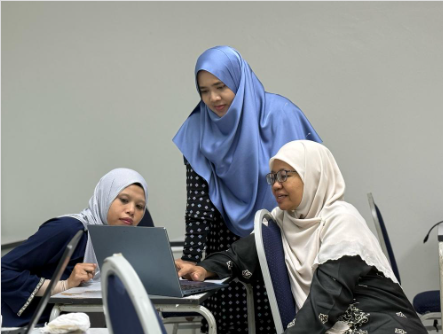
On 18 August 2025, the Faculty of Law (FUU), Universiti Kebangsaan Malaysia (UKM), through the Office of the Deputy Dean for Research and Innovation, organised the GGPM & GUP 2025 Grant Application Enhancement Guidance Workshop at the Faculty of Law. The workshop was facilitated by Prof. Dr. Ruzian Markom from the Centre for International Law and Siyar (CILAS), who provided participants with targeted guidance to strengthen the quality of their grant applications. The mentoring and guidance covered reviewing required application information, identifying common issues that may result in technical rejection, sharing good grant-application practices and tips, and explaining the appropriate application procedures.
Through this initiative, UKM provided a structured platform for academic mentoring, knowledge sharing and research capacity development, enabling participants to obtain direct guidance from an experienced academic in preparing stronger and more complete research grant applications. The programme demonstrates the University’s provision of mentoring and professional support within its academic community, particularly in strengthening researchers’ capacity to pursue research funding opportunities.
Source: https://www.instagram.com/p/DNfYbHSz-vH/?stkn=MXFmZHJnaG05Mjdsaw==
e. Department of Family Medicine, Faculty of Medicine – Mentor–Mentee System
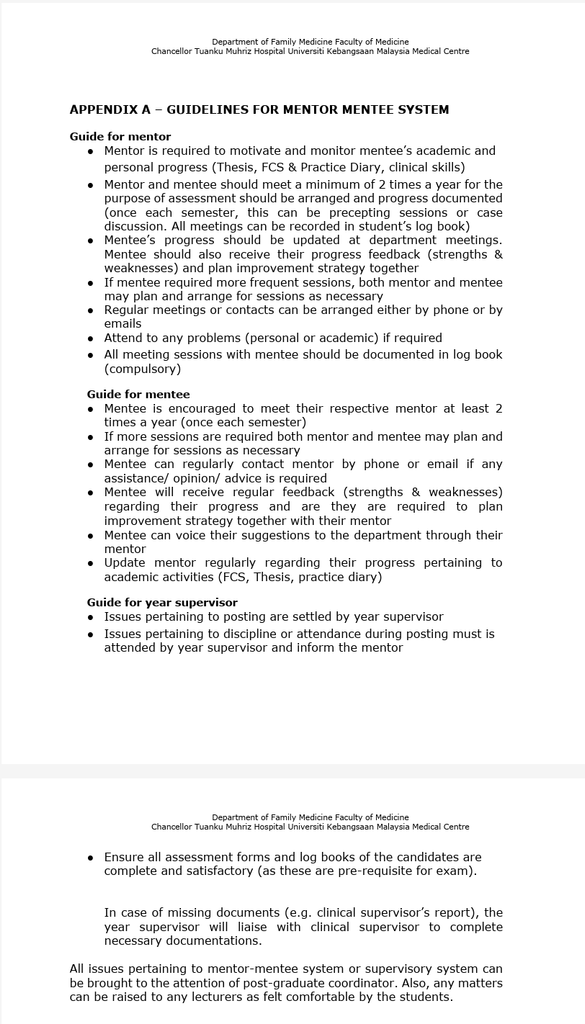
UKM, through the Department of Family Medicine, Faculty of Medicine, implements a structured Mentor–Mentee System to provide continuous academic and personal support to its students. The system is formally incorporated into the Department’s Postgraduate Study Guide 2025, which sets out specific responsibilities for mentors, mentees and year supervisors, demonstrating that mentoring is embedded within the Department’s academic support structure.
Under the system, mentors are responsible for motivating and monitoring the academic and personal progress of their mentees, including progress related to thesis work, Family Case Studies (FCS), Practice Diary and clinical skills. Mentors and mentees are expected to meet at least twice a year, normally once each semester, although additional sessions may be arranged whenever further guidance or support is required. Mentoring may also continue through telephone or email communication when students require assistance, opinions or advice.
An important feature of the scheme is its emphasis on continuous monitoring and documented mentoring. Students receive feedback concerning their strengths and areas requiring improvement and work together with their mentors to develop appropriate improvement strategies. Student progress may also be updated during departmental meetings, while all mentor–mentee meeting sessions are required to be documented in the student’s logbook. This provides an auditable mechanism demonstrating that mentoring interactions take place throughout the student’s academic progression.
The mentoring relationship extends beyond academic performance. Mentors may assist mentees with personal or academic problems, while mentees are able to communicate suggestions or concerns to the Department through their mentors. Consequently, the Mentor–Mentee System provides students with an established channel for academic guidance, professional development, feedback and personal support throughout their programme.
Source: https://www.ukm.my/spsfper/wp-content/uploads/2025/12/PG-Study-Guide-2025-2.pdf
f. Faculty of Medicine – PPA Mentoring Programme
UKM, through its Faculty of Medicine, implements the PPA (Personal and Professional Advancement) Mentoring Programme as a structured mentoring scheme that provides academic and personal guidance to medical students, including female students, throughout their studies. The programme forms part of the Faculty’s student support system and establishes a formal mentor–mentee relationship between academic staff and students.
Under the programme, students are assigned to academic staff members who serve as mentors. The mentors provide guidance and support to their mentees in areas such as academic progress, adaptation to the medical programme, professional development, personal well-being and challenges encountered during their studies. This structured arrangement provides students with an accessible point of contact within the Faculty and enables mentors to follow their mentees’ development over time.
The continuation of the scheme is demonstrated through the PPA Mentoring Programme for the 2025/2026 academic session including dedicated mentoring cohorts such as the PPA Mentoring Programme Year 4 Intake 2025/2026. The programme is administered through UKMFolio, UKM’s learning management platform, where participating academic staff and mentoring groups are organised. Its implementation across student cohorts demonstrates that mentoring is embedded within the Faculty’s student support structure rather than being conducted solely as a one-off activity. Importantly, female medical students are included as mentees within this programme and have access to the same structured academic, professional and personal mentoring support. This contributes to UKM’s broader institutional commitment to supporting women’s participation, progression and development in higher education.
Do the 2025 reporting year, UKM will substantiate women’s participation in the scheme using the Faculty’s mentor–mentee records and/or UKMFolio records. These records will be used to identify the number of female students participating in the PPA Mentoring Programme and to demonstrate their contribution towards the institutional requirement that at least 10% of UKM’s female student population participates in mentoring schemes.
Source: https://www.instagram.com/reel/DOrj27XEhI5/
3. Scholarships and Financial Assistance
i. Zamalah Scheme
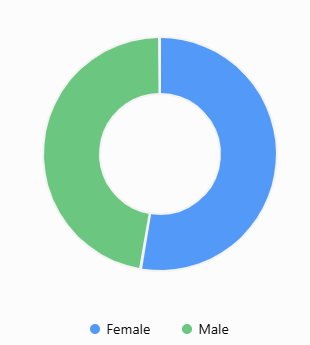
In 2025, UKM supported postgraduate research opportunities through its Research Zamalah Scheme, benefiting 91 recipients across two academic semesters. Of these, 48 were women (52.75%), while 43 were men (47.25%). The slightly higher proportion of female recipients demonstrates women’s strong participation in the scheme and highlights UKM’s contribution to supporting women’s access to postgraduate research opportunities and academic development.
ii. Graduate Research Assistance (GRA) and RA Scheme
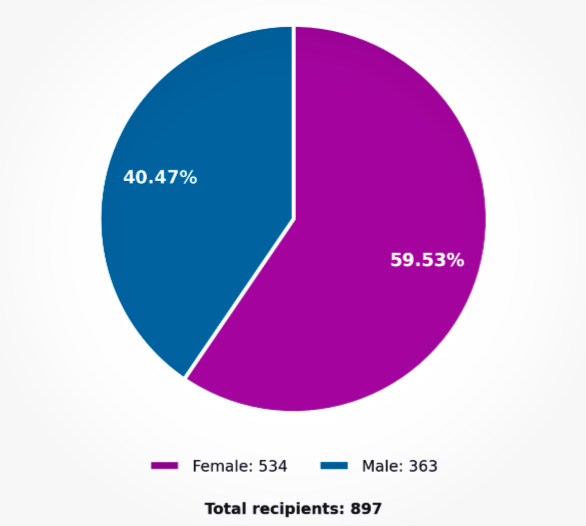
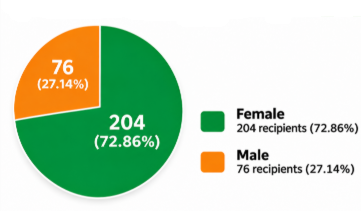
UKM promotes women’s participation in research and academic development through its Graduate Research Assistant (GRA) and Research Assistant (RA) schemes, providing opportunities for women to gain research experience, develop professional competencies and contribute to university research activities. In 2025, 897 individuals participated in the GRA scheme, comprising 534 women (59.53%) and 363 men (40.47%). Meanwhile, the RA scheme recorded 280 recipients, including 204 women (72.86%) and 76 men (27.14%).
Collectively, the two schemes recorded 1,177 recipients, of whom 738 (62.70%) were women. These figures demonstrate strong female participation in UKM’s research assistance schemes, reflecting the university’s commitment to supporting women’s access to research opportunities, academic development and professional advancement. Through these initiatives, UKM contributes to SDG 5: Gender Equality by fostering an inclusive research environment and strengthening opportunities for women’s participation in higher education and research.
4. Other Provision
i. Bicara Merdeka SUKMANITA 2025: Empowering Women as Key Contributors to National Development
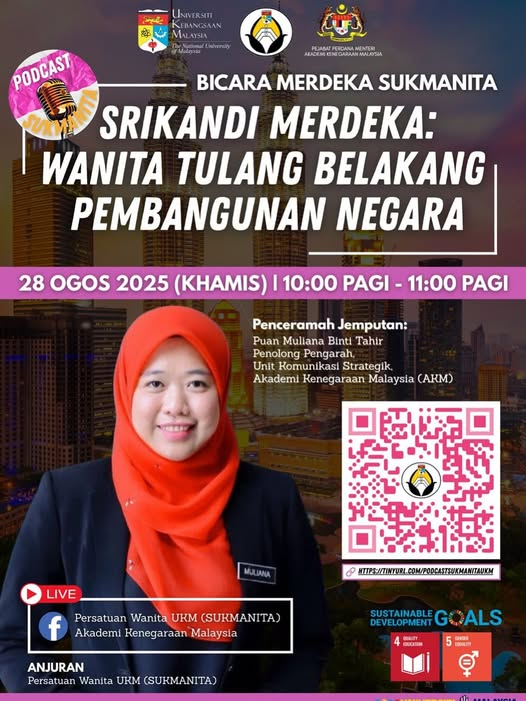
Bicara Merdeka SUKMANITA on 28th August 2025
UKM, through its Women’s Association (SUKMANITA), in collaboration with Akademi Kenegaraan Malaysia (AKM), organised the Bicara Merdeka SUKMANITA programme entitled “Srikandi Merdeka: Wanita Tulang Belakang Pembangunan Negara” (Women as the Backbone of National Development) on 28 August 2025. The programme featured Puan Muliana binti Tahir, Assistant Director of the Strategic Communications Unit at Akademi Kenegaraan Malaysia, Prime Minister’s Department, as the invited speaker. Conducted through a live podcast broadcast on the official Facebook platforms of SUKMANITA and AKM, the initiative provided an accessible educational platform highlighting women’s important contributions to national development.
By bringing together perspectives on women’s roles in society and nation-building, the programme sought to strengthen awareness of women’s leadership, contributions and participation in national progress. Its online delivery also enabled wider community access to discussions on women’s empowerment beyond the university campus.
Collectively, these initiatives demonstrate UKM’s integrated approach to promoting gender equality, strengthening women’s leadership and expanding access to educational, research and economic opportunities. By combining financial support, academic mentoring, professional development and community empowerment, UKM contributes to creating a more inclusive and equitable environment where women can realise their full potential. These efforts directly support SDG 5: Gender Equality, reflecting UKM’s commitment to empowering women within the university and across the wider community.