UKM SUSTAINABILITY RESEARCH GRANTS PROJECT – PHASE 1
Project 1:
Unveiling Sexually Transmitted Diseases Among Undergraduate Students at Universiti Kebangsaan Malaysia: Perception, Behaviour and Awareness.
Project Leader:
Dr. Vanitha A/P Mariappan
Faculty of Health Sciences (FSK)
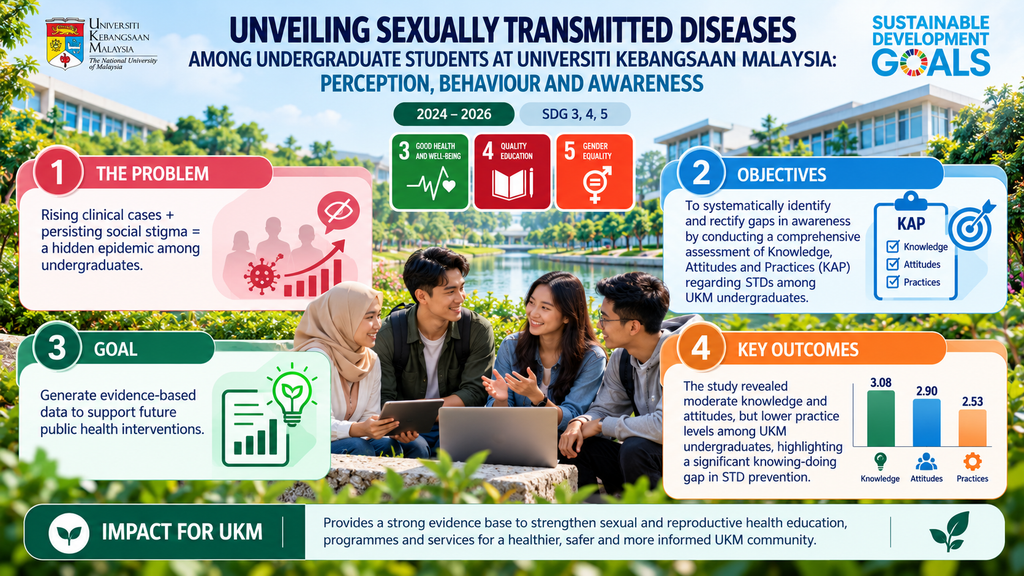
Sexually transmitted diseases (STDs) remain an important public health concern among university students. Greater independence, increased sexual activity and gaps in awareness of disease transmission and prevention can increase students’ vulnerability. Rising clinical cases, combined with persistent social stigma, may also contribute to STDs becoming a “hidden epidemic among undergraduates.” To address this issue, the research “Unveiling Sexually Transmitted Diseases Among Undergraduate Students at Universiti Kebangsaan Malaysia: Perception, Behaviour and Awareness”, led by Dr. Vanitha A/P Mariappan from the Faculty of Health Sciences (FSK), UKM, aims to assess students’ Knowledge, Attitudes and Practices (KAP) related to STDs and generate evidence to support future public health interventions.
The study focuses on full-time UKM undergraduate students aged 18–30 years from Health/Science and Non-Health/Non-Science faculties across the Bangi, Kuala Lumpur and Cheras campuses. The research provides an important baseline for understanding students’ awareness and behaviour related to STDs. A key finding is the existence of a “knowing–doing gap,” where having knowledge about STDs does not necessarily translate into appropriate preventive practices. This suggests that providing information alone may not be sufficient to encourage safer behaviour among students.
Based on these findings, the research recommends that UKM strengthen its sexual and reproductive health initiatives through more targeted and behaviour-oriented interventions, rather than relying solely on awareness and information campaigns. This includes improving sexual health education, addressing stigma, encouraging preventive practices and providing supportive access to sexual health information and services. The research supports SDG 3: Good Health and Well-being by promoting student health and STD prevention, SDG 4: Quality Education by strengthening sexual health literacy and education, and SDG 5: Gender Equality by supporting inclusive and equitable access to sexual and reproductive health knowledge and support.
Project 2:
Integration of Edible Campus Garden and Recycling Initiatives for Sustainable Living and SDGs Advancement in UKM Campus Kuala Lumpur.
Project Leader:
Prof. Dr. Zahara Abdul Manaf
Faculty of Health Sciences (FSK)
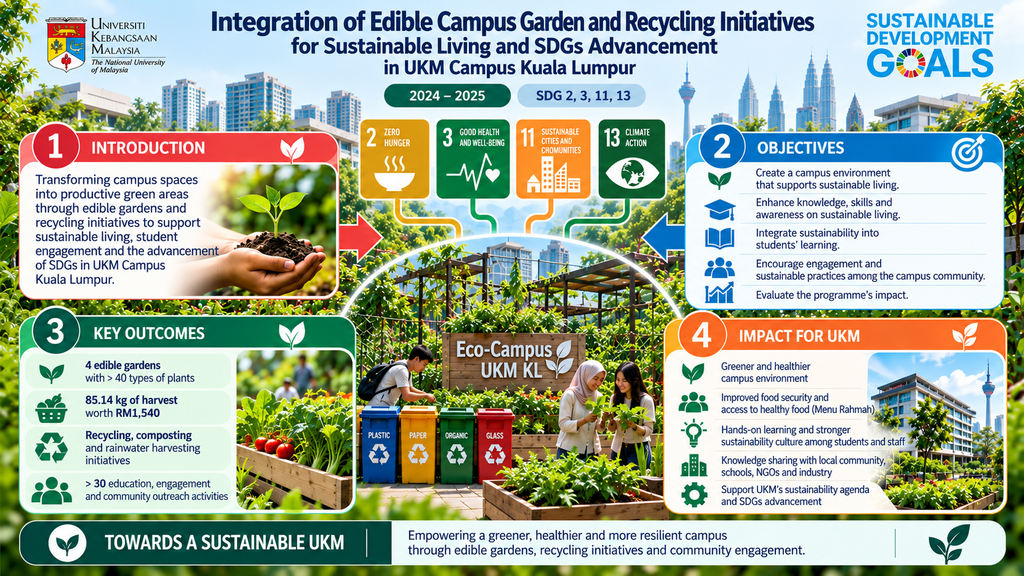
The Eco-Campus Project: Integration of Edible Campus Garden and Recycling Initiatives for Sustainable Living and SDGs Advancement in UKM Campus Kuala Lumpur (SDG-2024-005) was implemented from June 2024 to December 2025 as an initiative to transform UKM Kuala Lumpur into a practical Living Sustainability Laboratory. The project focuses on students and staff at UKM Campus Kuala Lumpur and Kolej Tun Syed Nasir (KTSN), integrating edible gardens, recycling, composting, rainwater harvesting and other resource-efficient practices into campus life. Its objectives are to create a campus environment that supports sustainable living; improve knowledge, skills and awareness of sustainability; integrate sustainability into students’ academic and experiential learning; encourage active participation by students and staff; and evaluate changes in participants’ knowledge, skills and sustainable practices. Importantly, the Eco-Campus is designed not simply as a physical greening initiative, but as a living laboratory connecting teaching, research, co-curricular activities, volunteering, entrepreneurship and practical sustainability action.
The project has generated tangible environmental, educational and social outcomes for UKM. Four edible gardens were established, producing more than 40 types of plants and 85.14 kg of produce valued at RM1,540, while more than 30 educational and volunteering sessions were conducted. The initiative also transformed available campus spaces into productive green areas and engaged 529 members of the campus community, while gardening, composting, recycling and resource management were incorporated into real-life sustainability learning.
Research findings further demonstrate the project’s behavioural and educational relevance: one-third of students were found not to consume sufficient vegetables; higher vegetable consumption was significantly associated with sustainable behaviour and gardening competency; 72.3% of students expressed interest in participating in future campus gardening activities; and 92% provided positive feedback on the activities. The project therefore contributes directly to SDG 2 (Zero Hunger) through campus food production, affordable and balanced food access and food-related education; SDG 3 (Good Health and Well-being) through healthy eating, physical gardening activities, green spaces and social well-being; SDG 11 (Sustainable Cities and Communities) through urban gardening, productive green spaces and community participation; and SDG 13 (Climate Action) through composting, waste reduction, recycling, reuse, campus greening and climate-action education.
Project 3:
Carbon Footprint Calculation and Assessment of Knowledge, Attitudes, and Practices (KAP) Towards Carbon Footprint Among the UKM Bangi Campus Community.
Project Leader:
Dr. Nurfashareena Muhammad
Institute For Environment And Development (LESTARI)
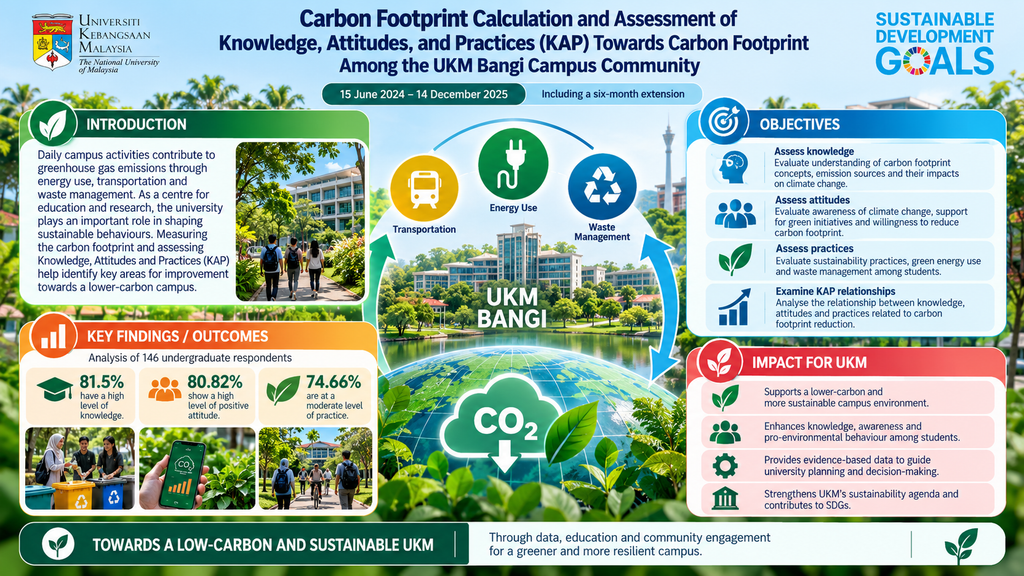
The research, “Carbon Footprint Calculation and Assessment of Knowledge, Attitudes and Practices (KAP) Towards Carbon Footprint Among the UKM Bangi Campus Community,” examines carbon awareness and sustainable behaviour among the UKM community. Daily activities such as energy use, transportation and waste management contribute to the campus carbon footprint. The study therefore assesses students’ knowledge, attitudes and practices (KAP) related to carbon footprints, including their understanding of carbon emissions and climate change, attitudes towards green initiatives, sustainable daily practices, and the relationship between these three areas.
The study involved 146 UKM undergraduate students. Results showed that 81.5% had high knowledge and 80.82% had positive attitudes, but 74.66% were only at a moderate level of sustainable practice. This shows a clear gap between what students know and believe and what they actually practise. For example, many students switched off unused lights and walked for short distances, but the use of bicycles or electric scooters and reusable food containers remained limited. The findings provide UKM with useful evidence to develop more targeted programmes, improve low-carbon facilities, encourage sustainable behaviour and monitor changes after interventions.
The research supports SDG 11: Sustainable Cities and Communities by promoting more sustainable energy, transportation and waste-management practices across the campus. It also supports SDG 13: Climate Action by strengthening carbon-footprint awareness and encouraging students to take practical actions to reduce emissions. Overall, the study shows that UKM students already have strong knowledge and positive attitudes towards sustainability, but more effort is needed to turn this awareness into consistent action. The research therefore provides an important foundation for UKM to develop a more sustainable, low-carbon and climate-responsive campus.
Project 4:
Empowering the Universiti Kebangsaan Malaysia Recycling Centre (PKS-UKM) Through Plastic Recycling Innovation.
Project Leader:
Prof. Madya Dr. Muhamad Azry Khoiry
Faculty of Engineering and Built Environment (FKAB)
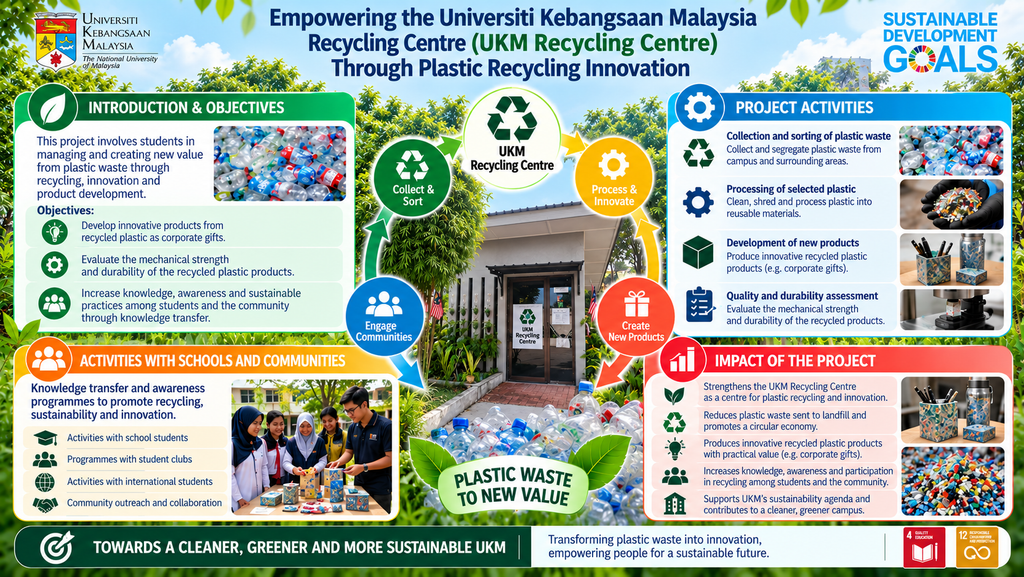
The “Empowering the Universiti Kebangsaan Malaysia Recycling Centre (UKM Recycling Centre) Through Plastic Recycling Innovation” project aims to turn plastic waste into useful, value-added products through recycling and innovation. The project involves collecting and sorting plastic waste, processing selected plastics, developing new products, and testing their quality and durability. A survey of 148 respondents found that the ID-card holder was the most preferred recycled-plastic corporate gift (73%). Unique design and practicality were also important factors in choosing recycled products.
The project successfully produced recycled-plastic products, particularly ID-card holders, using materials such as HDPE and PP. Product testing showed that recycled PP 175/8 had higher tensile strength, while recycled HDPE was more flexible. A user assessment involving 20 respondents also showed high awareness of recycled products (4.1/5), with recycled HDPE recording the highest purchase intention score (4.475/5). Beyond product development, the project promotes knowledge sharing through 3R and 5R awareness activities, STEM programmes, hands-on upcycling workshops, and recycling technology training involving school students, university students and communities.
Overall, the project collected 41.5 kg of plastic waste and developed two upcycled products, showing that plastic waste can be transformed into useful and potentially marketable products. Moving forward, UKM can improve product quality and design, expand the range of recycled products, and promote them as sustainable corporate gifts. The project supports SDG 4: Quality Education through hands-on learning and knowledge transfer, and SDG 12: Responsible Consumption and Production through waste reduction, recycling, upcycling and the responsible use of resources.
Project 5:
Development of a Disability-Inclusive Volunteerism Guideline Module to Promote Sustainable Equity for Persons with Disabilities (PWDs) at Universiti Kebangsaan Malaysia (UKM).
Project Leader:
Dr. Syar Meeze Mohd Rashid
Faculty of Education
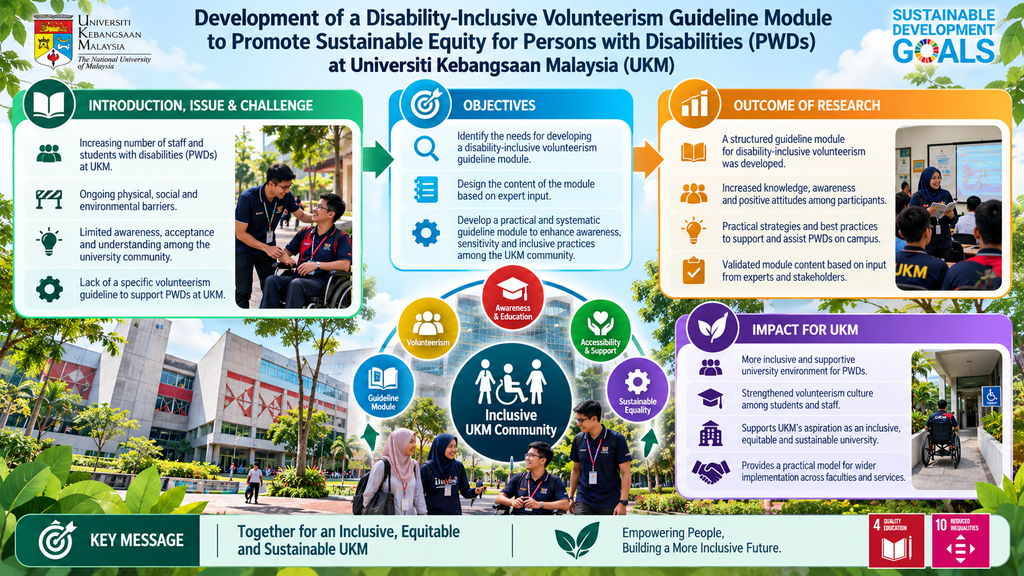
The Development of a Disability-Inclusive Volunteerism Guideline Module was initiated to strengthen disability equality and inclusion within the UKM community. The study highlights several challenges, including limited knowledge and awareness of how to appropriately support persons with disabilities (PWDs), continuing physical, social and environmental barriers, and the absence of a specific volunteerism guideline for supporting PWDs at UKM. The increasing number of staff and students with disabilities also creates a greater need for the university community to be prepared and knowledgeable in providing appropriate support. The research therefore aims to identify the need for such a module, design its content based on expert views, and develop a practical and systematic guideline to improve disability awareness, sensitivity and inclusive practices among the UKM community.
The research findings confirm the need for the module. The needs analysis involving 500 UKM staff and students identified gaps between positive attitudes and actual exposure to disability-related activities. For example, respondents showed strong willingness to work with PWDs (M = 4.54), but their actual interaction with PWDs was lower (M = 3.82). Knowledge of the Persons with Disabilities Act 2008 was also moderate (M = 3.57), while involvement in disability advocacy (M = 3.94) was lower than respondents’ confidence in defending PWD rights (M = 4.36). The module was subsequently evaluated by 20 experts using the Fuzzy Delphi method, with all five proposed chapters achieving more than 75% expert consensus. Overall expert consensus reached 96%, supporting the suitability of the module’s content for disability-inclusive volunteerism at UKM.
The project provides UKM with a practical framework to strengthen an inclusive and disability-friendly campus culture. The module can improve the knowledge, attitudes and skills of students and staff, standardise disability-inclusive volunteer practices, support training and orientation programmes, and strengthen collaboration with universities, NGOs, government agencies and PWD communities. It can also enhance UKM’s visibility as an institution committed to disability inclusion and equity. The project directly supports SDG 4: Quality Education by promoting inclusive learning, awareness and capacity-building among the university community, and SDG 10: Reduced Inequalities by strengthening equal participation, appropriate support and inclusion of persons with disabilities across UKM. This positions the module as both a research output and a practical institutional tool for building a more equitable and inclusive university environment.
Project 6:
Promoting awareness and wellness among UKM community: Screening for computer vision syndrome and its associated factors among office workers in UKM.
Project Leader:
Prof. Dr. Bariah Mohd Ali
Faculty of Health Sciences (FSK)
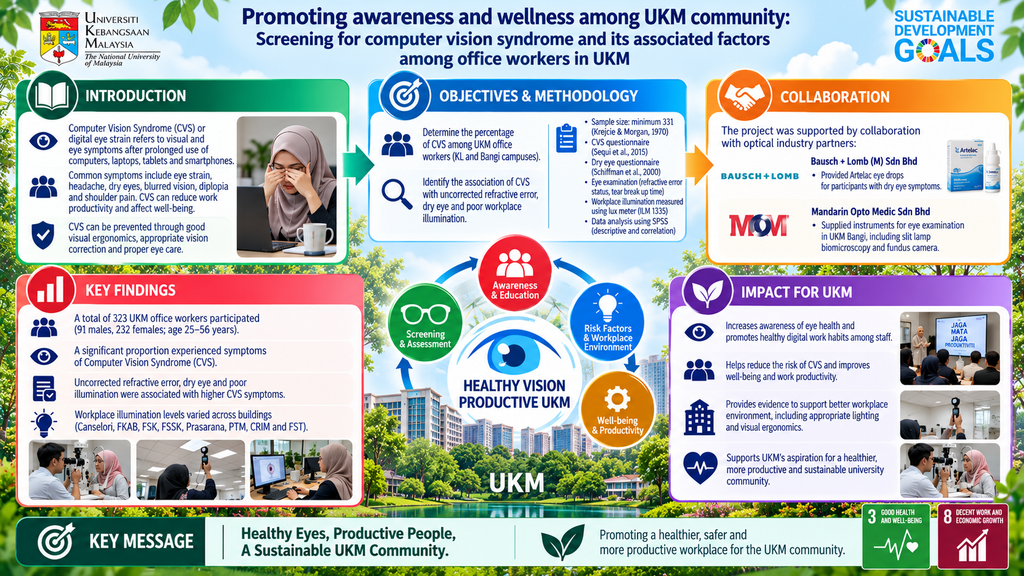
The research project “Promoting Awareness and Wellness among UKM Community: Screening for Computer Vision Syndrome and Its Associated Factors among Office Workers in UKM” focuses on Computer Vision Syndrome (CVS), a condition linked to prolonged use of computers, laptops and other digital devices. Common symptoms include eye strain, headaches, dry eyes, blurred vision and shoulder pain, which may affect employees’ well-being and work productivity. The study aimed to determine the prevalence of CVS among UKM office workers at the Bangi and Kuala Lumpur campuses and identify its relationship with factors such as dry eyes, uncorrected refractive errors and workplace illumination. Eye examinations, questionnaires and workplace lighting measurements were used to assess these factors.
The project also involved collaboration with industry partners to support eye-health screening activities. Bausch & Lomb (M) Sdn Bhd provided Artelac eye drops for participants experiencing dry-eye symptoms, while Mandarin Opto Medic Sdn Bhd supplied equipment for eye examinations at UKM Bangi. A total of 323 UKM office workers participated in the study, with 75.9% experiencing CVS, 66.8% reporting dry-eye symptoms, and 72.7% having refractive errors, of which 60% were uncorrected. The study also found that many workplace illumination levels did not comply with DOSH 2018 guidelines. Factors associated with CVS included age, gender, dry eyes, uncorrected refractive errors and workplace illumination.
The findings provide useful evidence for UKM to create a healthier, safer and more productive workplace. The project recommends annual eye-health and visual-ergonomics awareness programmes, improvements to workplace lighting, compulsory annual eye examinations, and the provision of optometry services at the UKM Bangi Health Centre. It also contributed to research and education through three Final Year Project (FYP) theses and research abstracts related to CVS, dry eyes and workplace conditions. The project supports SDG 3: Good Health and Well-being by promoting eye health, early screening and staff well-being, and SDG 8: Decent Work and Economic Growth by supporting safer workplace conditions, better visual ergonomics and improved employee productivity.