

End poverty in all its forms everywhere
SDG 1 Indicator
1.4 – Community anti-poverty programmes
1.4.2 – Local Start-Up Financial Assistance
Universiti Kebangsaan Malaysia (UKM) demonstrates its commitment to poverty alleviation and inclusive economic development by mobilising financial resources, strategic partnerships and institutional expertise to support financially and socially sustainable businesses within local communities. In 2025, UKM implemented several initiatives, including the Micro-Entrepreneurship for Local Empowerment of Asnaf (M.U.L.A), Komuniti@UniMADANI 2025, Usahawan Mikro Berbudi Daya (UMBI) Project, UKM-CESMED’s Rural Youth Agropreneurship Programme and Special Khidmat Budi Fund. Collectively, these initiatives provided a combination of direct business start-up grants, funded entrepreneurship development programmes, technical assistance, agricultural technology training and community empowerment opportunities, particularly benefiting low-income households, asnaf entrepreneurs, women, rural youth and other vulnerable groups.
Through these initiatives, UKM mobilised significant financial resources, including RM1,713,924.71 from The Coca-Cola Foundation for UMBI, RM600,000 for seven Komuniti@UniMADANI community development projects, and RM584,094.48 accumulated through the Special Khidmat Budi Fund, alongside direct business start-up grants awarded under Project M.U.L.A. Complementing these financial initiatives, UKM-CESMED’s Rural Youth Agropreneurship Programme conducted five knowledge-transfer workshops between January and October 2025, recording 105 participant attendances across several regions of Malaysia. The programme provided rural communities with practical agricultural entrepreneurship education and specialised training in Internet of Things (IoT) and Black Soldier Fly (BSF) technologies, strengthening technical capabilities and access to resources relevant to sustainable agricultural enterprises. While the financial allocation and direct assistance provided under the CESMED programme, its contribution demonstrates UKM’s broader institutional support for rural entrepreneurship development.
By integrating financial assistance with capacity building, mentorship, technological innovation and community partnerships, UKM strengthens the foundations for sustainable business development, promotes opportunities for financial independence and supports long-term socioeconomic resilience.
Financial Assistance and Community Entrepreneurship Initiatives in 2025
| No. | Programmes |
| 1. | Micro-Entrepreneurship for Local Empowerment of Asnaf (M.U.L.A Project) |
| 2. | Komuniti@UniMADANI 2025 – Financial Support for Community-Based Sustainable Enterprises |
| 3. | Micro-Entrepreneur Empowerment Initiative (UMBI – Usahawan Mikro Berbudi Daya) : Supporting Financially and Socially Sustainable Community Businesses |
| 4. | Special Khidmat Budi Fund (Tabung Khas Khidmat Budi) – Financial Support and Community Empowerment |
| 5. | UKM-CESMED’s Rural Youth Agropreneurship Programme: Mobilising Resources for Community-Based Agricultural Enterprises |
1. Micro-Entrepreneurship for Local Empowerment of Asnaf (M.U.L.A Project)
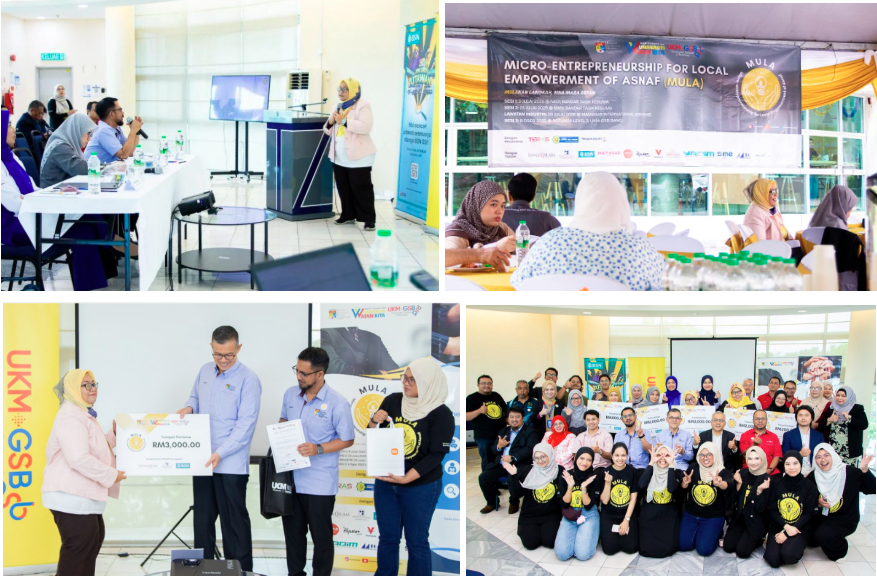
UKM provides financial and entrepreneurial assistance to the local community through Project M.U.L.A (Micro-Entrepreneurship for Local Empowerment of Asnaf), a community development initiative implemented by UKM Graduate School of Business (UKM-GSB). The project was designed to empower micro-entrepreneurs from the asnaf (eligible zakat recipient) community by providing financial assistance alongside entrepreneurship training, business resources, and structured mentoring to strengthen and expand their existing businesses.
Through a comprehensive capacity-building programme, participants received structured training workshops, one-to-one mentoring from successful entrepreneurs, and practical exposure to real business environments. These activities enhanced their entrepreneurial knowledge, business management capabilities, confidence, and readiness to grow sustainable enterprises. Conducted between July and August 2025, the programme included a series of workshops, mentoring sessions, and industry visits in Kajang, Bangi, and Semenyih, enabling participants to gain hands-on learning experiences and build valuable business networks.
Project M.U.L.A aims to transform participants from financial aid recipients into financially independent and competitive entrepreneurs, thereby promoting sustainable local economic development and social mobility. The initiative reflects UKM-GSB’s commitment to inclusive and sustainable community development, in line with the university’s mission to nurture ethical, socially responsible leaders who drive positive change through entrepreneurship and innovation. The winners were awarded business start-up grants of RM3,000 (Champion), RM2,000 (First Runner-up), and RM1,000 (Second Runner-up), together with a tablet device. The fourth- and fifth-place winners each received RM500 in business start-up funding, as well as additional support and benefits.
UKM News: https://www.ukm.my/beritaukm/projek-mula-ignites-sustainable-change-for-asnaf-entrepreneurs/
2. Komuniti@UniMADANI 2025 – Financial Support for Community-Based Sustainable Enterprises
In 2025, UKM through its Centre for Industry and Community Partnerships (I-KOM), participated in the Komuniti@UniMADANI Community Empowerment Programme, an initiative funded by Malaysia’s Ministry of Finance to strengthen the socioeconomic well-being and economic resilience of local communities. UKM secured a total allocation of RM600,000 to implement seven community development projects, including initiatives supporting community entrepreneurship, sustainable food production and income-generating activities. The programme provided a funding framework through which UKM could mobilise financial resources, academic expertise and practical technologies to support community development.
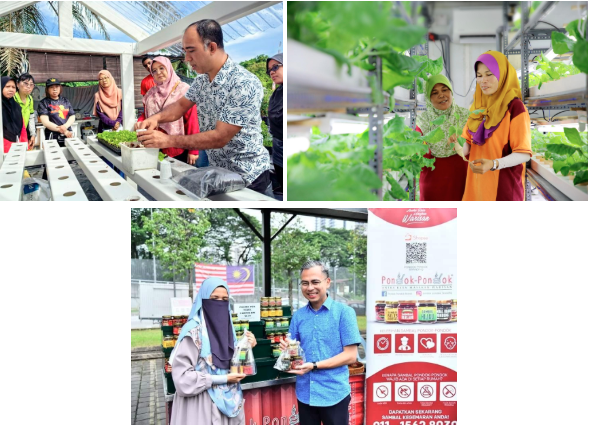
Among the entrepreneurship-related initiatives were Cili Bara: Hydroponic Cultivation and Sambal Products, led by Prof. Dr. Noraini Talip, which targeted housewives and single mothers; the Retort Sambal Production Project, led by Dr. Nurfatimah Mohd Thani, which focused on value-added food production; and the Urban Hydroponic Farming Programme in Kajang, led by Prof. Dr. Kalaivani Nadarajah, which promoted sustainable agricultural opportunities. These initiatives were designed to strengthen community capacity to develop economically viable activities through agricultural innovation, food processing and entrepreneurship. On 11 June 2025, UKM also organised a hydroponic agriculture programme for housewives and single mothers in Bangi, introducing modern farming techniques as a potential source of community income.
The Komuniti@UniMADANI funding framework permits expenditure on machinery, equipment, raw materials, packaging, advertising and marketing, which can contribute to the establishment and development of community-based enterprises. Through these funded projects, UKM demonstrates its role in facilitating financial and technical resources for inclusive economic empowerment, particularly among vulnerable community groups.
Source:
https://www.ukm.my/tamanbotanibangi/news/program-unimadani-bersama-ibu-tunggal-dan-surirumah-sekitar-bangi/
3. UKM’s RM1.7 Million Micro-Entrepreneur Empowerment Initiative (UMBI – Usahawan Mikro Berbudi Daya) : Supporting Financially and Socially Sustainable Community Businesses
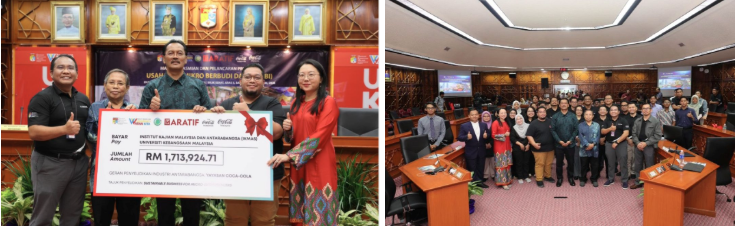
UKM through its Institute of Malaysian and International Studies (IKMAS), demonstrates its commitment to strengthening community entrepreneurship through the Usahawan Mikro Berbudi Daya (UMBI) Project (Empowered Micro-Entrepreneurs Project). Supported by RM1.7 million in international funding from The Coca-Cola Foundation, the initiative aims to empower micro-entrepreneurs, particularly small-scale traders, hawkers and food and beverage operators, by improving their business capabilities, financial sustainability and long-term economic resilience. Officially launched on 29 May 2025, the project is led by Dr. Muhamad Azwan Abd Rahman, a Research Fellow at IKMAS, with the involvement of academic experts, industry representatives and participating universities. The initiative represents a university-industry partnership that mobilises external financial resources to support community economic development and sustainable entrepreneurship.
The RM1.7 million funding commitment provides a financial foundation for implementing structured entrepreneurship development activities, research-based interventions, business mentoring and performance monitoring. Through the Revolusi Usahawan Mikro Berbudi Daya (RUMBI) programme, selected micro-entrepreneurs are supported through six strategic approaches designed to improve business performance, strengthen operational management and enhance income-generating opportunities. Rather than focusing solely on short-term business development, UMBI integrates financial sustainability with social empowerment by helping entrepreneurs strengthen their business practices, improve their capacity for growth and build more resilient livelihoods.
Throughout 2025, UMBI undertook community engagement and field assessment activities across seven geographical zones in Malaysia: Northern, Southern, Eastern, Central, Sabah, Sarawak and Labuan. Field activities included visits to micro-enterprise locations in Kota Kinabalu, Tawau, Sandakan, Kuching’s Matang area, Kuantan, Kuala Terengganu, Kota Bharu, Putrajaya, Bangi, Melaka, Johor and other locations. These activities supported the identification of entrepreneurs’ business needs, assessment of operational challenges and development of appropriate business improvement strategies. The project also incorporated the CAHAYA Model, a structured monitoring and impact assessment framework intended to evaluate participants’ progress and business sustainability.
Source:
https://www.ukm.my/beritaukm/ikmas-terima-dana-antarabangsa-bernilai-rm1-7-juta/
https://umbi.com.my/tentang-program/
4. Special Khidmat Budi Fund (Tabung Khas Khidmat Budi) – Financial Support and Community Empowerment
Universiti Kebangsaan Malaysia (UKM) established the Special Khidmat Budi Fund as a dedicated fundraising platform to mobilise financial contributions from the public, local communities and alumni to support community development and socioeconomic empowerment. Managed through UKM’s Give2UKM platform, the fund aims to assist vulnerable groups, including indigenous communities, single mothers, senior citizens, orphans, persons with disabilities and students. As reported in UKM’s 2025 sustainability evidence, the fund had accumulated RM584,094.48, demonstrating the university’s ongoing efforts to mobilise financial resources for community assistance and social inclusion.
The fund supports a broad range of community-oriented initiatives, including entrepreneurship programmes, digital equipment contributions, food assistance, educational activities and community engagement programmes. Its inclusion of entrepreneurship initiatives provides a potential mechanism for supporting economically disadvantaged individuals in developing income-generating activities and improving their financial independence. By combining fundraising, volunteer participation and community partnerships, UKM seeks to strengthen socioeconomic resilience, encourage inclusive economic participation and contribute to sustainable community development. However, specific financial disbursements for business start-ups in 2025 have not been publicly verified.
Source: https://give2ukm.ukm.my/tabung-sumbangan/96

5. UKM-CESMED’s Rural Youth Agropreneurship Programme: Mobilising Resources for Community-Based Agricultural Enterprises
UKM through its Centre for Entrepreneurship and SME Development (UKM-CESMED), contributes to rural economic empowerment through the Rural Youth Agropreneurship Programme, which provides structured knowledge-transfer activities and technical resources relevant to sustainable agricultural entrepreneurship. In 2025, the programme implemented five community-based workshops across several regions of Malaysia, recording 105 participant attendances. These activities included regional entrepreneurship-related knowledge-transfer sessions and specialised training in Internet of Things (IoT) installation and Black Soldier Fly (BSF) technology.
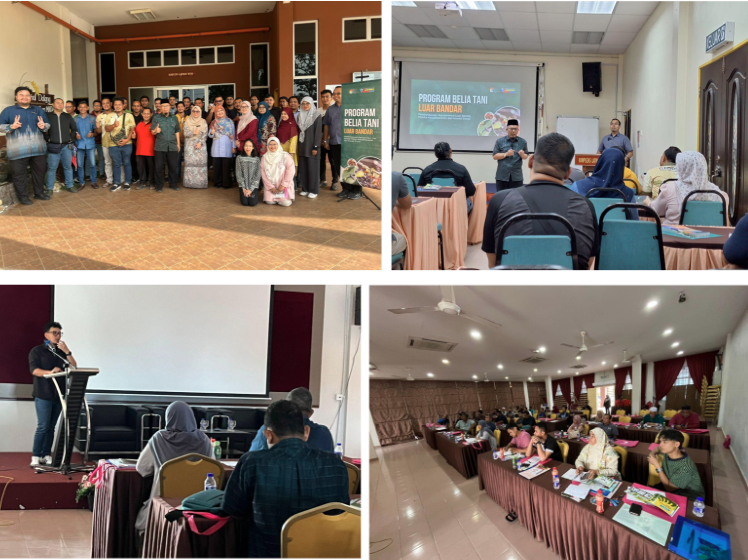
The programme demonstrates UKM’s mobilisation of institutional expertise, educational materials and technical resources to support rural communities in developing capabilities relevant to agricultural enterprise development. The IoT and BSF workshops are particularly relevant to resource-based entrepreneurship support, as they introduce participants to agricultural technologies that may help improve operational efficiency, resource utilisation and opportunities for sustainable production. While the programme provides evidence of institutional and technical assistance to rural agro-entrepreneurs, the available 2025 activity report does not specify the financial allocation, direct business grants, equipment contributions or start-up capital disbursed to participants.
Through its financial assistance, entrepreneurship programmes and strategic partnerships, UKM demonstrates its commitment to empowering disadvantaged communities and promoting sustainable livelihoods. By combining financial resources with practical training, mentorship and technical expertise, UKM helps local entrepreneurs strengthen their businesses, create income-generating opportunities and move towards financial independence. These initiatives reflect UKM’s dedication to transforming financial support into long-term economic opportunities, contributing to poverty alleviation, inclusive economic growth and resilient communities in alignment with SDG 1: No Poverty.