
Allow Remote Working Policy
Universiti Kebangsaan Malaysia (UKM) formally allows employees to work remotely through its Work from Home Guidelines (Garis Panduan Bekerja dari Rumah—BDR), established in 2021 and reviewed in 2023. Administered by the Registrar’s Office, these guidelines provide an institutional framework for eligible staff to undertake suitable duties from home, subject to supervisory approval and specified circumstances. Full-day or half-day arrangements are supported by established working hours, digital attendance recording through e-Warga or MyUKM and monitoring responsibilities to maintain accountability and service continuity. By enabling approved duties to be performed without travelling to campus, UKM provides a policy-based mechanism to reduce employee commuting while supporting staff well-being and operational flexibility.
The BDR guideline ensures that staff who work remotely maintain the same employment status, salary and benefits, supporting equitable treatment for all employees. This initiative reflects UKM’s recognition of the evolving work environment and its effort to create a flexible and efficient working culture that supports productivity, work-life balance and environmental sustainability. By reducing the need for daily commuting, the remote working arrangement indirectly contributes to UKM’s low-carbon campus goals by lowering transport-related emissions and traffic congestion around the university.
Policy:
- Eligibility for BDR: All staff members at UKM, including academic, management, professional, and support staff, can apply for BDR under specific conditions. This flexibility acknowledges diverse work responsibilities and personal needs.
- Conditions for Approval: BDR applications must be approved by the staff member’s supervisor, considering the nature of tasks that can be effectively performed from home. The policy allows for BDR in situations such as:
- Environmental pollution or health crises (e.g., infectious disease outbreaks).
- Personal circumstances that necessitate working from home, like childcare needs when educational facilities are closed.
- Work Hours and Monitoring: Staff working from home are required to adhere to established working hours and must log their attendance through the university’s digital systems. This ensures accountability and maintains operational standards.
- Support and Resources: UKM provides guidance on the technology and resources needed for effective remote work, encouraging the use of personal or university-owned IT equipment while ensuring data security.
- No Condensed Work Week Mentioned: While UKM supports flexible working arrangements through telecommuting, there is no explicit mention of a condensed work week in the provided documents. The focus appears to be on maintaining standard working hours while allowing for remote execution of duties.
UKM’s implementation of the Garis Panduan Bekerja Dari Rumah (BDR) reflects its strong commitment to flexible and sustainable work practices. By allowing telecommuting, the university promotes employee well-being, enhances organizational efficiency and reduces commuting-related emissions, contributing to a better work-life balance and a low-carbon campus. This initiative aligns with the UKM Sustainability Strategic Plan 2030 and supports SDG 11 (Sustainable Cities and Communities), positioning UKM as a progressive model for sustainable and flexible working arrangements in Malaysian higher education.
Policy Created: 2021
Policy Reviewed: 2023
Garis Panduan Bekerja dari Rumah (BDR) Universiti Kebangsaan Malaysia
Source: https://www.ukm.my/pendaftar/wp-content/uploads/2021/02/Garis-Panduan-BDR-UKM.pdf
Penambahan Garis Panduan Pelaksanaan Bekerja dari Rumah (BDR) (Semakan 2023)
Source: https://www.ukm.my/pendaftar/wp-content/uploads/2023/05/PPSM-Waktu-Bekerja.pdf
UKM supports sustainable mobility through Work from Home (WFH) arrangements for staff with special needs or specific circumstances. By reducing the need to travel to campus, this flexible working approach helps address transport barriers and supports efforts to reduce traffic congestion and commuting-related carbon emissions. The initiative reflects UKM’s commitment to integrating service continuity, staff well-being and environmental sustainability into its working practices.
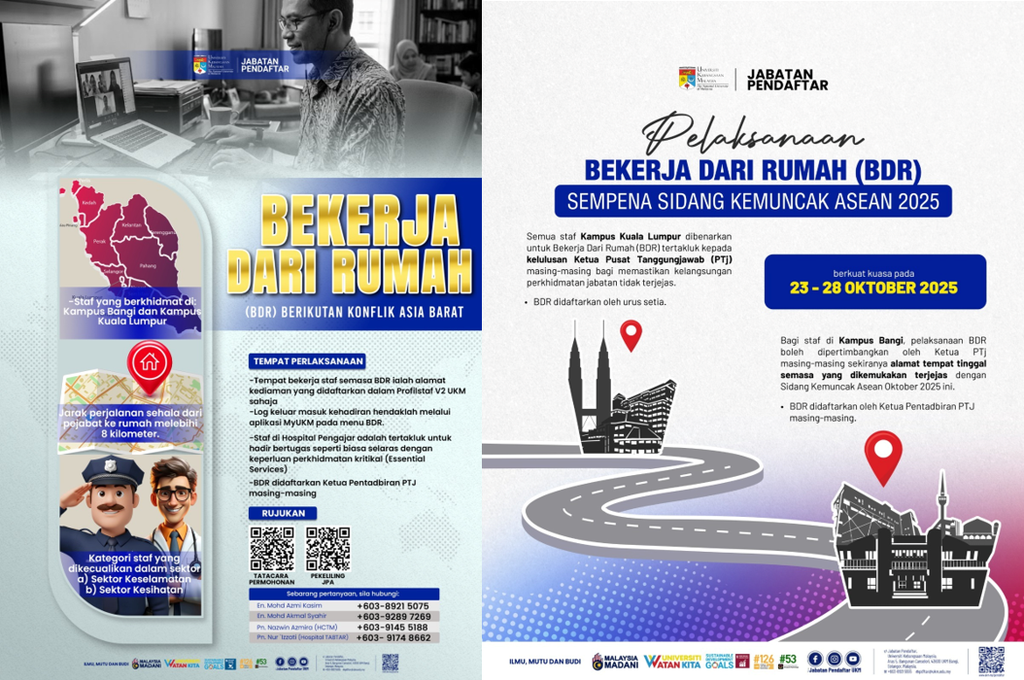
Collectively, remote working at UKM is supported by formal institutional guidelines, approval procedures and accountability mechanisms. These arrangements allow eligible employees to maintain their professional responsibilities while avoiding campus journeys during approved remote-working periods. By integrating workplace flexibility with service continuity and equitable employment conditions, UKM supports staff welfare and reduces the need for commuting, contributing to efforts to ease traffic congestion and limit transport-related emissions in alignment with SDG 11: Sustainable Cities and Communities.