


Achieve gender equality and empower all women and girls
SDG 5 Indicator
5.6 – Women’s progress measures
5.6.6 – Women’s Mentoring Schemes
UKM has women’s mentoring schemes, with at least 10% of female students participating. The compulsory mentor-mentee program offers personalised guidance from academic staff, helping students, especially women, succeed academically. With more female students than male, this program is key to promoting gender equity and empowering underperforming students.
Table shows list of women’s mentoring programme
| No | Mentoring Programme |
| 1 | Faculty of Medicine – PPA (Personal and Professional Advancement) Mentoring Programme |
| 2 | Faculty of Pharmacy – Mentor–Mentee Sessions |
| 3 | Faculty of Law (FUU) First-Year Mentor–Mentee Programme 2025/2026 |
| 4 | Department of Family Medicine, Faculty of Medicine – Mentor–Mentee System |
| 5 | Mentor–Mentee Programme – Faculty of Science and Technology (FST) |
1. Faculty of Medicine – PPA Mentoring Programme
UKM, through its Faculty of Medicine, implements the PPA (Personal and Professional Advancement) Mentoring Programme as a structured mentoring scheme that provides academic and personal guidance to medical students, including female students, throughout their studies. The programme forms part of the Faculty’s student support system and establishes a formal mentor–mentee relationship between academic staff and students.
Under the programme, students are assigned to academic staff members who serve as mentors. The mentors provide guidance and support to their mentees in areas such as academic progress, adaptation to the medical programme, professional development, personal well-being and challenges encountered during their studies. This structured arrangement provides students with an accessible point of contact within the Faculty and enables mentors to follow their mentees’ development over time.
The continuation of the scheme is demonstrated through the PPA Mentoring Programme for the 2025/2026 academic session, including dedicated mentoring cohorts such as the PPA Mentoring Programme Year 4 Intake 2025/2026. The programme is administered through UKMFolio, UKM’s learning management platform, where participating academic staff and mentoring groups are organised. Its implementation across student cohorts demonstrates that mentoring is embedded within the Faculty’s student support structure rather than being conducted solely as a one-off activity.
Importantly, female medical students are included as mentees within this programme and have access to the same structured academic, professional and personal mentoring support. This contributes to UKM’s broader institutional commitment to supporting women’s participation, progression and development in higher education.
For the 2025 reporting year, UKM will substantiate women’s participation in the scheme using the Faculty’s mentor–mentee records and/or UKMFolio records. These records will be used to identify the number of female students participating in the PPA Mentoring Programme and to demonstrate their contribution towards the institutional requirement that at least 10% of UKM’s female student population participates in mentoring schemes.
Source: https://www.instagram.com/reel/DOrj27XEhI5/
2. Faculty of Pharmacy – Mentor–Mentee Sessions
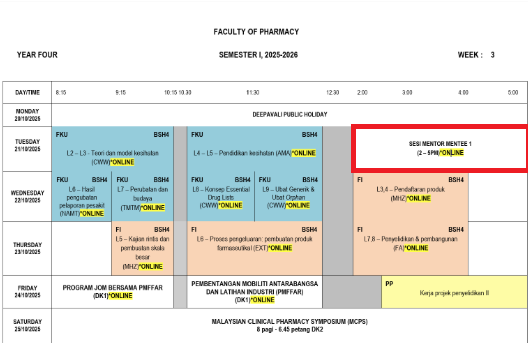
UKM, through its Faculty of Pharmacy, provides structured mentor–mentee sessions as part of its academic and student support system. The mentoring arrangement provides students, including female students, with opportunities to engage with academic mentors who can offer guidance, academic support, advice and assistance throughout their studies.
The continuation of this mentoring mechanism during the 2025/2026 academic session is demonstrated in the Faculty of Pharmacy’s official academic timetable. For Year 4 students, a dedicated “Mentor–Mentee Session 2” was scheduled on 17 December 2025 from 2.00 p.m. to 5.00 p.m. The allocation of a specific session within the official academic schedule demonstrates that mentor–mentee engagement is incorporated into the Faculty’s structured student support activities rather than being limited to an informal or one-off interaction.
Through these mentor–mentee sessions, students are provided with a dedicated platform to communicate with their academic mentors, discuss their academic development and obtain guidance concerning their progression and university experience. The mentoring structure therefore contributes to the University’s broader approach to supporting student development and retention.
Source: https://www.ukm.my/farmasi/wp-content/uploads/2025/10/TAHUN-4-JADUAL-WAKTU-PENGKULIAHAN-SEM-1-2025-2026_21-28Okt.pdf
3. Faculty of Law (FUU) First-Year Mentor–Mentee Programme 2025/2026
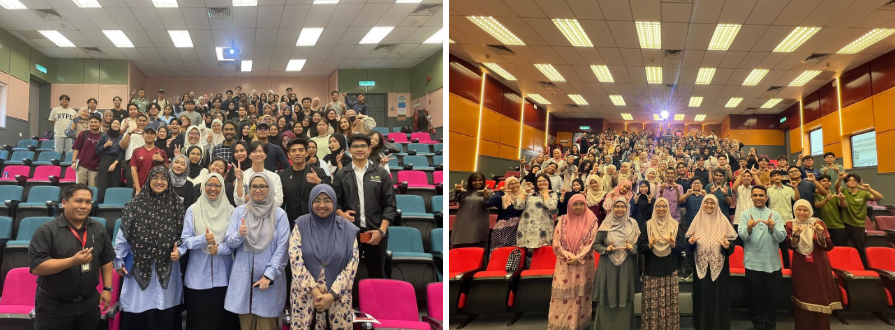
UKM, through its Faculty of Law (FUU), implements a structured Mentor–Mentee Programme as part of its student support and development system. The programme establishes direct mentoring relationships between academic staff and students, providing an organised platform for students to engage with their assigned academic mentors and receive guidance throughout their studies.
For the 2025/2026 academic session, first-year students were assigned to designated academic mentors at the Faculty. The mentoring arrangement was implemented through mentor–mentee engagement during meetings with students, providing opportunities for mentees to meet and interact directly with their respective mentors. These engagements strengthen communication between students and academic staff and provide an accessible channel through which students can seek academic guidance, discuss their development and university experience, and obtain appropriate advice and support.
The programme demonstrates that mentoring at FUU is not merely an administrative assignment of students to academic staff, but is supported through actual mentor–mentee engagement with students. The student meeting documented in the Faculty’s 2025 evidence provides visual evidence of the implementation of this mentoring arrangement during the reporting year.
Importantly, the programme demonstrates substantial participation by female students. Based on FUU’s First-Year Mentor–Mentee records for the 2025/2026 academic session, 90 of the 158 recorded mentee entries were female students, representing approximately 56.96% of the recorded mentee participation.
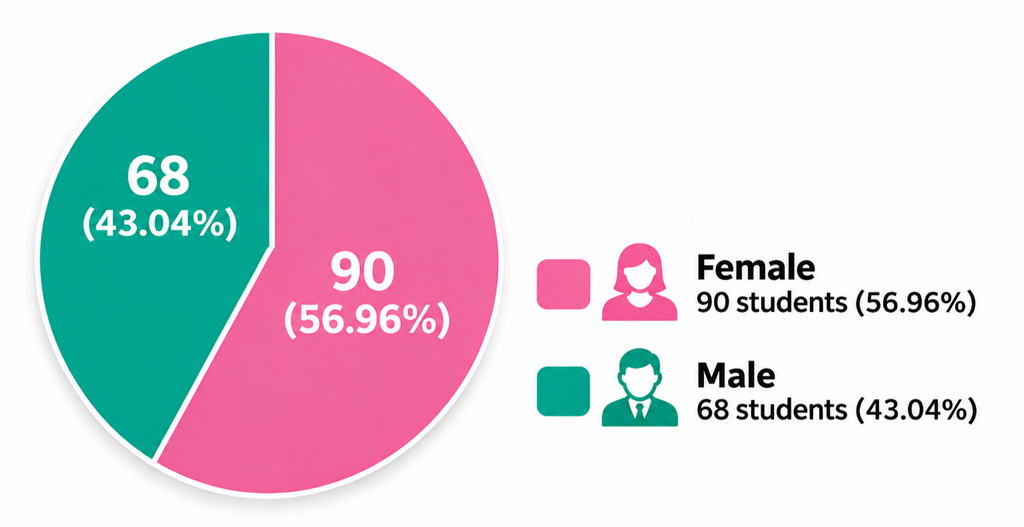
This substantial female participation demonstrates that women are actively included in and have access to the Faculty’s structured mentoring mechanism. Through their assigned mentors and mentor–mentee engagements, female students are provided with an established support network within the Faculty that facilitates academic guidance, personal development and continued engagement with academic staff.
The FUU Mentor–Mentee Programme therefore contributes to UKM’s wider institutional provision of mentoring opportunities for women. The 90 recorded female mentee entries from FUU can be consolidated with verified female participation in mentoring programmes across other UKM faculties to assess UKM’s overall performance against the THE Impact Ratings indicator concerning mentoring schemes in which at least 10% of female students participate.
Source: https://www.facebook.com/share/p/19ioxgDuND/
4. Department of Family Medicine, Faculty of Medicine – Mentor–Mentee System
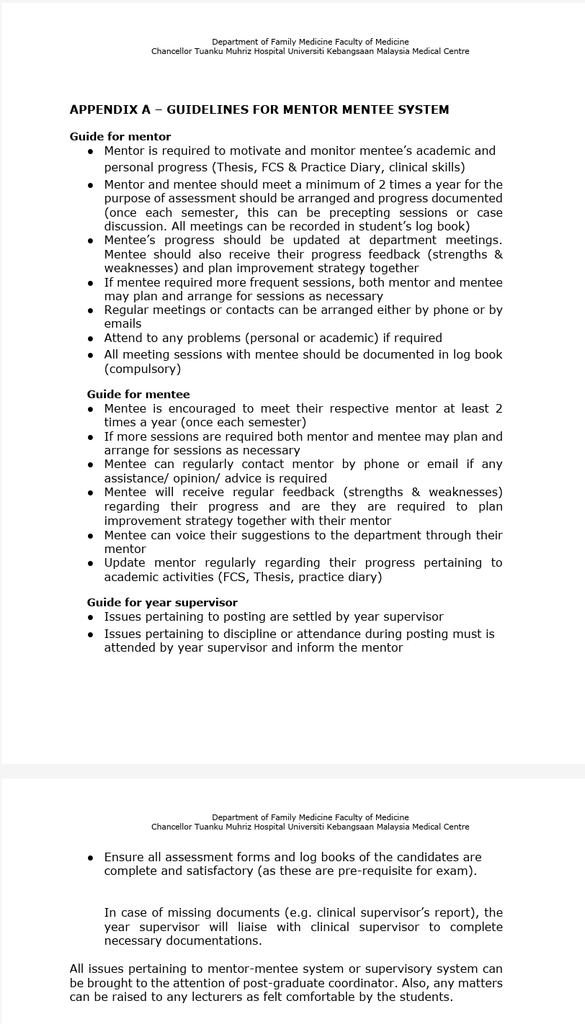
UKM, through the Department of Family Medicine, Faculty of Medicine, implements a structured Mentor–Mentee System to provide continuous academic and personal support to its students. The system is formally incorporated into the Department’s Postgraduate Study Guide 2025, which sets out specific responsibilities for mentors, mentees and year supervisors, demonstrating that mentoring is embedded within the Department’s academic support structure.
Under the system, mentors are responsible for motivating and monitoring the academic and personal progress of their mentees, including progress related to thesis work, Family Case Studies (FCS), Practice Diary and clinical skills. Mentors and mentees are expected to meet at least twice a year, normally once each semester, although additional sessions may be arranged whenever further guidance or support is required. Mentoring may also continue through telephone or email communication when students require assistance, opinions or advice.
An important feature of the scheme is its emphasis on continuous monitoring and documented mentoring. Students receive feedback concerning their strengths and areas requiring improvement and work together with their mentors to develop appropriate improvement strategies. Student progress may also be updated during departmental meetings, while all mentor–mentee meeting sessions are required to be documented in the student’s logbook. This provides an auditable mechanism demonstrating that mentoring interactions take place throughout the student’s academic progression.
The mentoring relationship extends beyond academic performance. Mentors may assist mentees with personal or academic problems, while mentees are able to communicate suggestions or concerns to the Department through their mentors. Consequently, the Mentor–Mentee System provides students with an established channel for academic guidance, professional development, feedback and personal support throughout their programme.
Source: https://www.ukm.my/spsfper/wp-content/uploads/2025/12/PG-Study-Guide-2025-2.pdf
5. Mentor–Mentee Programme – Faculty of Science and Technology (FST)
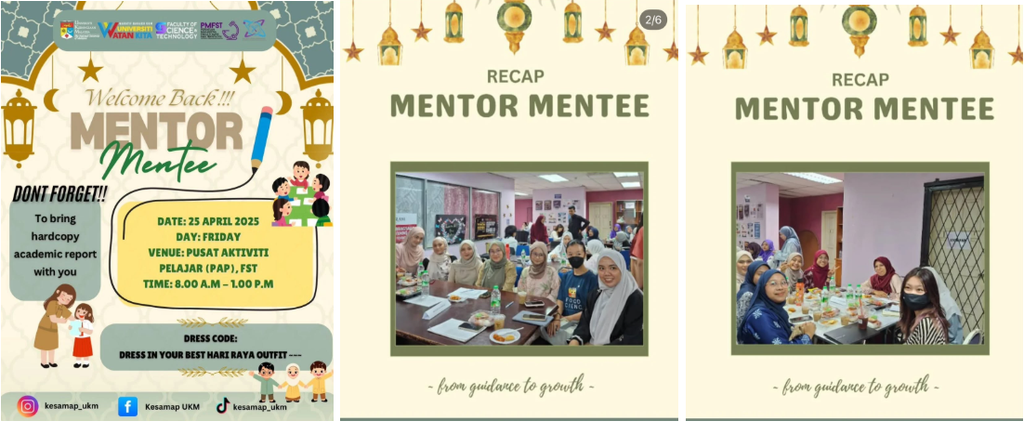
On 25 April 2025, the Food Science Students’ Association (KESAMAP), Faculty of Science and Technology, Universiti Kebangsaan Malaysia (UKM), organised a Mentor–Mentee Programme at the Student Activity Centre (PAP), FST. The programme provided students with an opportunity to meet their mentors and receive academic evaluation and guidance, supporting their academic development and progress. Through direct mentor–mentee engagement, the programme provides a structured support mechanism for students to discuss their academic performance and receive guidance from their assigned mentors.