
Protect, restore and promote sustainable use of terrestrial ecosystems, sustainably manage forests, combat desertification, and halt and reverse land degradation and halt biodiversity loss
SDG 15 Indicator
15.2 – Supporting Land Ecosystems Through Education
15.2.4 – Educational Programmes on Ecosystems
Universiti Kebangsaan Malaysia (UKM) demonstrates a strong and continuous commitment to ecosystem education, biodiversity conservation, and environmental stewardship, reinforcing its leadership in advancing Sustainable Development Goal (SDG) 15: Life on Land. Through a range of educational programs and community engagement initiatives, UKM bridges academic research with real-world conservation practices, empowering students and local communities to protect Malaysia’s unique ecosystems.
Key initiatives such as the Eco-Educational Tourism at Bangi Botanical Garden, Intensive Tree Identification Course At Fraser Hills, and the KAB Edutourism highlight UKM’s integrated approach to ecosystem learning. These programs combine scientific knowledge, field experience, and community participation to foster environmental awareness and hands-on learning about wild flora, fauna and natural habitats.
UKM educational Programmes on Ecosystems
| No | UKM educational Programmes on Ecosystems |
| 1 | Intensive Tree Identification Course At Fraser Hills |
| 2 | Eco-Educational Tourism at Bangi Botanical Garden |
| 3 | Faculty of Medicine Tree Planting and Beach Cleaning Community Services Program |
| 4 | Kolej Aminuddin Baki (KAB) Edutourism @ Chini Lake |
1. Intensive Tree Identification Course At Fraser Hills
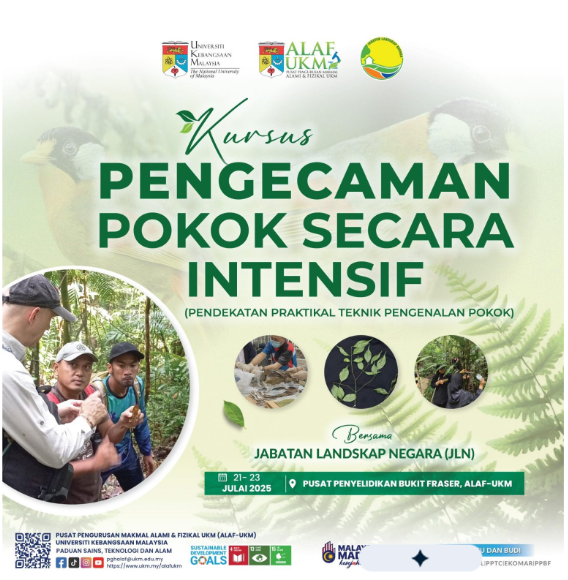
Universiti Kebangsaan Malaysia (UKM) offers educational programmes on ecosystems, particularly focusing on wild flora, forest biodiversity and ecological conservation, for local and national communities. One example is the Intensive Tree Identification Course: A Practical Approach to Tree Identification Techniques, organised by ALAF-UKM through the Fraser Hill Research Centre (PPBF) in strategic collaboration with the National Landscape Department (JLN), from 21–23 July 2025 at the Fraser Hill Research Centre.
The course provides participants with systematic and practical field-based training in tree species identification, while facilitating knowledge exchange among botanists, technical officers and landscape practitioners. Through hands-on learning, participants gain practical knowledge of forest flora and strengthen their professional capabilities in the conservation and management of upland forest biodiversity. The programme also reinforces Fraser Hill’s role as an important natural laboratory for ecological education and upland biodiversity research, demonstrating UKM’s commitment to extending ecosystem and biodiversity education beyond the university to local and national communities.
Source:
https://www.ukm.my/fraser/2025/07/22/kursus-pengecaman-pokok-secara-intensif-di-bukit-fraser/
https://www.facebook.com/share/v/1CBaD96yNa/
2. Eco-Educational Tourism at Bangi Botanical Garden
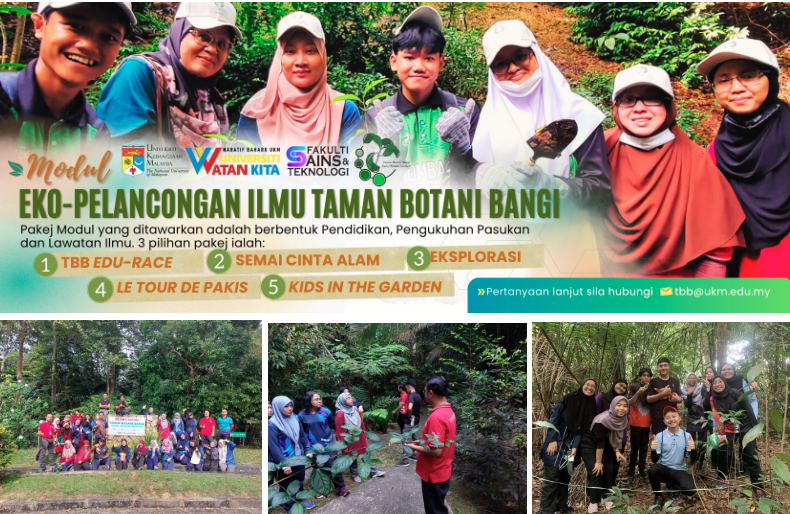
Universiti Kebangsaan Malaysia (UKM) offers educational programmes on ecosystems, with a focus on wild flora, fauna and biodiversity, through Taman Botani Bangi (Bangi Botanical Garden). Taman Botani Bangi serves as a natural laboratory that provides facilities and biological resources for research, education and environmental learning. It also offers eco-educational tourism packages designed to provide communities with experiential learning opportunities related to nature, ecosystems and biodiversity. The modules include Taman Botani Bangi EDU-RACE, Semai Cinta Alam, and Eksplorasi Mahabbah, which incorporate educational activities, team-building exercises and guided knowledge-based visits. Through these programmes, participants are exposed to the diversity and importance of wild flora and fauna while developing greater appreciation and awareness of ecosystem conservation. These initiatives demonstrate UKM’s commitment to extending environmental and biodiversity education beyond the university to local and national communities.
Source: https://www.ukm.my/tamanbotanibangi/pengenalan-modul/
3. Faculty of Medicine Tree Planting and Beach Cleaning Community Services Program
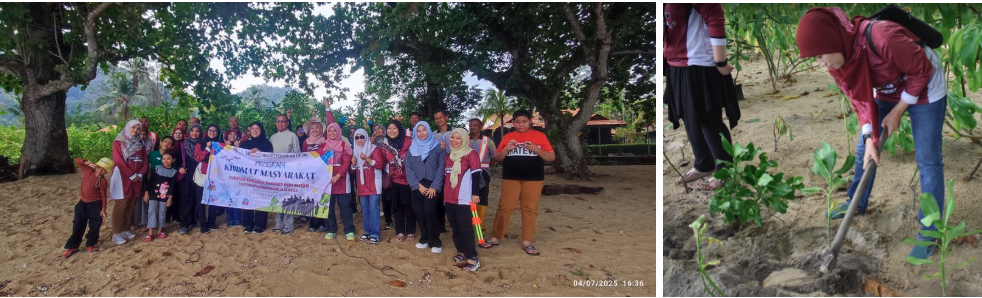
Universiti Kebangsaan Malaysia (UKM) offers educational and community-based programmes that promote awareness and conservation of ecosystems, including wild flora and fauna, for local communities. On 4 July 2025, the Department of Biochemistry, Faculty of Medicine, UKM, organised a community service programme at Pantai Pasir Bogak, Pulau Pangkor, in collaboration with Majlis Perbandaran Manjung. The programme engaged the local community in merambong tree planting and beach clean-up activities to support turtle nesting and coastal ecosystem conservation. Participants were introduced to the ecological importance of coastal vegetation, particularly the role of merambong in maintaining coastal habitats and supporting turtle conservation. Through hands-on environmental activities and community engagement, the programme strengthened public understanding of coastal ecosystems, wildlife conservation and responsible environmental stewardship, contributing to the sustainable protection of local flora and fauna.
Source: https://photos.google.com/share/AF1QipMmRmJNPpcPPe1KbfyxpH0bTcj2ibJHx66DKWEDFNX7Od304SuF0RQT8U5339IRPQ?key=Xzlob3pwS2NlWFlfN0dScW81aF85MjE1a2tHZHVB
4. Kolej Aminuddin Baki (KAB) Edutourism @ Chini Lake
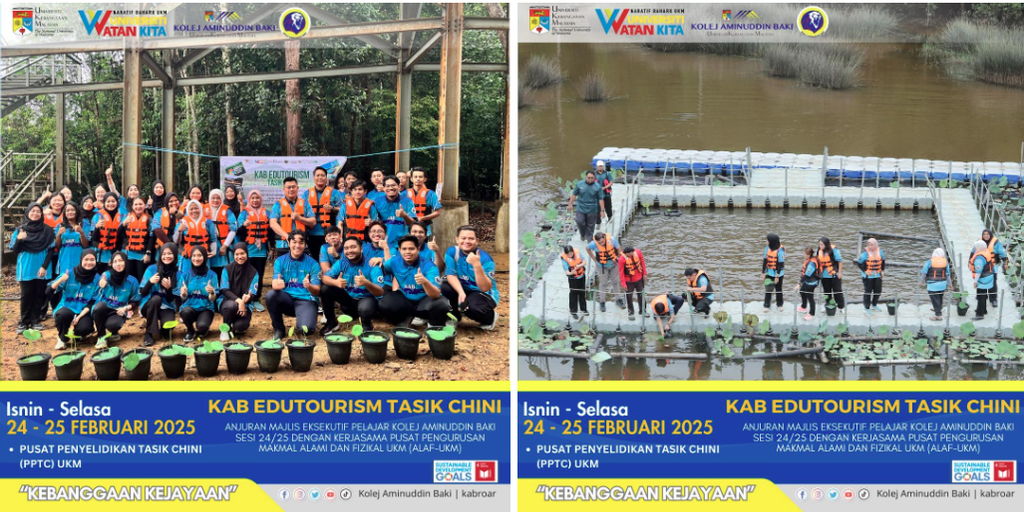
Universiti Kebangsaan Malaysia (UKM) offers educational programmes that promote ecosystem awareness, biodiversity conservation and responsible interaction with natural environments. On 24–25 February 2025, Kolej Aminuddin Baki (KAB), in collaboration with the UKM Natural and Physical Laboratory Management Centre (ALAF-UKM), organised the KAB Edutourism Programme at the Chini Lake Research Centre (PPTC). The programme integrated education, environmental sustainability and ecotourism, providing participants with a hands-on learning experience focused on the relationship between people and natural ecosystems. As part of the programme, 43 participants, including UKM international students, took part in the release of 25 young lotus plants into Chini Lake with the support of PPTC staff. The activity provided practical exposure to aquatic ecosystem conservation and the importance of protecting native flora and maintaining the ecological health of Lake Chini. Through experiential learning and direct engagement with the natural environment, the programme strengthened participants’ knowledge of biodiversity, ecosystem conservation and sustainable interaction with natural resources.
Source: https://www.facebook.com/share/p/16n3Z99wBk/
Together, these programmes demonstrate UKM’s contribution to ecological literacy through direct engagement with forest, freshwater and coastal environments. Combining scientific explanation with field experience helps participants understand the importance of flora, fauna and their habitats, while practical activities connect that understanding with responsible environmental action. By making its expertise and natural learning facilities available through education and outreach, UKM supports the knowledge and skills needed for ecosystem stewardship, advancing SDG 15: Life on Land.