
Ensure availability and sustainable management of water and sanitation for all
SDG 6 Indicator
6.5 – Water in the community
6.5.1 – Water management educational opportunities
Universiti Kebangsaan Malaysia (UKM) extends water-management education beyond campus through free outreach programmes that connect university expertise with schools, communities and practitioners. Its initiatives include the Water Scientist Programme (MySTIA): Clean Water, Healthy Generation, held with a school community in Bangi on 28 September 2025 and the International UNESCO Water Watch for Young Leaders Camp, held on 20–22 May 2025, involving 21 secondary schools and 18 expert instructors. Complemented by water-related learning modules and a workshop on microalgae applications in wastewater treatment, these activities provide opportunities to learn about river conservation, water quality, treatment technologies and responsible water use. Through practical learning and collaboration, UKM equips participants to support better water management within their schools, households and wider communities.
Summary of the education for local communities to learn about good water management.
| No | Educational Programs |
|---|---|
| 1 | FREE: MOOC UKM (Massive Open Online Courses) |
| 2 | FREE: Citra Course at UKM : LMCP1522 (Water Module ) |
| 3 | FREE: Microalgae Workshop II: I 2025: Strengthening Green Technology Innovation and Wastewater Treatment |
| 4 | FREE: Water Scientist Program (Mystia): Clean Water, Healthy Generation |
| 5 | FREE: Water Seminar: Integrated Water Research Synergy Consortium (IWaReS) |
Detail of the program can be found below:
1. Free Programs: MOOC UKM (Massive Open Online Courses)
UKM offers a range of Massive Open Online Courses (MOOC) designed to enhance access to education and promote lifelong learning. These online courses cover diverse topics, including environmental science, water management, sustainability, and various other academic disciplines. By utilizing modern technology, UKM MOOC provides flexible learning opportunities for students, professionals, and the general public, enabling them to engage with course materials at their own pace. The MOOC at UKM fosters a deep understanding of the intricate relationships between humans, rivers and water resources. They emphasize the critical importance of water for human survival, economic development, and environmental sustainability. Courses explore contemporary water-related challenges, such as water scarcity, pollution and climate change, encouraging participants to consider their roles in addressing these issues.

i. Activities
The courses typically start with an introductory journey into the water cycle and the significance of water in everyday life. Participants engage in interactive group discussions and presentations that delve into watershed management, highlighting the interconnectedness of water systems. Additionally, hands-on field activities enable learners to assess river water quality through bioindicators and chemical kits, providing practical experience in monitoring environmental health.
ii. Learning Outcomes
By the end of the MOOCs, participants will have a comprehensive understanding of water, rivers, and watershed concepts. They will recognize the vital role of integrated water management in addressing pressing water issues and promoting sustainable practices. The courses aim to equip learners with the knowledge and skills necessary to contribute to water conservation efforts and effective watershed management, fostering a culture of environmental stewardship within communities.
UKM MOOC initiative exemplifies the university’s commitment to enhancing educational accessibility and addressing global challenges related to water resources. By empowering individuals with knowledge and skills, UKM fosters a generation of environmentally conscious leaders capable of driving positive change in water management and conservation efforts.
iii. Environmental Science Course
The MOOC courses are open to all students and staff at UKM. The courses offered are organized by the Faculty of Science and Technology (FST) at UKM. The Environmental Science Course at MOOC UKM offers a comprehensive exploration of environmental issues and sustainable practices. The course is designed to provide participants with an understanding of the intricate relationship between humans and the environment, focusing on critical topics such as biodiversity, ecosystem services, climate change, pollution, and resource management.
The key features of the environmental science course:
- Introduction to Environmental Science: Participants will learn about the fundamental principles of environmental science, including the water cycle, ecosystems, and the impact of human activities on the environment.
- Current Environmental Issues: The course addresses pressing global environmental challenges, such as climate change, deforestation, pollution, and their socio-economic implications.
- Interactive Learning: The course includes interactive components such as group discussions, case studies, and practical assessments. Participants engage in activities like river water quality assessments using bioindicators and chemical kits.
- Integrated Water Management: Emphasis is placed on the importance of integrated water management strategies for sustainable development, focusing on watershed management and pollution prevention.
- Learning Outcomes: By the end of the course, participants will gain a solid understanding of environmental concepts, the significance of sustainable practices, and the skills necessary to address environmental challenges in their communities.
Overall, the Environmental Science course aims to empower participants with the knowledge and tools to promote environmental stewardship and contribute to sustainable development efforts. The Environmental Science course on MOOC UKM provides educational opportunities on water management to the public through various means, including interactive online modules, practical assignments, and case studies that focus on sustainable practices. Participants engage in discussions about current water issues, learn about integrated water management strategies, and explore the importance of water conservation. The course encourages active participation and aims to equip learners with the knowledge and skills necessary to address water management challenges effectively.
2. Free Programs: Citra Course at UKM : LMCP1522 (Water Module)
Water is the essence of life, intricately woven into the fabric of human existence and the natural environment. Rivers, as dynamic ecosystems, play a crucial role in supporting biodiversity, providing essential resources for drinking, irrigation, and sanitation, and shaping the landscapes we inhabit. The relationship between humans and rivers is multifaceted, encompassing cultural, economic, and ecological dimensions. Historically, rivers have served as lifelines for civilizations, facilitating trade, agriculture, and transportation. However, as urbanization and industrialization have intensified, this relationship has faced unprecedented challenges, including pollution, habitat destruction, and climate change. Understanding this complex interplay is vital for fostering sustainable water management practices and ensuring the health of both human communities and aquatic ecosystems.
i. Activities
Participants will embark on an introductory journey that explores the fundamental concepts of water and the water cycle. This segment emphasizes the significance of water in human life and highlights current issues such as water scarcity, contamination, and mismanagement. The program will include interactive group discussions focused on watershed management, where participants will analyze the challenges and strategies associated with maintaining healthy river systems. Additionally, hands-on field activities will enable participants to assess river water quality using bioindicators and chemical kits. These activities will provide practical insights into the methodologies used in water quality monitoring and the factors affecting aquatic ecosystems.
ii. Learning Outcomes
By the end of the program, participants will gain a comprehensive understanding of the concepts of water, rivers, and watersheds. They will appreciate the critical importance of water in sustaining life and the interconnectedness of human activities and aquatic health. Participants will also learn about the principles of integrated water management, equipping them with the knowledge and tools to address the vast array of water-related issues. This knowledge will empower them to advocate for sustainable practices and contribute to the protection of vital water resources within their communities.

3. Free Programs: Microalgae Workshop II: I 2025: Strengthening Green Technology Innovation and Wastewater Treatment
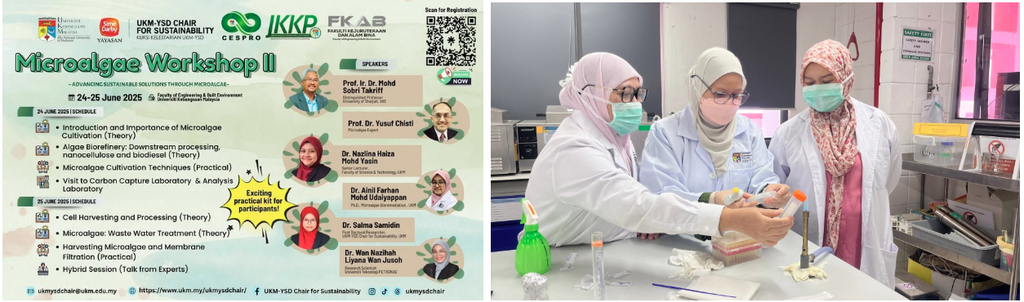
Held from June 24 to 25, 2025, the free “Microalgae Workshop II” was a high-level hybrid academic conference organized by the Centre for Sustainable Process Technology (CESPRO) and the UKM-YSD Chair for Sustainability, in collaboration with the Department of Chemical and Process Engineering (JKKP). The two-day program successfully gathered 23 international delegates, researchers, and industry practitioners from Malaysia, the Philippines, India, Bangladesh, and Indonesia. The workshop focused on exploring the vital role of microalgae in biorefineries, clean energy production, and sustainable wastewater treatment. This initiative created a substantial global and regional impact by successfully building collaborative academic and industrial networks across ASEAN and South Asia. By strengthening the technical capacity of scientists to implement bio-based renewable energy systems, the program reinforced UKM’s leadership in sustainable energy solutions and actively accelerated progress toward global low-carbon targets.
Source: https://www.facebook.com/share/p/1E4Sfx6V6b/
4. Free Programs: Water Scientist Program (Mystia): Clean Water, Healthy Generation
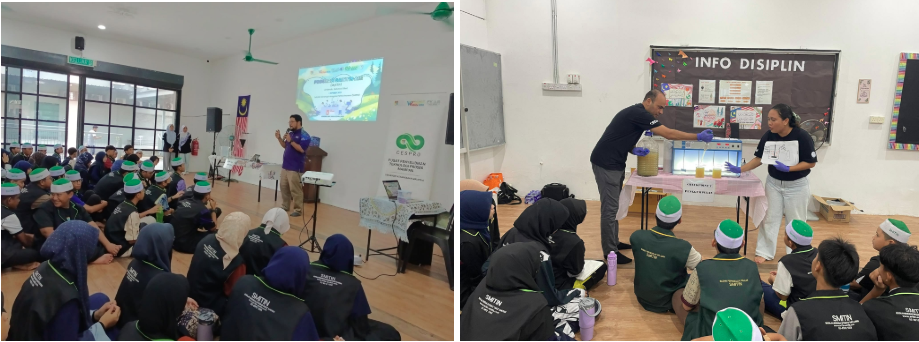
The Water Scientist Program (MySTIA): Clean Water, Healthy Generation program is a community service initiative program held on 28 September 2025 as a as a national -level initiative that organized by the Research Centre for Sustainable Process Technology (CESPRO), in collaboration with the Department of Chemical and Process Engineering, Faculty of Engineering and Built Environment, UKM and community of Sekolah Kebangsaan Integrasi Tahfiz Ilmuwan (SMITIN), Bangi. The program aims to share knowledge and expertise on the importance of river conservation and water treatment, particularly with school students. The program also provides a platform for students to enhance their awareness of the significance of river and water conservation. The implementation of such programs helps unite and expand ideas on the importance of rivers, fostering a lasting sense of responsibility and care for their preservation. Besides, to enhance students’ interest in Science, Technology, Engineering, and Mathematics (STEM) through water treatment technology.
Source: https://www.facebook.com/share/p/1RTXNxMmPN/
5. Free Programs: 1st International Unesco Water Watch For Young Leaders Camp 2025
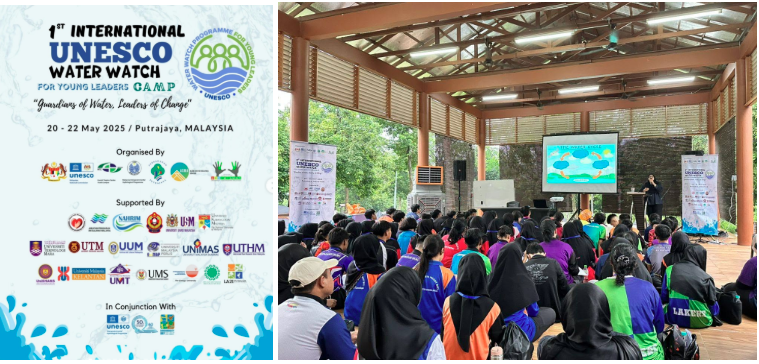
On 20- 22 May 2025, 1st International UNESCO Water Watch for Young Leaders Camp, a dynamic collaboration by UKM Ekorelawan, Perbadanan Putrajaya, Malaysian National Committee of IHP, Malaysian National Commission of UNESCO, Humid Tropics Centre Kuala Lumpur under the auspices of UNESCO, Alam Sekitar Malaysia Sdn. Bhd.and over 15 strategic partners. The program gathers 21 high schools from across the nation and 18 expert instructors from universities and agencies united to inspire the next generation of water and environmental leaders. Through interactive learning, practical activities, and leadership development, the programme equipped young participants with knowledge and skills to practise responsible water use and become advocates for water sustainability. The participants were encouraged to share their knowledge and influence positive water-use practices within their schools, families, and wider communities, contributing to greater awareness and conscious water consumption beyond the programme itself.
Source: https://www.facebook.com/share/p/197R5bQVxv/
Collectively, these initiatives demonstrate UKM’s contribution to community water education through accessible learning, practical engagement and partnerships. By connecting water science with everyday decisions, UKM helps participants understand how to conserve water, prevent pollution and protect river ecosystems. Its engagement with schools and young people also encourages knowledge sharing beyond individual programmes, extending opportunities for responsible water stewardship into families and communities. These efforts support SDG 6: Clean Water and Sanitation by building the knowledge and skills needed to care for shared water resources.