

Take urgent action to combat climate change and its impacts
SDG 13 Indicator
13.3 – Environmental education measures
13.3.4 – Inform and Support Government
Universiti Kebangsaan Malaysia (UKM) plays a pivotal role in informing, guiding and supporting government efforts in addressing climate change and disaster risks through science-based research, data-driven tools and strategic partnerships. By collaborating with national and regional agencies, UKM ensures that policy decisions and disaster management strategies are grounded in evidence, innovation, and sustainability. UKM collaborates with NGOs and other external stakeholders on climate adaptation through research, knowledge sharing, disaster risk reduction and climate resilience initiatives. These include the MyIKLIM Climate Change Research Data Curation Portal, the Kuala Lumpur Multi-Hazard Platform (KL-MHP), and the Stakeholder Workshop on Urban Heat Islands in Southeast Asia Megacities. These initiatives involve collaboration and engagement with NGOs, government agencies, researchers and community groups to strengthen climate-risk monitoring, early warning, adaptation planning and community resilience, highlighting its strong commitment to enhancing national preparedness, early warning systems and adaptive capacity. These programs strengthen Malaysia’s resilience against climate-related challenges while advancing regional cooperation in disaster risk reduction and low-carbon development.
Participant in informing and supporting the local or regional government in local climate change disaster/risk early warning and monitoring.
| No | Inform and support local or regional government in local climate change disaster/risk early warning and monitoring |
|---|---|
| 1 | The Kuala Lumpur Multi-Hazard Platform Featured at Global Platform for Disaster Risk Reduction 2025 (GPDRR 2025) |
| 2 | Data Curation portal for Climate Change Research in Malaysia (MyIKLIM) |
| 3 | Stakeholder Workshop Explores Urban Heat Islands in Southeast Asia Megacities |
1. The Kuala Lumpur Multi-Hazard Platform Featured at Global Platform for Disaster Risk Reduction 2025 (GPDRR 2025)
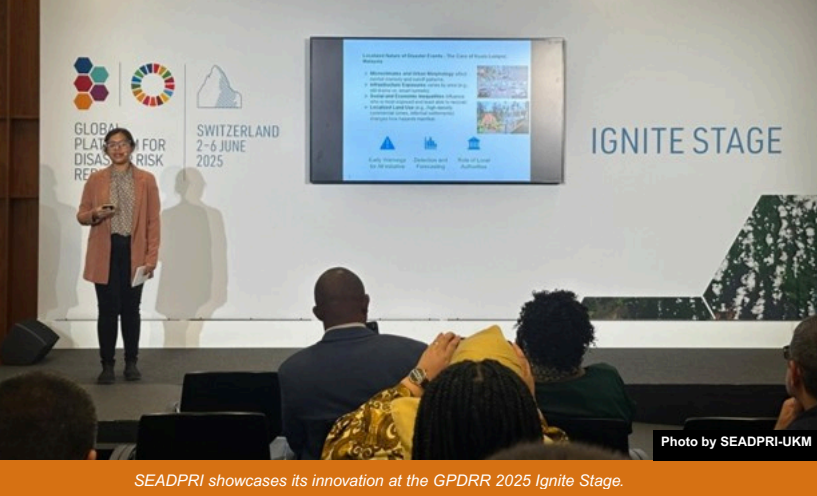
Universiti Kebangsaan Malaysia (UKM) supports local and regional authorities in climate-related disaster risk early warning and monitoring through the development of the Kuala Lumpur Multi-Hazard Platform (KL-MHP) by the Southeast Asia Disaster Prevention Research Initiative (SEADPRI-UKM). The innovative, data-driven platform integrates high-resolution meteorological, geophysical and atmospheric information, hazard modelling and monitoring capabilities to provide early warning and decision-support information for climate-related hazards, including floods, heatwaves and extreme weather events. Gs. Dr. Nurfashareena Muhamad from SEADPRI-UKM presented the KL-MHP as an outcome of strategic Malaysia–United Kingdom collaboration supported by the Newton-Ungku Omar Fund. The platform strengthens authorities’ capacity to monitor hazards, anticipate climate-related risks and make evidence-based decisions for disaster preparedness, risk reduction and climate adaptation, contributing to more resilient and climate-smart cities.
Source: https://www.ukm.my/seadpri/wp-content/uploads/2025/12/Buletin-SEADPRI_Bil.31_WEB_web.pdf , https://www.facebook.com/share/p/14tiLQPhnkG/
2. Data Curation portal for Climate Change Research in Malaysia (MyIKLIM)
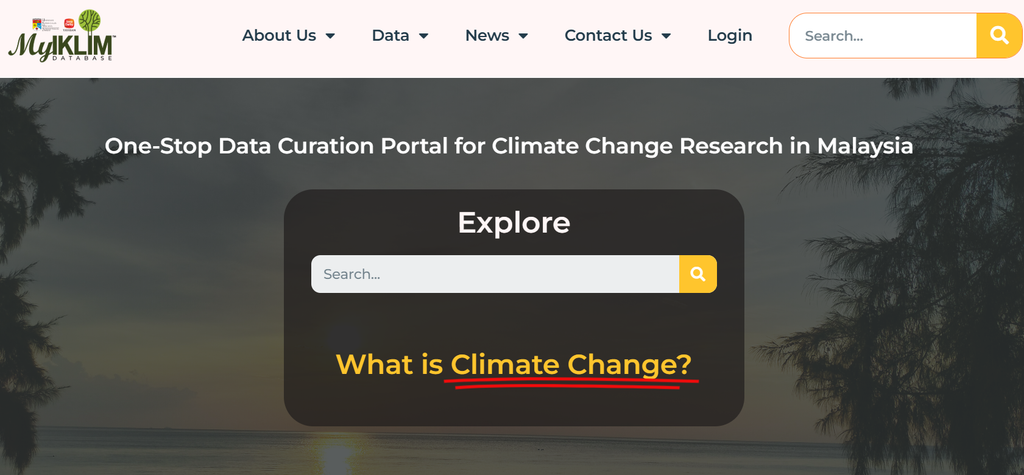
UKM has developed the OneStop Data Curation portal for Climate Change Research in Malaysia (MyIKLIM) aims to provide a comprehensive platform for climate change research data. It is a project under the UKM-YSD Chair for Sustainability under the Climate Change Mitigation Thrust Area. This tool helps local and regional governments enhance their early warning and monitoring capabilities for climate change related disasters. By offering accessible data, customised alerts, and a user friendly interface, myIKLIM supports proactive risk management and informed decision making, reinforcing UKM role in climate resilience and adaptation. The data are mainly provided and/or processed by researchers in a form that can be easily understood by the public. It is an interactive and informative platform where users can extract the information they need and get to know the people who are behind the dataset if they like to seek more information.
Source: https://myiklimysd.ukm.my/
3. Stakeholder Workshop Explores Urban Heat Islands in Southeast Asia Megacities
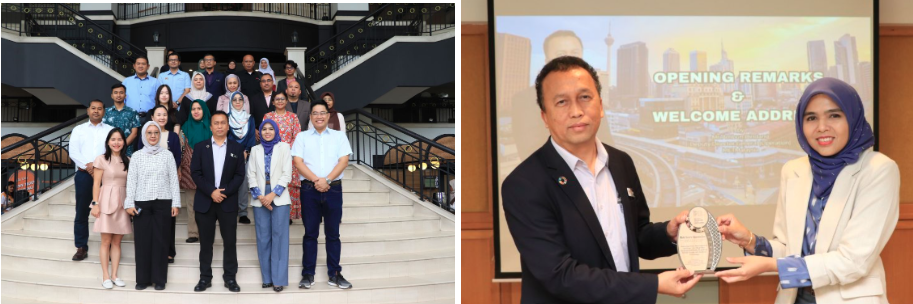
UKM collaborates with non-governmental organisations (NGOs), government agencies, academia and community groups on climate adaptation and urban resilience. On 27 August 2025, the Earth Observation Centre, Institute of Climate Change (IPI), UKM, hosted a stakeholder workshop and regional meeting titled “Assessing UHI in Southeast Asia Megacities: An Integrated Study of Land Use, Climate Change and Heatwave Occurrences.” The workshop brought together representatives from NGOs, government agencies, academia, community groups and international experts to strengthen collaborative approaches to urban heat and climate resilience, with Kuala Lumpur as the pilot study site. The collaboration focused on developing integrated assessment frameworks and identifying adaptation and mitigation measures for Urban Heat Island (UHI) and heatwave risks, including expanding urban green spaces and forests, adopting reflective and sustainable building materials, strengthening public awareness and encouraging community participation. Through stakeholder dialogue, knowledge exchange and joint development of practical solutions, UKM supports cross-sectoral efforts to strengthen urban resilience and help communities adapt to increasing heatwave and climate-related risks.
Source: https://www.ukm.my/beritaukm/stakeholder-workshop-explores-urban-heat-islands-in-southeast-asia-megacities/?fbclid=IwY2xjawT7NQxwZG9mBWV4dG4DYWVtAjExAHNydGMGYXBwX2lkEDIyMjAzOTE3ODgyMDA4OTIAAR6s5ENe8GwUfAggPhODgpQOGBQ45mq33zoZQnXrUxQhGPTyPcWmbRkHME6a_g_aem_HGP2naA5NOPiTCZMxE4vmQ
UKM strengthens climate-informed public decision-making by translating multidisciplinary research into accessible climate data, risk-assessment tools, technical advice and capacity-building. Through collaboration with government bodies and international partners, the university connects multi-hazard analysis, climate information and urban heat assessment with practical needs in preparedness, monitoring and resilience planning. These contributions provide a scientific basis for anticipating and managing climate-related risks, supporting Malaysia’s climate priorities and SDG 13: Climate Action. Documenting how local and regional authorities receive and apply these outputs would demonstrate their contribution to policy and practice, strengthen accountability and guide further collaboration. By connecting scientific expertise with public-sector needs, UKM supports informed climate decisions and coordinated action towards a more resilient future.