
Conserve and sustainably use the oceans, seas and marine resources for sustainable development
SDG 14 Indicator
14.3 – Supporting Aquatic Ecosystems Through Action
14.3.4 – Technologies Towards Aquatic Ecosystem Damage Prevention (Direct Work)
Universiti Kebangsaan Malaysia (UKM) actively contributes to preventing damage to aquatic ecosystems through scientific research, technological innovation and strategic collaborations, aligned with SDG 14: Life Below Water. UKM’s key initiatives include international research on sustainable aquaculture and freshwater conservation, climate-resilient aquaculture in Sabah, and Vessel Monitoring System (VMS) technology for sustainable fisheries management in Pahang waters. UKM also supports efforts to combat plastic pollution, including in marine environments, through its involvement in the Global Plastics Treaty advisory process. Additionally, research on common seahorse (Hippocampus kuda) populations, fish biodiversity in Tok Bali, and microplastic contamination in Merambong Shoal contributes to marine biodiversity conservation and ecosystem monitoring. Collectively, these seven initiatives demonstrate UKM’s commitment to advancing sustainable marine industry practices, reducing environmental impacts and protecting aquatic ecosystems through evidence-based research and innovation.
UKM Research Technologies Towards Aquatic Ecosystem Damage Prevention
| No | Technologies Towards Aquatic Ecosystem Damage Prevention (Direct Work) |
| 1 | International Research Collaboration on Sustainable Aquaculture and Freshwater Ecosystem Conservation |
| 2 | Collaborative Research on Climate-Resilient Aquaculture and Marine Ecosystem Protection in Sabah |
| 3 | Research on Vessel Monitoring System (VMS) Technology for Sustainable Fisheries Management in Pahang Waters |
| 4 | Direct Work to Preventing Plastic Pollution, Protecting Marine Ecosystems and Advancing Sustainable Marine Industry Practices |
| 5 | Population Status of Common Seahorse, Hippocampus Kuda, in the Urban Seagrass Meadow of Merambong Shoal |
| 6 | Research On Fish Biodiversity In Tok Bali, Kelantan, Malaysia: An Integrative Taxonomic Approach For Sustainable Fisheries Management And Conservation And Fish Biodiversity In Tok Bali, Kelantan, Malaysia: An Integrative Taxonomic Approach For Sustainable Fisheries Management And Conservation By Dr. Danial Hariz Bin Zainal Abidin. |
| 7 | Research On the Prevalence Of Common Seahorse, Hippocampus Kuda, Along The Merambong Shoal Seagrass Meadow At Different Seagrass Density And Microplastic Contamination In Marine Environments: Implications On The Growth And Behaviour Of Coral Fish, Wrasse (Labridae Spp.) by Ts. Dr. Noorashikin Binti Md Noor. |
1. International Research Collaboration on Sustainable Aquaculture and Freshwater Ecosystem Conservation
Universiti Kebangsaan Malaysia (UKM), through Dr. Noorashikin Md Noor, a researcher at the Earth Observation Centre, Institute of Climate Change (IPI), contributed to an international research study entitled “Growth Dynamics, Reproductive Biology, and Nutritional Profiling of the Freshwater Mussel Lamellidens marginalis: Implications for Wild Stock Conservation and Sustainable Aquaculture Development,” published on 13 August 2025 in Frontiers in Sustainable Food Systems. The research involved collaboration with researchers from Bangladesh, Australia, Brunei Darussalam and Saudi Arabia to investigate sustainable freshwater mussel cultivation, reproductive patterns, environmental conditions and conservation of natural populations.
The findings provide scientific insights into sustainable aquaculture practices, including appropriate harvesting periods, reproductive management and cultivation approaches that could reduce pressure on wild mussel populations. The research supports the development of environmentally responsible aquaculture practices while promoting aquatic biodiversity conservation and reducing ecological impacts associated with unsustainable harvesting. Through this research, UKM contributes to advancing sustainable aquaculture technologies and ecosystem protection practices, supporting SDG 14 (Life Below Water).
2. Collaborative Research on Climate-Resilient Aquaculture and Marine Ecosystem Protection in Sabah
Universiti Kebangsaan Malaysia (UKM), through the Institute of Climate Change (IPI) and Faculty of Social Sciences and Humanities (FSSK), collaborated with Universiti Malaysia Sabah (UMS) and WorldFish on a research initiative entitled “Listening to Coastal Voices: Strengthening Aquaculture Resilience in Sabah,” reported in the July–December 2025 IPI e-Bulletin.
The research involved direct engagement with coastal communities and aquaculture stakeholders in Sabah to investigate climate-related challenges affecting marine ecosystems and aquaculture activities. Researchers integrated climate science, ecological expertise and local knowledge to identify suitable aquaculture species, climate-resilient farming systems and sustainable adaptation practices addressing rising sea temperatures, changing salinity, coastal degradation and extreme weather. The initiative also promoted gender-inclusive, community-based aquaculture approaches, ensuring that women, youth and vulnerable coastal communities participated in discussions on sustainable marine resource management.
This research contributes to the development of environmentally responsible and climate-resilient aquaculture practices by providing scientific guidance on suitable species selection, farming systems and adaptation strategies.The project also enhances knowledge exchange between researchers and aquaculture communities, supporting the marine industry’s transition towards more sustainable operations.
3. Research on Vessel Monitoring System (VMS) Technology for Sustainable Fisheries Management in Pahang Waters
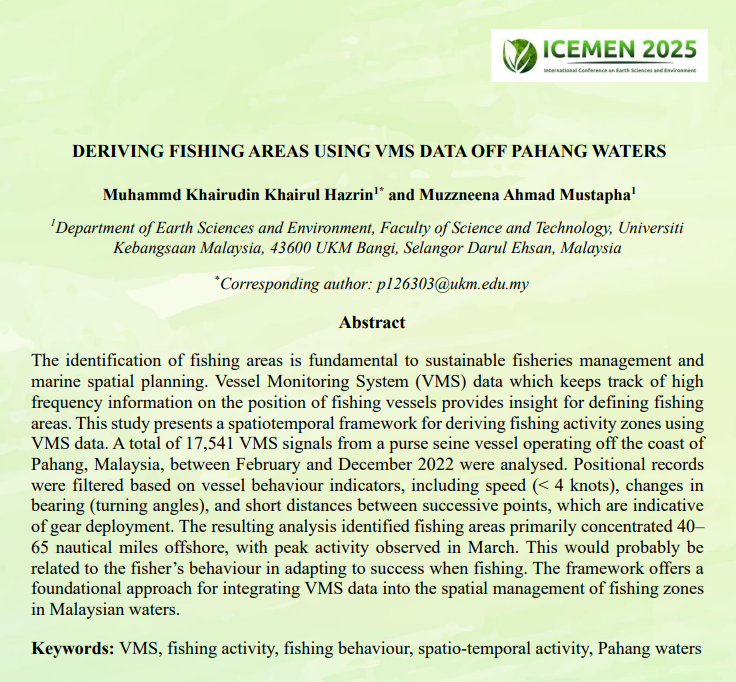
Universiti Kebangsaan Malaysia (UKM), through researchers Muhammad Khairudin Khairul Hazrin and Muzzneena Ahmad Mustapha from the Department of Earth Sciences and Environment, Faculty of Science and Technology (FST), conducted a study entitled “Deriving Fishing Areas Using VMS Data off Pahang Waters,” presented at the International Conference on Earth Sciences and Environment (ICEMEN 2025). The research utilised Vessel Monitoring System (VMS) technology to analyse 17,541 positional signals from purse seine fishing vessels operating off Pahang. By examining vessel movements, speeds and turning patterns, the study identified major fishing zones approximately 40–65 nautical miles offshore, providing a scientific framework for sustainable fisheries management and marine spatial planning. This research supports the marine industry’s transition towards environmentally responsible fishing practices by enabling more effective monitoring of fishing activities, improving fishing zone management and potentially reducing pressure on sensitive marine habitats. The findings provide valuable scientific insights for fisheries authorities and industry stakeholders to minimise ecological disturbances, prevent unsustainable fishing practices and strengthen the long-term conservation of marine biodiversity and aquatic ecosystems.
4. Direct Work to Preventing Plastic Pollution, Protecting Marine Ecosystems and Advancing Sustainable Marine Industry Practices
Universiti Kebangsaan Malaysia (UKM) is committed to advancing sustainable marine industry practices through scientific research, technological innovation, and strategic engagement with government agencies, industries, and international organisations. These efforts focus on preventing and reducing plastic pollution, including pollution affecting the marine environment, minimising environmental damage to aquatic ecosystems, protecting marine biodiversity, and promoting sustainable resource management. UKM’s commitment is further demonstrated through the 2025 appointment of Ir. Dr. Nor Yuliana Yuhana as a National Advisory Panel Member for the Global Plastics Treaty by Malaysia’s Ministry of Natural Resources and Environmental Sustainability (NRES). This appointment highlights UKM’s contribution of scientific and technical expertise to national and international efforts to develop a legally binding instrument addressing plastic pollution, including in the marine environment.
5. Population Status of Common Seahorse, Hippocampus Kuda, in the Urban Seagrass Meadow of Merambong Shoal
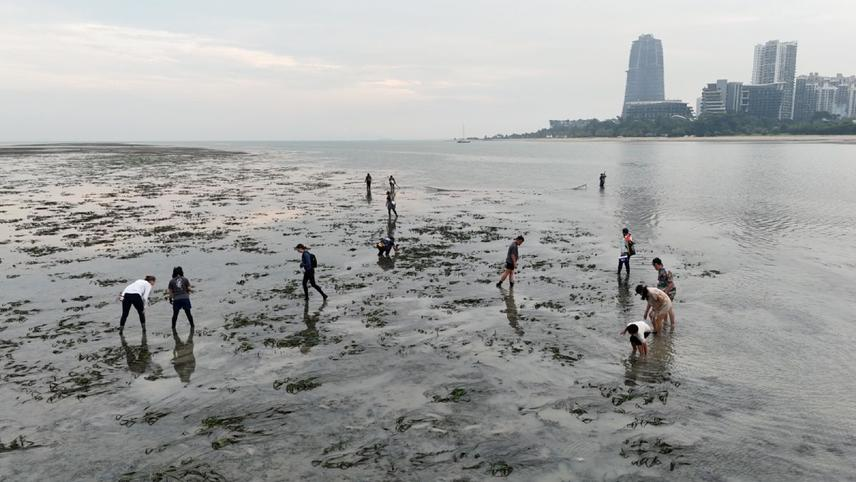
The project titled “Population Status of Common Seahorse, Hippocampus kuda, in the Urban Seagrass Meadow of Merambong Shoal”, supported by the The Rufford Foundation and led by Wong Jieyi UKM postgraduate Student, Supervised by Dr Wee Hin Boo, focuses on assessing and protecting a vulnerable seahorse species in one of Malaysia’s largest seagrass meadows located between highly urbanised zones (Forest City, Johor and Tuas, Singapore). The research highlights that Hippocampus kuda is heavily exploited for aquarium trade and traditional medicine, while its seagrass habitat is threatened by urban development. The study aims to gather baseline data on population status using monthly field surveys and tagging, as well as to understand seahorse–seagrass interactions, a method employing technology and scientific monitoring to inform conservation measures.
By establishing robust data on seahorse populations and their habitats, this project contributes actionable knowledge for ecosystem damage prevention. It supports strategies to mitigate habitat degradation and species decline, thereby aligning with the theme of technological and research-based interventions for aquatic ecosystem protection.
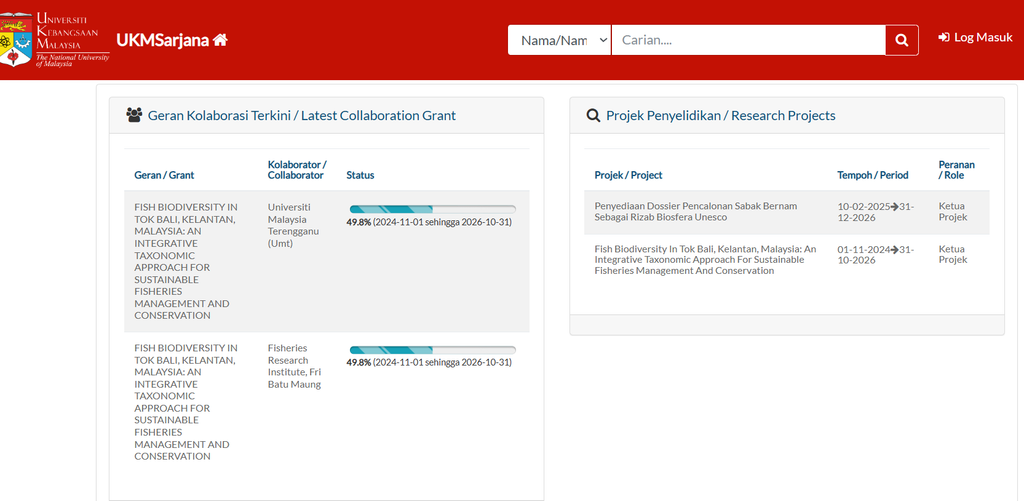
6. Research On Fish Biodiversity In Tok Bali, Kelantan, Malaysia: An Integrative Taxonomic Approach For Sustainable Fisheries Management And Conservation And Fish Biodiversity In Tok Bali, Kelantan, Malaysia: An Integrative Taxonomic Approach For Sustainable Fisheries Management And Conservation By Dr. Danial Hariz Bin Zainal Abidin.
The research was led by Dr. Danial Hariz bin Zainal Abidin, titled “Fish Biodiversity in Tok Bali, Kelantan, Malaysia: An Integrative Taxonomic Approach for Sustainable Fisheries Management and Conservation duration of 1 November 2024 to 31 October 2026. This study employs integrative taxonomy, combining morphological and molecular techniques to accurately identify and classify fish species within the Tok Bali ecosystem.
The research provides critical insights into fish diversity, population health, and habitat conditions, serving as a scientific foundation for sustainable fisheries management and conservation planning. By leveraging advanced technologies in molecular biology, environmental DNA (eDNA) analysis, and biodiversity monitoring, UKM enhances early detection of ecosystem changes and supports strategies to prevent overexploitation, habitat loss, and aquatic pollution.
Source: https://ukmsarjana.ukm.my/main/lihat_profil/SzAyNjA4NA==
7. Research On the Prevalence Of Common Seahorse, Hippocampus Kuda, Along The Merambong Shoal Seagrass Meadow At Different Seagrass Density And Microplastic Contamination In Marine Environments: Implications On The Growth And Behaviour Of Coral Fish, Wrasse (Labridae Spp.) by Ts. Dr. Noorashikin Binti Md Noor.
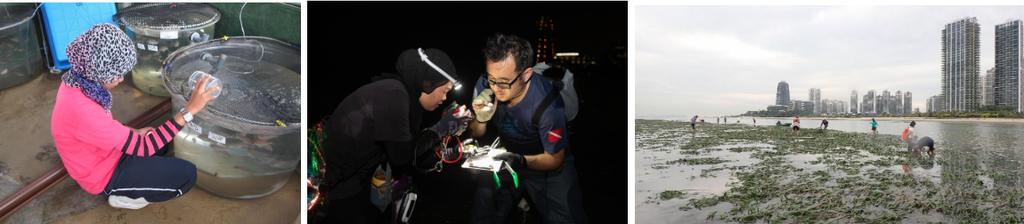
On going research by Ts. Dr. Noorashikin Binti Md Noor on Prevalence Of Common Seahorse, Hippocampus Kuda, Along The Merambong Shoal Seagrass Meadow At Different Seagrass Density And Microplastic Contamination In Marine Environments: Implications On The Growth And Behaviour Of Coral Fish, Wrasse (Labridae Spp.) duration of 1 November 2024 to 31 October 2026. These research projects contribute to understanding the relationship between habitat quality, seagrass density, and species population health, as well as the ecotoxicological effects of microplastic pollution on marine organisms. By combining field sampling, behavioral observation, and laboratory-based microplastic analysis, the studies generate valuable data for the management of sensitive marine habitats such as seagrass meadows and coral ecosystems. Through such research, UKM strengthens its role in developing technologies and strategies to prevent aquatic ecosystem damage, particularly in biodiversity hotspots vulnerable to pollution and habitat degradation.
Source: https://ukmsarjana.ukm.my/main/lihat_profil/SzAyNDI0OQ==
Through its continuous research, technological innovation and collaborative partnerships, Universiti Kebangsaan Malaysia (UKM) demonstrates its strong commitment to minimising and preventing damage to aquatic ecosystems. From sustainable freshwater and climate-resilient aquaculture research to Vessel Monitoring System (VMS) applications, fish biodiversity assessments, seahorse population monitoring and investigations into microplastic contamination in seagrass habitats, these initiatives highlight UKM’s integrated approach to marine ecosystem protection. Collectively, these research efforts generate valuable scientific evidence to support sustainable fisheries management, responsible aquaculture practices, biodiversity conservation and informed environmental decision-making.
Aligned with the UKM Sustainability Strategic Plan 2030, these initiatives reinforce the university’s commitment to advancing science-based solutions for sustainable marine resource management and ecosystem resilience. By integrating ecological research, technological applications and stakeholder engagement, UKM contributes to the development of environmentally responsible practices that can help marine industries minimize ecological disturbances, protect vulnerable aquatic habitats and support Malaysia’s transition towards a sustainable and resilient blue economy. These efforts further strengthen UKM’s contribution to SDG 14 (Life Below Water), promoting the long-term conservation of aquatic biodiversity and the well-being of coastal communities for future generations.