


Conserve and sustainably use the oceans, seas and marine resources for sustainable development
SDG 14 Indicator
14.5 – Maintaining a local ecosystem
14.5.5 – Watershed Management Strategy
Universiti Kebangsaan Malaysia (UKM) is deeply committed to integrated watershed management and biodiversity conservation, focusing on safeguarding aquatic ecosystems and enhancing their ecological resilience. Through science-based management strategies, UKM integrates biodiversity data, aquatic species monitoring, and community participation to sustain freshwater habitats, particularly within the Tasik Chini UNESCO Biosphere Reserve, one of Malaysia’s most significant ecological treasures.
Under the Watershed Management Strategy Program, UKM has implemented key initiatives such as the Sustainable Lotus Conservation Project and the Fish Seed Release Program at Tasik Chini. The Sustainable Lotus Conservation Project, led by the Tasik Chini Research Centre (PPTC) in collaboration with FRIM, ECERDC, and the local Orang Asli community, focuses on restoring the lotus population through innovative floating nurseries and community-based replanting. Meanwhile, the Fish Seed Release Program, involving the reintroduction of over 21,000 native Lampam Sungai and Baung fish species, aims to restore the ecological balance of the lake’s aquatic biodiversity. Together, these programs exemplify UKM’s holistic approach to watershed management, combining conservation science, technological innovation and local engagement to preserve natural heritage and ecosystem vitality.
Watershed Management Strategy Programs
| No | Watershed Management Strategy Programs |
| 1 | Sustainable Lotus Conservation in Chini Lake for Continuity of Biosphere Heritage. |
| 2 | UKM Release of Fish Seeds at Tasik Chini UNESCO Biosphere Reserve Site. |
1. Sustainable Lotus Conservation in Chini Lake for Continuity of Biosphere Heritage.
The lotus (Nelumbo nucifera) is an aquatic plant species that is synonymous with and serves as the main identity of Tasik Chini. In the past, this plant thrived abundantly and formed vast stretches of pink blossoms covering parts of the lake surface, contributing significantly to the area’s aesthetic value, ecological importance, and tourism attraction. However, in recent years, the lotus population in Tasik Chini has shown a significant declining trend due to various environmental factors.
One of the main factors identified was the annual northeast monsoon floods, which caused the lotus habitat areas to remain submerged for prolonged periods. This condition adversely affected the growth, survival rate, and natural reproductive process of the species. In addition, fluctuations in water levels and changes in the lake environment also impacted the stability of the lotus aquatic habitat.
In response to this issue, the Forest Research Institute Malaysia (FRIM), the East Coast Economic Region Development Council (ECERDC), and the Pusat Penyelidikan Tasik Chini (PPTC, UKM) established a strategic collaboration to conduct research and implement lotus conservation projects in Tasik Chini. This initiative aimed to develop more effective and sustainable conservation methods to ensure the long-term preservation of the lotus population in the area.
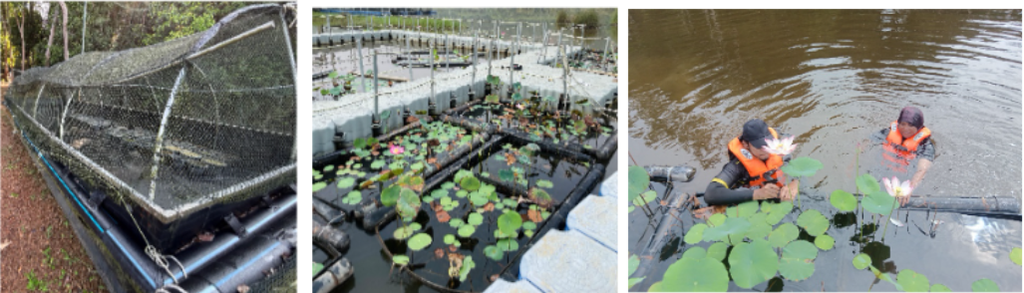
To address the issue of lotus habitats being submerged due to flooding, the Forest Research Institute Malaysia (FRIM) introduced a conservation approach using a flotilla system and floating nursery. This approach involved the construction of specially designed floating nursery ponds that enabled lotus plants to survive and continue growing despite rising water levels during the flood season.
The floating nursery structures were constructed using High-Density Polyethylene (HDPE), a petroleum-based thermoplastic polymer known for its high resistance to environmental stress, corrosion, and various chemicals. In addition, HDPE possesses strong durability against temperature changes, making it suitable for long-term applications in aquatic environments.
The floating nursery ponds were designed with dimensions of 2.80 metres in length, 4.50 metres in width, and 0.90 metres in height, and were equipped with support pipes measuring 152 mm in diameter to ensure structural stability while floating. The flotilla system consisted of several floating nursery units arranged around a square-shaped main pontoon on the lake surface and connected to the mainland to facilitate regular monitoring, maintenance, and project management activities.
Funded by ECERDC and implemented by FRIM together with PPTC and ALAF-UKM, the project involves the construction of nine nursery ponds and 50 units of floating lotus (flotilla) in Tasik Chini shown in This initiative aims to restore the declining lotus population and preserve the lotus as an iconic symbol of Tasik Chini. In addition, it focuses on researching and implementing innovative conservation measures to ensure the long-term survival of the lotus plants and the health of their ecosystem for future generations.
The program centers on replanting lotus using specially designed floating flotillas that serve as nurseries in the lake, followed by the natural replanting of lotus plants in targeted areas. The implementation of this conservation project was expected to help restore the lotus population in Tasik Chini, while also supporting efforts to preserve the aquatic ecosystem and maintain the natural heritage value of Tasik Chini as a recognised Biosphere Reserve.
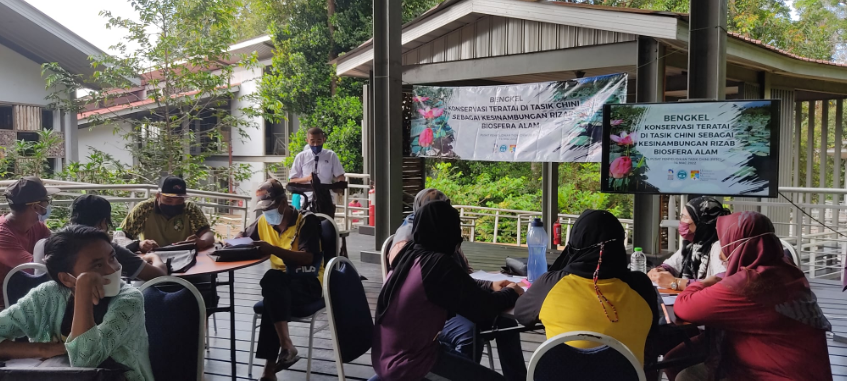
On 14 March 2022, the Forest Research Institute Malaysia (FRIM), together with the East Coast Economic Region Development Council (ECERDC) and Tasik Chini Research Center (PPTC, UKM), organised a Lotus Conservation Workshop at Tasik Chini as part of the continuation of the Biosphere Reserve initiative in Malaysia. The workshop, which was held at PPTC, aimed to enhance knowledge and awareness among stakeholders regarding the importance of conserving the sustainable ecosystem of Tasik Chini, as well as to provide training in the preparation of lotus planting stocks and flotilla construction methods. The workshop, conducted through both theoretical sessions and practical field training, focused on basic lotus cultivation techniques using seeds and seedlings.
https://www.facebook.com/pptcukm/posts/pfbid02XPKxo3g5VPxqPJkYH1fwwEvsKifvkAAwkZVNsFtq8Hec8UecA9DK357b3Dzebf6zl
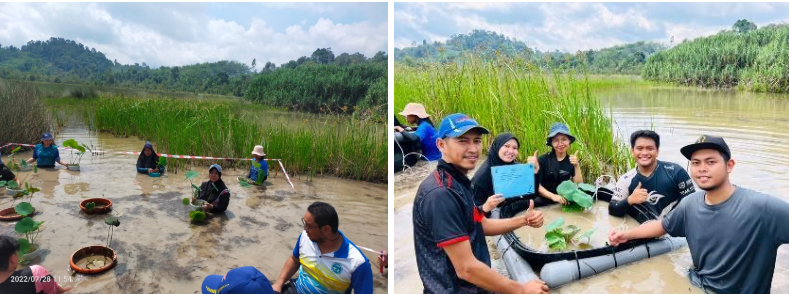
The Forest Research Institute Malaysia (FRIM), together with the East Coast Economic Region Development Council (ECERDC) and the Tasik Chini Research Center (PPTC, UKM), organised the Lotus Planting Workshop for the Conservation of the Tasik Chini Biosphere Reserve on 27–28 July 2022. The workshop, which was conducted through both theoretical sessions and practical field activities, focused on two conservation methods for lotus plants: cultivation through seeds and the use of flotilla systems.
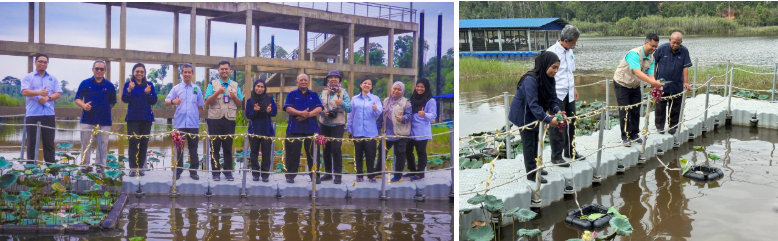
On 1 August 2023, the East Coast Economic Region Development Council (ECERDC) officially handed over the assets of the Sustainable Lotus Conservation Project at Tasik Chini to the Tasik Chini Research Center (PPTC, UKM) for management (Figure 1.18.13). This transfer was carried out as part of an ecotourism and conservation initiative aimed at strengthening long-term stewardship of the project assets. It also supported ongoing efforts to conserve lotus populations, enhance ecosystem sustainability, and promote Tasik Chini as both a conservation site and an educational ecotourism destination.
https://www.ukm.my/alafukm/majlis-penyerahan-projek-konservasi-teratai-secara-lestari-di-tasik-chini-bagi-kesinambungan-rizab-biosfera-kepada-pptc-alaf-ukm/
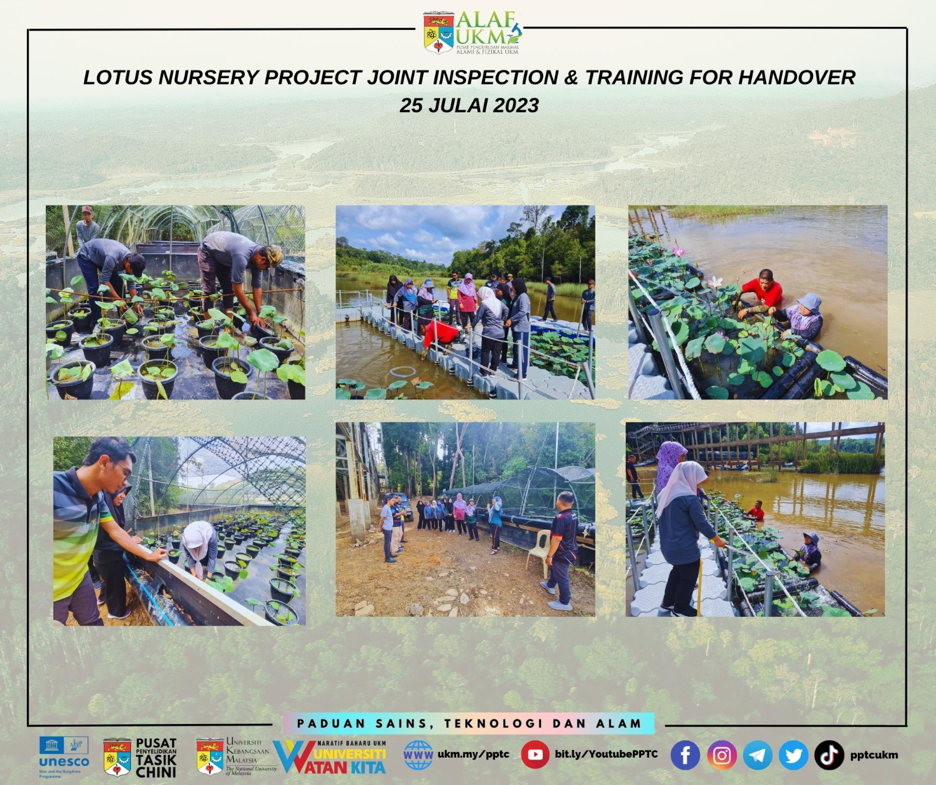
A joint inspection of the ECERDC–FRIM–PPTC Lotus Nursery Project was conducted in July 2023 to evaluate the progress and outcomes of the nursery site development project. The inspection focused on assessing the effectiveness of the floating lotus propagation innovation introduced as part of the conservation initiative at Tasik Chini. The evaluation involved observations on the growth performance, survival rate, and adaptability of the lotus plants cultivated through the floating nursery system, particularly under changing water levels and environmental conditions within the lake ecosystem. The inspection also aimed to determine the suitability and long-term potential of the floating propagation method as a sustainable conservation approach for restoring lotus populations in Tasik Chini.
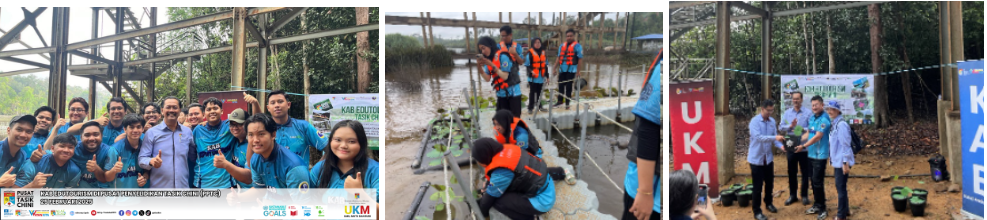
On 25 February 2025, a lotus conservation programme was carried out under the KAB Edutourism Tasik Chini initiative through a collaboration between a group of students from Kolej Aminuddin Baki, Universiti Kebangsaan Malaysia, and the Centre for Management of Natural and Physical Laboratories (ALAF-UKM). One of the main activities of the programme was lotus planting, along with participants’ involvement in the International Biosphere Reserve Day Celebration held at the Pusat Penyelidikan Tasik Chini (PPTC). During the programme, a total of 25 lotus seedlings were released into Tasik Chini with the assistance of PPTC staff. Participants were also given the opportunity by ALAF-UKM to set up a KAB Edutourism exhibition space at the PPTC Gallery in conjunction with the International Biosphere Reserve Day Celebration @ Tasik Chini.
https://www.ukm.my/pptc/kab-edutourism-di-pusat-penyelidikan-tasik-chini-pptc/
2. UKM Release of Fish Seeds at Tasik Chini UNESCO Biosphere Reserve Site
Tasik Chini has also become a domestic and international tourist attraction due to its uniqueness and rich biodiversity of flora and fauna, including the beauty of the lotus flower (Nelumbo nucifera), which once bloomed extensively across the lake surface. However, the population of this aquatic plant has gradually declined following the construction of a spillway dam, which disrupted the river’s hydrological dynamics. This disturbance affected the balanced inflow and outflow of water and consequently caused negative impacts on the lake ecosystem. Based on the issue of declining fish species in Tasik Chini, the Department of Fisheries Malaysia (DOF), in collaboration with the Pusat Penyelidikan Tasik Chini (PPTC, UKM), assisted in releasing fish species that are economically important to the local community. The following are the fish species and the number of fish released in Tasik Chini from 2014 to 2025.
Table: Fish species list and density rank in Tasik Chini
| Year | Conservation Program | Species and Number of Individuals (fish) |
| 2014 | Restocking of Juvenile Fish | Hampala macrolepidota (200) Anabas testidineus (300) Barbodes schwenenfeldii (500) |
| 2015 | Restocking of Juvenile Fish | Barbodes schwenenfeldii (500) Probarbus jullieni (500) |
| 2016 | Restocking of Juvenile Fish | Hemibagrus nemurus (100) |
| 2017 | Restocking of Juvenile Fish | Barbodes schwenenfeldii (35,000) Osteochilus vittatus (5,000) |
| 2018 | Restocking of Juvenile Fish | Hypsibarbus (500) Hemibagrus nemurus (3,000) Barbodes schwenenfeldii (3,000) Tor tambra (70) |
| 2019 | Restocking of Juvenile Fish | Barbodes schwenenfeldii (5,500) Puntiuplites bulu (200) Hypsibarbus (400) Hemibagrus nemurus (1,500) |
| 2021 | Restocking of Juvenile Fish and Freshwater Prawns | Hemibagrus nemurus (3,000) Sclerophagus Formosus (18) Hypsibarbus (300) Barbodes schwenenfeldii (45,000) Macrobrachium rosenbergii (20,000) |
| 2022 | Restocking of Juvenile Fish | Barbodes schwenenfeldii (10,000) Hemibagrus nemurus (1,000) |
| 2023 | Restocking of Juvenile Fish | Hemibagrus nemurus (10,000) Barbodes schwenenfeldii (30,000) |
| 2025 | Restocking of Juvenile Fish (In Conjunction with the International Biosphere Reserve Day Celebration) | Barbodes schwenenfeldii (21,000) Hemibagrus nemurus (10,000) Osteochilus hasseltii (15,000) |
From the year 2014, UKM undertook a significant ecological initiative by releasing Juvenile fish into the UNESCO Biosphere Reserve at Tasik Chini. This restocking project, aimed at enhancing conservation of aquatic ecosystems. By reintroducing native fish species, UKM not only bolsters food availability for local communities that rely on these resources but also aids in maintaining the ecological balance and biodiversity of Tasik Chini. The initiative is part of UKM’s broader commitment to fostering sustainable practices that ensure the resilience of aquatic ecosystems and contribute to Malaysia’s long-term goals in biodiversity conservation and food security.
On 25 February 2025, the Perbadanan Taman Negeri Pahang, together with the Pusat Pengurusan Makmal Alami dan Fizikal UKM (ALAF-UKM) and the Pusat Penyelidikan Tasik Chini (PPTC) UKM, conducted a fish restocking programme at the Tasik Chini Biosphere Reserve. Several fish species, including Lampan Sungai, Terbul, and Baung, as well as mature Lampan Sungai broodstock, were released to enrich the lake’s aquatic biodiversity. This initiative not only helps maintain ecological balance but also supports the sustainability of natural fisheries resources.
Link : https://www.ukm.my/alafukm/sesi-pelepasan-benih-ikan-sempena-sambutan-hari-rizab-biosfera-antarabangsa-tasik-chini-rizab-biosfera/
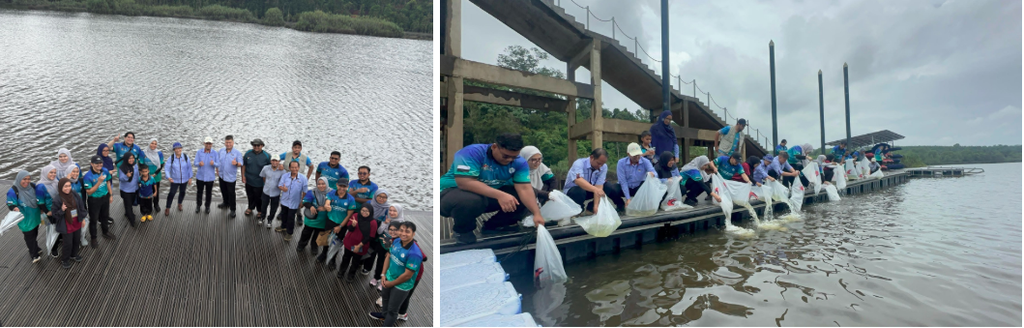
Table: Fish species list and density rank in Tasik Chini
Species | Local Name | Individual | Mean Physical | |
| Standardlength (cm) | Weight(g) | |||
| Family Notopteridae | ||||
| Notopterus notopterus | Potok/Selat | 213 | 17.1 | 37.2 |
| Family Cyprinidae | ||||
| Thynnichthys thynnoides | Loma | 112 | 18.3 | 65.9 |
| Labiobarbus fasciata | Mengkawan | 18 | 18.8 | 60.7 |
| Family Siluridae | ||||
| Kryptopterus bicirrhis | Lais | 12 | 22.9 | 53.9 |
| Family Helostomatidae | ||||
| Helostoma temminckii | Tembakang | 10 | 15.3 | 95.1 |
| Family Cyprinidae | ||||
| Cyclocheilichthys apogon | Cemperas | 8 | 13.7 | 30.7 |
| Labiobarbus festiva | Mengkawan | 8 | 18.9 | 79.0 |
| Family Bagridae | ||||
| Mystus singaringan | Kenjing | 7 | 15.1 | 92.3 |
| Family Cyprinidae | ||||
| Osteochilus vitattus | Terbul | 9 | 15.5 | 47.2 |
| Family Pristolepididae | ||||
| Pristolepis fasciata | Patong | 5 | 10.7 | 58.9 |
| Family Cyprinidae | ||||
| Osteochilus melanopleura | Terbul jalur | 6 | 18.7 | 56.3 |
| Family Butidae | ||||
| Oxyeleotris marmoratus | Ketutu | 5 | 27.8 | 254.9 |
| Family Cyprinidae | ||||
| Puntiuplites bulu | Tengalan | 3 | 17.0 | 54.6 |
| Family Pristolepididae | ||||
| Pristolepis grooti | Kepor | 2 | 11.6 | 31.7 |
| Family Cyprinidae | ||||
| Barbichthys laevis | Petulu | 2 | 19.0 | 62.3 |
| Macrochirichthysmacrochirus | Parang Sungai | 2 | 26.4 | 85.6 |
| Family Clariidae | ||||
| Clarias batrachus | Keli | 2 | 21.7 | 94.5 |
| Family Pangasiidae | ||||
| Pangasius spp. | Patin | 1 | 45.5 | 580.0 |
| Family Cyprinidae | ||||
| Amblyrhynchichthystruncatus | Puling | 1 | 16.6 | 51.2 |
| Hampala macrolepidota | Sebarau | 1 | 26.8 | 223.1 |
| Labiobarbus leptocheilus | Mengkawan | 1 | ||
| Barbonymus schwanefeldii | Lampam Sungai | 1 | ||
| Cyclocheilichthys armatus | Mata Merah | 1 | ||
| Family Bagridae | ||||
| Hemibagrus capitulum | Baung lemak | 1 | 19.5 | 60.1 |
| Family Channidae | ||||
| Channa lucius | Bujuk | 1 | 34.2 | 480.6 |
| Family Anabantidae | ||||
| Anabas testudineus | Puyu | 1 | 12.0 | 85 |
Through its long-term conservation efforts at Tasik Chini, UKM demonstrates strong leadership in watershed management and aquatic ecosystem restoration, ensuring that science and community action work hand in hand to protect Malaysia’s freshwater ecosystems. The university’s initiatives not only safeguard native flora and fauna but also strengthen local livelihoods and cultural heritage connected to the lake. These efforts align with the UKM Sustainability Strategic Plan 2030 and directly contribute to SDG 14 (Life Below Water) by promoting sustainable management of inland waters and biodiversity. By integrating research excellence with practical conservation, UKM continues to set a national benchmark in sustainable watershed governance, ensuring that ecosystems like Tasik Chini remain thriving centers of biodiversity, education and community pride for generations to come.