
Strengthen the means of implementation and revitalize the Global Partnership for Sustainable Development
SDG 17 Indicator
17.2 – Relationships to support the goals
17.2.1 – Relationships with regional NGOs and government for SDG policy
UKM provides direct academic and technical input into SDG-related policy development through commissioned research, policy drafting, technical committees and stakeholder consultation. Its documented contributions include national initiatives concerning public–private TVET collaboration, children’s protection and development, planetary health, counselling services, business and human rights, and inclusive education. UKM experts contribute to identifying challenges, analysing evidence and translating findings into policy recommendations, guidelines and action plans. Selected initiatives also propose implementation indicators, review processes and feedback mechanisms. These contributions connect multidisciplinary university expertise with government decision-making and demonstrate UKM’s role in supporting evidence-informed policies addressing interconnected social, economic and environmental priorities.
Summary of UKM’s Involvement in SDG Policy Development with Government Agencies and NGO’s
| No | List of the policies | Related SDG | National Government Agencies | NGO’s | Regional |
|---|---|---|---|---|---|
| 1 | Guidelines and Action Plan for Implementing the Public-Private Synergy Model in Malaysian TVET Institutions | SDG4 | Ministry of Economy | Government – Industry TVET Coordination Body | – |
| 2 | National Children’s Policy and Action Plan (2025–2030): UKM’s Direct Contribution to National SDG Policy Development | SDG10 SDG16 | Ministry of Women, Family and Community Development | SUHAKAM | – |
| 3 | UKM’s Contribution to the Development of Malaysia’s National Planetary Health Action Plan (NPHAP) 2025 | SDG3 | Ministry of Science, Technology and Innovation | Academy of Sciences Malaysia | |
| 4 | National Counselling Policy | SDG3 | Ministry of Women, Family and Community Development. | Lembaga Kaunselor Malaysia (Board of Counsellors Malaysia) | |
| 5 | National Action Plan on Business Human Rights 2025 – 2030 | SDG8 SDG10 SDG12 SDG16 | Prime Minister Office | ||
| 6 | Compendium of Policy Recommendations on Psychological Well-Being In The Public Service – Psychological and Emotional Well-Being: Strategies for Strengthening the Well-Being of TVET Institutional Leadership | SDG3 | Public Service Department | ||
| 7 | Direct Involvement in Policy Development for Inclusive Education and Education for Persons with Visual Disabilities | SDG4 SDG10 | Ministry of Education Malaysia | ||
| 8 | Guidelines on Primary Eye Care Services for the Optometrist Profession | SDG3 | Ministry of Health | ||
| 9 | UKM’s Expert Contributions to National Plastics Standardisation and Global Environmental Governance | SDG12 SDG16 SDG17 | Ministry of Natural Resources and Environmental Sustainability (NRES) | ||
| 10 | National Climate Policy Development through the Climate Mitigation and Conservation Action Plan | SDG3 SDG17 | Ministry of Natural Resources and Environmental Sustainability (NRES) | ||
| 11 | UKM’s Contribution to SDG Policy Development with the Malaysian Government: Advancing ASEAN Economic Cooperation and Regional Industrial Sustainability in 2025 | SDG8 SDG9 SDG13 SDG17 | Ministry of Investment, Trade and Industry (MITI) | Economic Research Institute for ASEAN and East Asia (ERIA) | |
| 12 | Compendium of Policy Recommendations on Psychological Well-Being In The Public Service – Childcare Issues Among Women Workers | SDG5 SDG8 | Public Service Department | ||
| 13 | Malaysia’s National Broadcasting Policy | SDG9 SDG16 SDG17 | Ministry of Communications | ||
| 14 | Preparing ASEAN Talent for the Future of Work | SDG4 SDG8 SDG9 | Economic Research Institute for ASEAN and East Asia (ERIA) | ||
| 15 | ASEAN Intergovernmental Commission of Human Rights (AICHR) Five Year Work Plan (2026-2030) | SDG16 SDG17 | ASEAN Foreign Ministers’ Meeting | ||
| 16 | UKM’s Collaboration with the Negeri Sembilan Islamic Religious Council in Developing the Hibah Enactment 2025 | SDG16 SDG17 | Negeri Sembilan Islamic Religious Council |
1. Guidelines and Action Plan for Implementing the Public-Private Synergy Model in Malaysian TVET Institutions
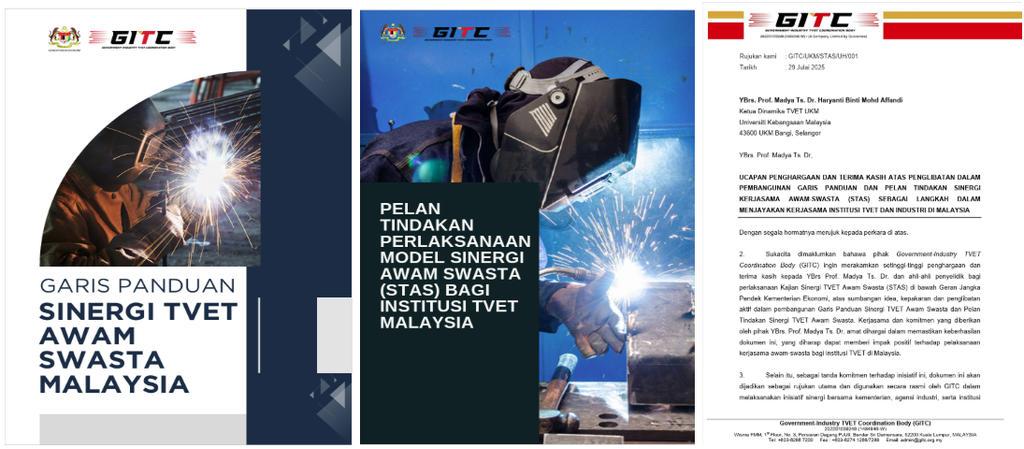
UKM has direct and significant involvement in national policy development through the expertise of its academics in supporting the formulation of Malaysia’s Guidelines for Public–Private TVET Synergy and Action Plan for Implementing the Public–Private TVET Synergy (STAS) Model in Malaysian TVET Institutions , in collaboration with the Ministry of Economy and GITC. The first edition of the policy was published in 2025. Led by Associate Professor Ts. Dr. Haryanti Mohd Affandi and the TVET Dynamics University Research Group, UKM academics served as key advisors and technical committee members throughout the policy development process. Their contributions included identifying national challenges and risks associated with public–private collaboration in TVET; developing policy strategies, implementation guidelines and alternative funding models; assessing potential future outcomes through cost–benefit and return-on-investment analyses; establishing monitoring and reporting mechanisms with clear key performance indicators (KPIs); and supporting adaptive management through collaborative quality-assurance approaches based on ISO/TR 44000:2019 standards. Through these contributions, UKM provided direct expert input into the development, implementation, monitoring and continuous improvement of a national strategy aimed at strengthening Malaysia’s TVET ecosystem and supporting sustainable socio-economic development.
2. National Children’s Policy and Action Plan (2025–2030): UKM’s Direct Contribution to National SDG Policy Development
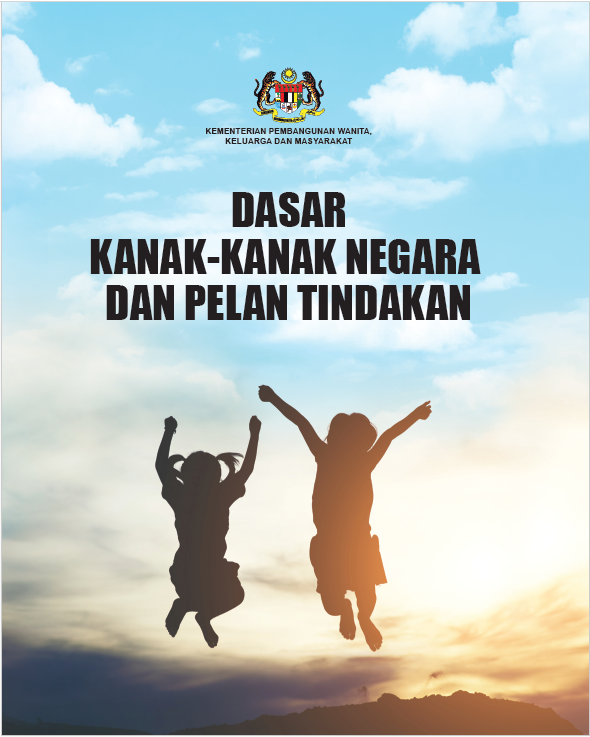
UKM demonstrates its direct involvement in national Sustainable Development Goals (SDG) policy development through the contributions of Associate Professor Dr. Mohd Al Adib bin Samuri from the Faculty of Islamic Studies, alongside Dr. Muhamad Sayuti bin Hassan @ Yahya from the Faculty of Law and Dr. Kamarul Baraini binti Keliwon from the Faculty of Economics and Management, who served as research consultants in developing Malaysia’s National Children’s Policy Action Plan 2025–2030 under the Ministry of Women, Family and Community Development (KPWKM).
Their contributions were formally acknowledged by the Ministry in an official appreciation letter dated 4 February 2025, confirming UKM’s direct academic involvement in formulating the national action plan. The plan complements the National Children’s Policy, approved by the Cabinet on 20 June 2024, and translates its four key objectives and 16 strategic priorities into a national implementation framework for 2025–2030.
Through this policy development initiative, UKM contributed research expertise to a framework addressing critical challenges in children’s survival, protection, development and participation, including child exploitation, online safety, unequal access to essential services and the needs of vulnerable children. The policy framework establishes strategic priorities and targeted interventions to strengthen child protection, improve service delivery and promote inclusive development. It also provides a basis for coordinated implementation, monitoring and evaluation by relevant government agencies and stakeholders.
This collaboration demonstrates UKM’s direct contribution to evidence-informed national policy and strategy development, supporting SDG 10 (Reduced Inequalities) and SDG 16 (Peace, Justice and Strong Institutions), particularly in strengthening child protection systems, promoting equal opportunities and advancing inclusive and accountable governance.
Source: SURAT PENGHARGAAN NATIONAL CHILDREN’S POLICY
3. UKM’s Contribution to the Development of Malaysia’s National Planetary Health Action Plan (NPHAP) 2025
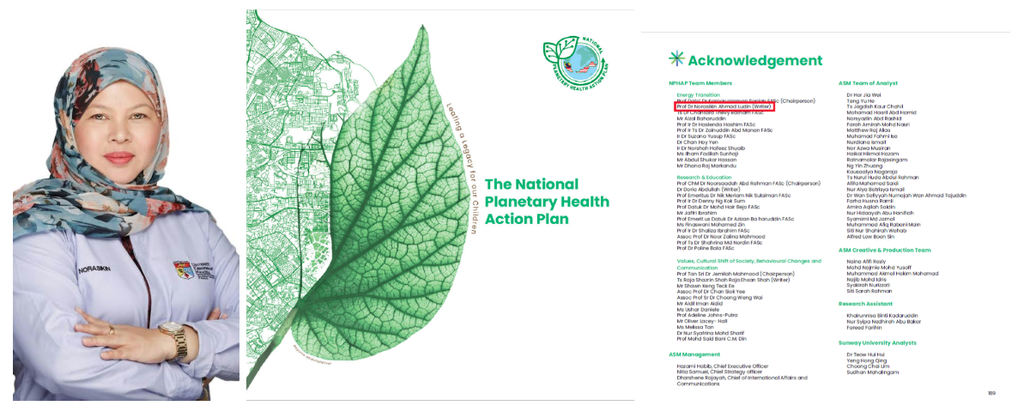
UKM actively contributes to national Sustainable Development Goal (SDG) policy development through the participation of its academic experts in government-led sustainability initiatives. A significant example is the National Planetary Health Action Plan (NPHAP) 2025, developed by the Academy of Sciences Malaysia (ASM) in collaboration with the Ministry of Science, Technology and Innovation (MOSTI). The action plan serves as a national strategic framework to integrate planetary health principles into Malaysia’s governance, environmental protection, socioeconomic development and long-term sustainability agenda. UKM’s involvement is demonstrated through Prof. Dr. Norasikin Ahmad Ludin of the Solar Energy Research Institute (SERI), who is officially acknowledged as a writer of the national action plan, reflecting the university’s academic contribution to the preparation of evidence-based national sustainability policy.
The NPHAP adopts a whole-of-nation approach, incorporating six Key Result Areas: Governance, Environment and Health, Sustainable Food, Research and Education, Energy Transition, and Values, Culture, Behaviour Change and Communications. It promotes coordinated action across government agencies, research institutions, industries and communities to address climate change, biodiversity loss, environmental degradation and public health challenges. The plan also proposes systemic reforms, scientific research, renewable energy development and impact-monitoring mechanisms to strengthen Malaysia’s progress towards the SDGs. Prof. Norasikin’s documented involvement as a writer demonstrates UKM’s participation in the national policy-development process, particularly relevant to sustainability research and energy transition, while reinforcing collaboration between academia and government in advancing sustainable development.
Through this contribution, UKM supports SDG 17 by contributing academic expertise to a national policy framework intended to guide SDG-related planning, implementation and cross-sector collaboration. The initiative demonstrates the university’s role as a knowledge partner in strengthening Malaysia’s sustainability governance and advancing evidence-informed decision-making towards a healthier, more resilient and sustainable nation.
Source: NATIONAL PLANETARY HEALTH ACTION PLAN
4. National Counselling Policy
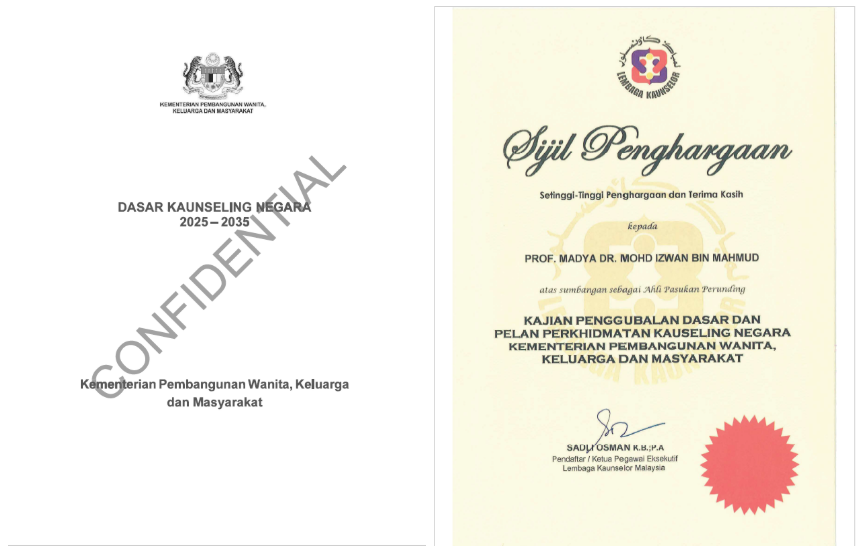
UKM demonstrates direct involvement in national policy development through the expertise and participation of its academic staff. Assoc. Prof. Dr. Mohd Izwan Mahmud from UKM’s Centre for Educational Diversity, Faculty of Education, was formally appointed as a Consultant/Expert for the Study on the Formulation of the National Counselling Policy and Service Plan, a consultancy project undertaken for the Ministry of Women, Family and Community Development (KPWKM).
As part of his appointed role, Dr. Izwan was involved in discussions and meetings with the project team and KPWKM, participated in workshops and focus group discussions (FGDs), chaired discussions, analysed and interpreted data, and contributed to the preparation of reports and action plans. These responsibilities demonstrate UKM’s direct input into the identification of issues and challenges, evidence gathering and analysis, and the development of policy recommendations and strategies for strengthening counselling services at the national level.
This involvement reflects UKM’s contribution to evidence-informed national policy development through the expertise of its academics. The development of an improved national framework for counselling services is also relevant to the Sustainable Development Goals, particularly SDG 3: Good Health and Well-being, by supporting measures that can strengthen mental health, psychosocial support and access to counselling services.
Therefore, UKM’s involvement through Dr. Izwan’s formal appointment as a Consultant/Expert provides evidence that the university contributes directly to national government policy development, including identifying challenges through stakeholder engagement and FGDs, analysing evidence, developing recommendations and action plans, and supporting the formulation of strategies for future implementation and improvement.
5. National Action Plan on Business Human Rights 2025 – 2030
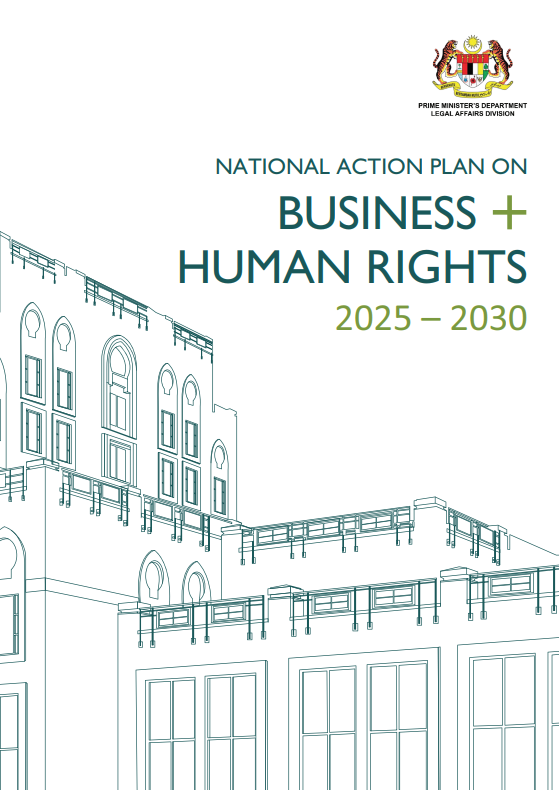
UKM has contributed academic expertise to national SDG-related policy development through the involvement of its academic, Associate Professor Dr. Andika Ab. Wahab of the Institute of Malaysian and International Studies (IKMAS), in Malaysia’s policy-development process on business and human rights. Dr. Andika’s expertise in human rights, international migration and business and human rights contributed to national discussions leading towards the development of Malaysia’s National Action Plan on Business and Human Rights (NAPBHR) 2025–2030. As part of this process, he was involved in the National High-Level Dialogue on Business and Human Rights in 2019, where he moderated a session specifically focused on “Developing A National Action Plan on Business and Human Rights.”
The development of the NAPBHR involved a structured and multi-stakeholder process of identifying business-related human rights challenges, assessing gaps in existing governance and regulatory mechanisms, and translating these findings into national priorities and strategic actions. The development process included collaboration among government agencies, SUHAKAM, international organisations, civil society, academia, private-sector representatives and affected communities. Stakeholder consultations and written feedback were used to ensure that the Action Plan reflected practical challenges and lived experiences, particularly in relation to labour rights, environmental protection and access to remedy.
The resulting National Action Plan on Business and Human Rights 2025–2030, launched by the Malaysian Government in August 2025, establishes a national framework for strengthening the protection of human rights in business activities. It identifies priority areas and sets out strategic actions to address business-related human rights impacts, including labour rights, environmental concerns and access to effective remedy. The inclusion of these actions demonstrates the transition from problem identification and stakeholder consultation towards the development of coordinated policy responses and interventions.
The Action Plan also provides a basis for coordinated implementation involving relevant government agencies and stakeholders. Its five-year timeframe supports the tracking and review of actions, while continued engagement with stakeholders and the use of evidence, consultation and implementation feedback can support the refinement of policy responses over time. This reflects an approach that links policy development with implementation, monitoring, review and adaptive management.
Through Dr. Andika Ab. Wahab’s participation and expertise, UKM therefore provided direct academic input into the national policy-development process that led to Malaysia’s first National Action Plan on Business and Human Rights 2025–2030. His involvement demonstrates UKM’s contribution to identifying emerging policy challenges, facilitating national dialogue among stakeholders, informing the development of strategies and interventions, and supporting an evidence-based and participatory approach to national policy formulation. This contribution is particularly relevant to SDG 8 (Decent Work and Economic Growth), SDG 10 (Reduced Inequalities), SDG 12 (Responsible Consumption and Production) and SDG 16 (Peace, Justice and Strong Institutions). Dr Andika Ab. Wahab’s involvement is noted on page 25 of the National Action Plan on Business and Human Rights (NAPBHR) 2025–2030 report.
6. Compendium of Policy Recommendations on Psychological Well-Being In The Public Service – Psychological and Emotional Well-Being: Strategies for Strengthening the Well-Being of TVET Institutional Leadership
UKM has provided direct expert input into national policy development through the contribution of its academics to the Compendium of Policy Recommendations on Psychological Well-Being in the Public Service: Psychological and Emotional Well-Being, published by the Malaysian Public Service Department (JPA). In particular, Ts. Dr. Haryanti Mohd Affandi, a UKM academic specialising in TVET, human resource development, and policy and systems management, contributed to the development of policy recommendations on strengthening the psychological well-being of TVET institutional leadership. The first edition of the policy was published in 2025.
The policy development process involved identifying and analysing problems affecting the psychological well-being of TVET institutional leaders, including through focus group discussions involving TVET lecturers, institutional management and officers from 13 ministries. The findings were then used to develop strategies, which were subsequently discussed and validated with stakeholders to assess their relevance and effectiveness in the actual institutional context.
The resulting recommendations included structured leadership training, sustainable funding and resources, comprehensive psychological support systems, workplace counselling, stress-management programmes, and periodic assessment of staff psychological well-being. The recommendations also proposed mechanisms for monitoring and evaluation, including regular psychological well-being assessments and the use of data and feedback to improve implementation.
This provides evidence that UKM’s academic expertise contributed directly to a national policy-development process by helping to identify policy challenges, formulate strategies and interventions, validate proposed approaches with stakeholders, and support mechanisms for monitoring, evaluation and adaptive policy improvement. The contribution is particularly relevant to SDG 3 (Good Health and Well-being) and demonstrates UKM’s role in translating academic expertise and research into national policy recommendations.
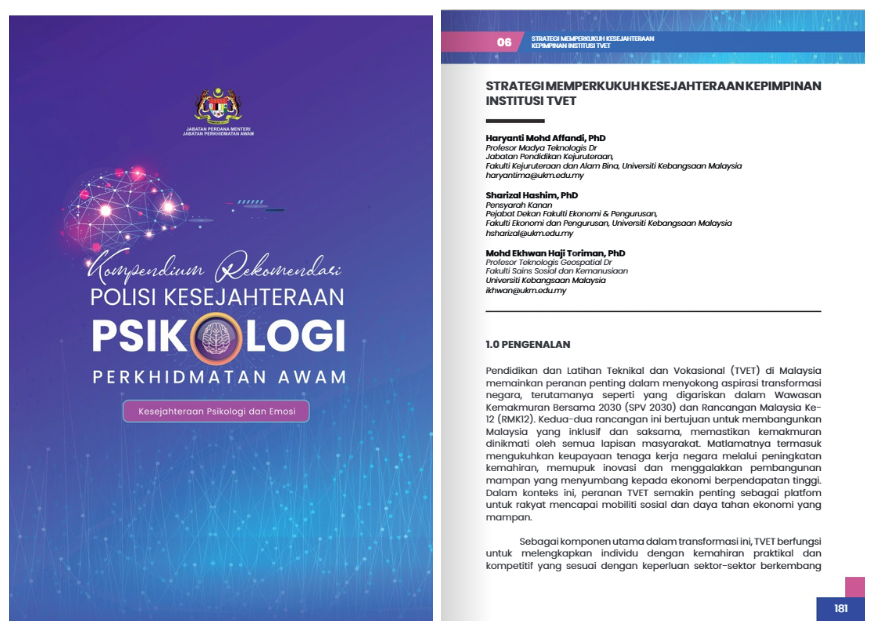
Source : https://docs.jpa.gov.my/docs/flipbook/Kesejahteraan-Psikologi-dan-Emosi/
7. Direct Involvement in Policy Development for Inclusive Education and Education for Persons with Visual Disabilities
UKM, through Assoc. Prof. Dr. Mohd Norazmi Nordin, Faculty of Education, demonstrates direct involvement in policy development concerning inclusive and special education, particularly education for persons with visual disabilities. His expertise has been formally engaged by both the Curriculum Development Division, Ministry of Education Malaysia (KPM) and Yayasan Orang Buta Malaysia (YOBM) in developing policy documents intended to strengthen educational provision, accessibility and support systems for learners with visual disabilities.
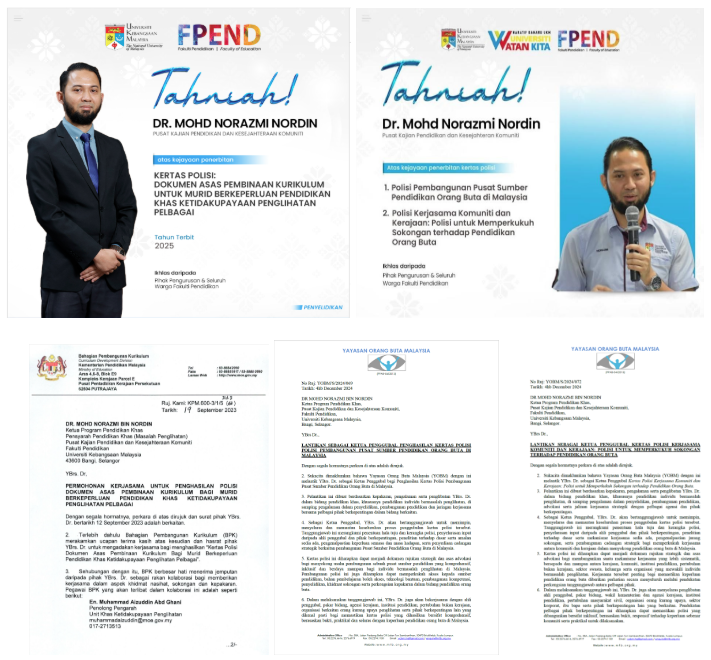
i. Collaboration with the Ministry of Education Malaysia in Developing a Curriculum Policy Framework
UKM’s involvement with the national government is demonstrated through formal collaboration between Dr. Mohd Norazmi Nordin and the Curriculum Development Division (Bahagian Pembangunan Kurikulum), Ministry of Education Malaysia. In its letter dated 19 September 2023, the Ministry accepted the proposed collaboration to produce a policy paper entitled “Kertas Polisi Dokumen Asas Pembinaan Kurikulum Bagi Murid Berkeperluan Pendidikan Khas Ketidakupayaan Penglihatan Pelbagai”, which was subsequently published in 2025. The Ministry appointed an officer from its Visual Disability Special Education Unit as a collaborating research officer and requested that the completed policy paper be shared with the Curriculum Development Division following completion of the study.
This represents direct UKM input into a national government education policy and curriculum-development process. Rather than functioning solely as an academic research activity, the collaboration connects UKM’s special-education expertise with the Ministry division responsible for curriculum development, enabling research findings and specialist knowledge concerning students with multiple visual disabilities to contribute to the development of an evidence-based curriculum policy framework.
ii. Development of the Policy for an Educational Resource Centre for Blind Persons in Malaysia
UKM’s policy-development role was further extended through Yayasan Orang Buta Malaysia (YOBM). In its appointment letter dated 4 December 2024, YOBM formally appointed Dr. Mohd Norazmi Nordin as Lead Policy Drafter for the Policy on the Development of an Educational Resource Centre for Blind Persons in Malaysia, which was published in 2025. The appointment was based explicitly on his expertise and experience in special education, particularly education for persons with visual disabilities, as well as his research, educational development and stakeholder collaboration experience.
His responsibilities closely correspond to the requirements of SDG 17.2.1. As Lead Policy Drafter, he is responsible for leading, coordinating and monitoring the overall policy-development process, determining the policy direction and framework, coordinating input from policy drafters and stakeholders, reviewing existing policies and practices, identifying present and future needs, and developing strategic recommendations for establishing the educational resource centre.
The proposed policy is intended to provide a strategic reference and advocacy foundation for developing a comprehensive, inclusive and sustainable educational resource centre, strengthening access to educational resources, accessible learning materials, assistive technologies, competency development, research, support services and expertise sharing for persons with visual disabilities.
Significantly, this is also a multi-stakeholder policy-development process. Dr. Norazmi is expected to work with subject-matter experts, government agencies, educational institutions, NGOs, organisations representing persons with visual disabilities and other stakeholders so that the resulting policy is evidence-based, practical and responsive to actual educational needs.
iii. Government–Community Cooperation Policy to Strengthen Education for Blind Persons
Dr. Mohd Norazmi Nordin was appointed Lead Policy Drafter for the “Community and Government Cooperation Policy: Policy to Strengthen Support for the Education of Blind Persons” which was subsequently published in 2025.
He is responsible for leading, coordinating and monitoring the entire policy-formulation process, determining the direction and policy framework, coordinating stakeholder input, reviewing existing policies and cooperation mechanisms, identifying gaps in support, and developing strategic recommendations to strengthen collaboration between communities and government in supporting education for blind persons in Malaysia.
The policy aims to establish a more systematic, integrated and sustainable cooperation mechanism involving government, communities, educational institutions, NGOs, the private sector, families and organisations representing persons with visual disabilities. Dr. Norazmi is also tasked with coordinating participation from policy drafters, experts, representatives of ministries and government agencies, educational institutions, civil-society organisations, disability organisations, corporations and parents, ensuring that the resulting policy is inclusive, evidence-based, responsive to community needs and practical for implementation.
The intended policy outcomes encompass educational-resource provision, teacher and support-staff capacity development, assistive technology, accessible learning materials, family support, community interventions, financing, advocacy and sustainable educational support networks. YOBM further states that the policy has the potential to form the foundation of a stronger government–community cooperation ecosystem for the education of blind persons in Malaysia.
Source : https://www.instagram.com/p/DQTd-lzEXHz/
8. Guidelines on Primary Eye Care Services for the Optometrist Profession
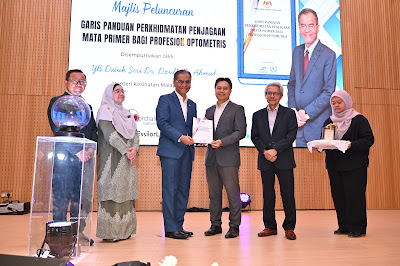
UKM provides direct input into national government policy development, strongly advancing SDG 3 (Good Health and Well-being). A key example is the involvement of Prof. Datuk Dr. Rokiah Omar in developing the Guidelines on Primary Eye Care Services for the Optometrist Profession for the Malaysian Optical Council (Ministry of Health). The first edition of the guideline was published in 2025 Through this framework, UKM experts identify critical challenges in public eye health and formulate standardized national strategies for primary eye care, diagnosis, and management. The policy models effective clinical interventions through systematic referral pathways to ophthalmologists to prevent vision loss. Furthermore, it enforces monitoring and adaptive management by mandating strict professional ethics and annual Continuing Professional Development (CPD), ensuring the national optometry workforce continuously adapts to new health challenges and medical advancements.”
Source: GARIS PANDUAN PERKHIDMATAN PENJAGAAN MATA PRIMER BAGI PROFESION OPTOMETRIS
9. UKM’s Expert Contributions to National Plastics Standardisation and Global Environmental Governance
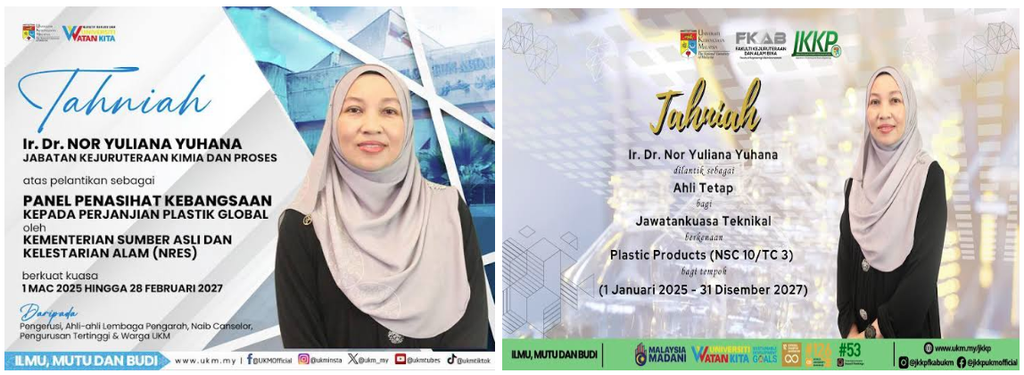
In 2025, UKM strengthened its contribution to government advisory mechanisms through the appointment of Ir. Dr. Nor Yuliana binti Yuhana to three national committees and advisory roles related to plastics standardisation, environmental sustainability and international environmental governance.
Effective from 1 January 2025 to 31 December 2027, she was appointed as a permanent member of the National Standards Committee on Plastics and Plastic Products (NSC 10) and the Technical Committee on Plastic Products (NSC 10/TC 3) under the Department of Standards Malaysia. These committees are responsible for supporting the development and review of Malaysian Standards, evaluating international standardisation practices, and providing technical input to strengthen national standardisation processes.
In addition, UKM’s expertise was recognised through her appointment as a National Advisory Panel Member for the Global Plastics Treaty, effective from 1 March 2025 to 28 February 2027, or until the treaty is finalised, whichever occurs earlier. Appointed by the Ministry of Natural Resources and Environmental Sustainability (NRES), this advisory role supports the Malaysian Government’s engagement in international negotiations under the United Nations Environment Programme’s Intergovernmental Negotiating Committee process.
These appointments demonstrate UKM’s institutional contribution to government advisory structures through the provision of specialised academic expertise in plastics-related standardisation and environmental governance. They also complement Malaysia’s broader sustainability policy direction under the Malaysia Plastics Sustainability Roadmap 2021–2030, which acknowledges UKM among the academic institutions involved in its development.
Through these national appointments, UKM strengthens university–government collaboration, supports evidence-informed technical decision-making and contributes expertise relevant to sustainable materials management, circular economy development and international environmental cooperation, advancing SDG 12 (Responsible Consumption and Production), SDG 16 (Peace, Justice and Strong Institutions) and SDG 17 (Partnerships for the Goals).
Source: Appointment Letter of Ir. Dr. Yuliana
10. National Climate Policy Development through the Climate Mitigation and Conservation Action Plan
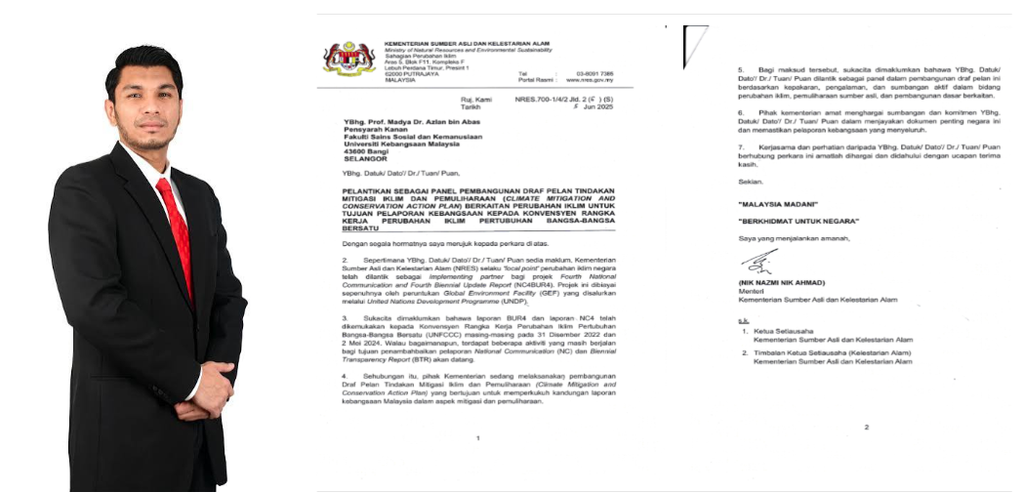
UKM demonstrates its commitment to supporting national sustainable development policies through the direct involvement of its academic experts in government-led climate change initiatives. On 5 June 2025, Associate Professor Dr. Azlan bin Abas, from UKM’s Faculty of Social Sciences and Humanities, was officially appointed by the Ministry of Natural Resources and Environmental Sustainability (NRES) as a panel member for developing Malaysia’s draft Climate Mitigation and Conservation Action Plan. This appointment recognises his expertise and contributions in climate change, natural resource conservation and policy development.
The initiative supports Malaysia’s national climate reporting commitments under the United Nations Framework Convention on Climate Change (UNFCCC). As Malaysia’s national climate change focal point, NRES is implementing the Fourth National Communication and Fourth Biennial Update Report (NC4BUR4) project, fully funded by the Global Environment Facility (GEF) through the United Nations Development Programme (UNDP). The Climate Mitigation and Conservation Action Plan is intended to strengthen Malaysia’s national reporting on climate change mitigation and conservation.
Through this appointment, UKM contributes academic expertise to the development of government climate policy documents, supporting evidence-informed decision-making and strengthening collaboration between academia and national policymakers. This initiative directly supports SDG by demonstrating UKM’s involvement in government-led SDG policy development, while advancing SDG 13 (Climate Action) and SDG 17 (Partnerships for the Goals).
Source: Assoc. Prof. Dr. Azlan Abas
11. UKM’s Contribution to SDG Policy Development with the Malaysian Government: Advancing ASEAN Economic Cooperation and Regional Industrial Sustainability in 2025
UKM actively contributes to Sustainable Development Goal (SDG) policy development through the provision of academic expertise, policy analysis and strategic recommendations supporting national and regional government initiatives. In 2025, UKM’s involvement in three significant ASEAN policy documents demonstrated its contribution to Malaysia’s ASEAN Chairmanship and the advancement of sustainable economic cooperation, technological innovation and regional development.
Through its Institute of Malaysian and International Studies (IKMAS) and Institute of Microengineering and Nanoelectronics (IMEN), UKM contributed expertise to policy initiatives involving the Ministry of Investment, Trade and Industry (MITI), ASEAN Member States and international policy stakeholders. These contributions demonstrate how academic knowledge can inform government-led policy development, particularly in relation to SDG 8 (Decent Work and Economic Growth), SDG 9 (Industry, Innovation and Infrastructure) and SDG 17 (Partnerships for the Goals).
i. Joint Statement of the ASEAN-GCC-China Summit (2025): Strengthening International Cooperation for Sustainable Development
Date: 27 May 2025
Location: Kuala Lumpur, Malaysia
Policy stakeholders: ASEAN, Gulf Cooperation Council (GCC) and the People’s Republic of China
UKM experts: Dr. Muhammad Faliq Abd Razak and Prof. Dato’ Dr. Sufian Jusoh
UKM Institute: Institute of Malaysian and International Studies (IKMAS)
UKM contributed academic expertise to policy-related work associated with the Joint Statement of the ASEAN-GCC-China Summit, adopted in Kuala Lumpur on 27 May 2025. The statement established a common direction for strengthening cooperation among ASEAN, GCC and China in addressing regional economic challenges and advancing sustainable development.
The policy document incorporates commitments to the United Nations 2030 Agenda for Sustainable Development and identifies several areas of cooperation, including sustainable trade, green economic development, renewable energy, climate action, digital transformation, food security and resilient infrastructure.
It also promotes the exchange of scientific expertise, technological innovation and international best practices to support environmental sustainability and sustainable economic growth.
UKM’s institutional publication record identifies Dr. Muhammad Faliq Abd Razak as the lead contributor and Prof. Dato’ Dr. Sufian Jusoh as adviser to the policy document. Their recorded involvement demonstrates the participation of UKM academics in an international policy development process connected to Malaysia’s ASEAN Chairmanship.
By contributing expertise to this policy-related work, UKM supported the integration of sustainability considerations into international economic cooperation discussions, reinforcing the importance of research-informed policy development in achieving the SDGs.
SDG contribution: SDG 8, SDG 9, SDG 13 and SDG 17.
ii. Joint Declaration on Economic Cooperation between ASEAN and the GCC (2025): Advancing Sustainable Regional Economic Policy
Date of adoption: 27 May 2025
Location: Kuala Lumpur, Malaysia
Policy stakeholders: ASEAN and GCC Member States
UKM experts: Dr. Muhammad Faliq Abd Razak and Prof. Dr. Sufian Jusoh
UKM institute: Institute of Malaysian and International Studies (IKMAS)
UKM also contributed academic expertise to the development of the Joint Declaration on Economic Cooperation between ASEAN and the Gulf Cooperation Council, adopted during the Second ASEAN-GCC Summit on 27 May 2025.
The declaration outlines policy priorities for strengthening economic relations between the two regions through sustainable trade and investment, digital economic cooperation, renewable energy development, food security, infrastructure development and inclusive entrepreneurship.
Among its key policy directions are the exploration of an ASEAN-GCC Free Trade Agreement, enhanced digital connectivity, cooperation in clean and renewable energy technologies, and technical assistance for micro, small and medium enterprises (MSMEs), particularly those involving women, youth and underserved communities.
The declaration also encourages greater coordination among governments, businesses and other stakeholders to create a more resilient and sustainable regional economy.
UKM’s institutional publication record identifies Dr. Muhammad Faliq Abd Razak as the lead contributor and Prof. Dr. Sufian Jusoh as adviser. The policy document was subsequently recognised as a completed Priority Economic Deliverable under Malaysia’s ASEAN Chairmanship at the 57th ASEAN Economic Ministers’ Meeting on 23 September 2025.
This outcome demonstrates the significance of the policy development process in advancing Malaysia’s regional economic agenda and establishing a foundation for continued ASEAN-GCC cooperation.
Through its involvement, UKM contributed academic expertise relevant to the formulation of government-led regional economic policies that promote inclusive economic opportunities, sustainable industrial development and international partnerships.
SDG contribution: SDG 8, SDG 9 and SDG 17.
iii. ASEAN Framework for Integrated Semiconductor Supply Chain (AFISS) (2025): Supporting Sustainable Industrial and Technological Policy Development
Year: 2025
Policy stakeholder: ASEAN
Publisher recorded by UKM: Economic Research Institute for ASEAN and East Asia (ERIA)
UKM experts: Dr. Azrul Azlan Hamzah, Prof. Dr. Sufian Jusoh and Dr. Mohd Hariszuan Jaharudin
UKM Institutes: Institute of Microengineering and Nanoelectronics (IMEN) and Institute of Malaysian and International Studies (IKMAS)
UKM further contributed specialised academic and technical expertise to the ASEAN Framework for Integrated Semiconductor Supply Chain (AFISS), developed to strengthen regional semiconductor competitiveness, industrial resilience and technological cooperation.
The framework responds to increasing global demand for semiconductors and the need for ASEAN Member States to address supply chain vulnerabilities, technological disparities and workforce development challenges.
AFISS was developed using a mapping of the comparative strengths of ASEAN Member States and consultations involving government agencies, industry representatives, academic institutions and other stakeholders.
The framework identifies three principal policy focus areas: supply chain integration, technology and infrastructure development, and talent development. These are supported by six strategic thrusts covering infrastructure resilience, technology innovation and transfer, semiconductor industry clusters, industrial and trade policies, market access and workforce mobility.
The framework also proposes measures to improve resource efficiency, encourage shared industrial infrastructure, strengthen research collaboration and facilitate technology transfer across ASEAN.
UKM’s involvement brought together expertise in semiconductor engineering, international economic policy and regional industrial development. The institutional publication record identifies Dr. Azrul Azlan Hamzah as the lead contributor, Prof. Dr. Sufian Jusoh as adviser and Dr. Mohd Hariszuan Jaharudin as a committee member.
Through this interdisciplinary contribution, UKM participated in developing a policy framework intended to guide ASEAN Member States towards a more integrated, innovative and resilient semiconductor ecosystem.
SDG contribution: SDG 8, SDG 9 and SDG 17.
Collectively, these contributions demonstrate UKM’s involvement in translating research and specialist expertise into SDG-related policy proposals, guidelines and strategic actions. Official acknowledgements, consultancy appointments and published contributions establish pathways through which university knowledge informs public decision-making. Across the strongest examples, UKM supports problem identification, stakeholder engagement, evidence analysis and the formulation of practical recommendations. Where documented, proposed monitoring and review arrangements provide a basis for future policy refinement. Through these engagements, UKM strengthens university–government cooperation and contributes to SDG 17: Partnerships for the Goals.
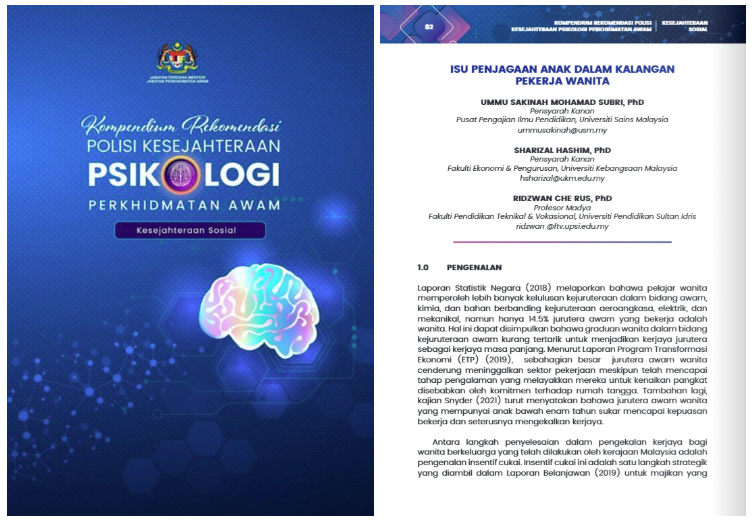
12. Compendium of Policy Recommendations on Psychological Well-Being In The Public Service – Childcare Issues Among Women Workers
UKM has contributed academic expertise to national policy development through the participation of its academics in policy recommendation processes undertaken in collaboration with Malaysian government institutions. One example is the Compendium of Policy Recommendations on Psychological Well-Being in the Public Service: Social Well-Being, published by the Malaysian Public Service Department (JPA) in 2025, which examines social policy issues including childcare challenges among women workers.
The compendium demonstrates a structured policy-development approach by identifying challenges faced by working women, assessing gaps in existing policies and implementation mechanisms, and formulating recommendations to strengthen workplace childcare support. The analysis considers existing legislation, government guidelines and fiscal incentives, while identifying challenges such as high implementation costs, limited awareness, weak monitoring and enforcement, and insufficient information on implementation procedures.
The policy recommendations further propose stronger inter-agency and NGO collaboration, digitalised monitoring and reporting systems, periodic impact assessments, and the use of research findings, worker feedback and monitoring reports to update policies. These elements demonstrate the use of evidence and stakeholder feedback to support policy implementation, monitoring, evaluation and adaptive policy management.
Through the involvement and expertise of its academics, UKM therefore contributes to national policy development by helping to identify social challenges, analyse existing policy responses, formulate strategies and interventions, and strengthen mechanisms for monitoring, evaluation and policy refinement. This contribution is particularly relevant to SDG 5 (Gender Equality) and SDG 8 (Decent Work and Economic Growth), as the recommended measures aim to improve work–family balance, support women’s continued participation in the workforce, and promote more inclusive working environments.
13. Malaysia’s National Broadcasting Policy 2025
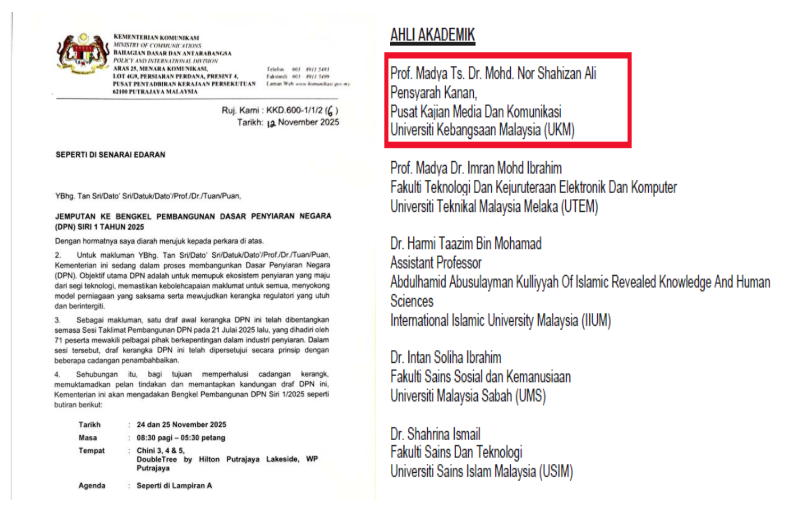
UKM demonstrates its commitment to national policy development through its academic involvement in the formulation of Malaysia’s National Broadcasting Policy 2025, an initiative led by the Ministry of Communications Malaysia. The policy aims to establish a progressive and sustainable broadcasting ecosystem by embracing technological advancement, promoting equitable access to information, supporting fair competition and strengthening an effective and integrated regulatory framework.
As part of this national initiative, Associate Professor Ts. Dr. Mohd Nor Shahizan Ali, a senior lecturer at UKM’s Centre for Research in Media and Communication MENTION), was officially invited to participate in the National Broadcasting Policy Development Workshop (Series 1/2025), scheduled for 24–25 November 2025 at DoubleTree by Hilton Putrajaya Lakeside, Putrajaya. The workshop was designed to refine the proposed policy framework, finalise strategic action plans and strengthen the content of the draft policy through structured discussions involving government agencies, industry representatives and academic experts.
Notably, UKM’s representative was specifically assigned to Pillar 1: Sustainability, one of the six strategic pillars underpinning the proposed National Broadcasting Policy. This working group brought together representatives from the Ministry of Economy, Media Prima, Astro Malaysia, Commercial Radio Malaysia, the Media Specialists Association, the Malaysian Advertisers Association and the Intellectual Property Corporation of Malaysia. The multidisciplinary structure provided an opportunity for academic expertise to inform policy discussions on the long-term sustainability and resilience of Malaysia’s broadcasting industry.
The policy development process also encompassed five additional pillars: Local Content Development, Competitiveness, Technology, Regulation and Data Analytics. Through this collaborative framework, UKM was positioned to contribute academic perspectives to discussions on sustainability challenges, strategic priorities and policy measures supporting a more inclusive and future-ready broadcasting sector.
This involvement provides documented evidence of UKM’s inclusion in a national government policy development process, particularly in the sustainability component of the National Broadcasting Policy. It is relevant to SDG 17 (Partnerships for the Goals) through university–government–industry collaboration and supports the broader objectives of SDG 9 (Industry, Innovation and Infrastructure) and SDG 16 (Peace, Justice and Strong Institutions) through sustainable industry development, equitable information access and institutional governance.
Source: NATIONAL BROADCASTING POLICY
14. Preparing ASEAN Talent for the Future of Work
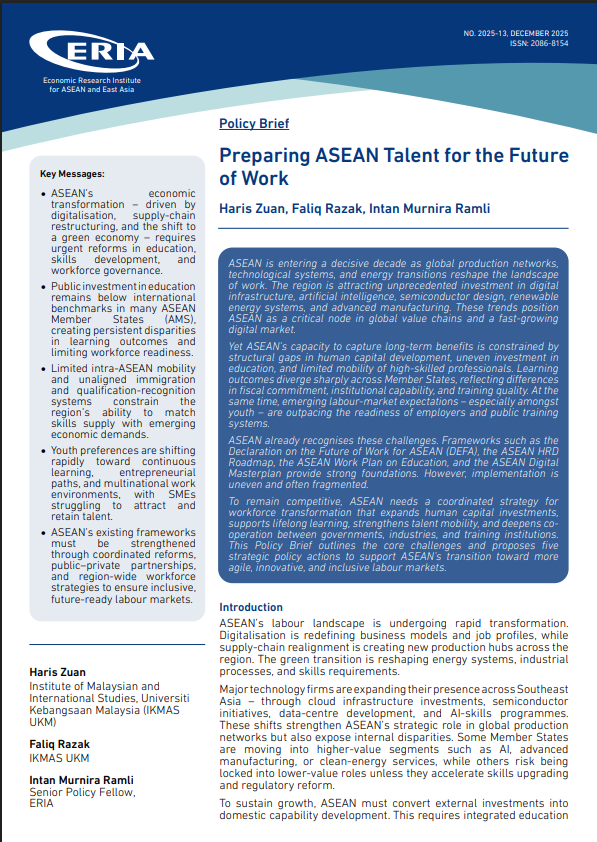
UKM has contributed direct academic input into regional policy development through the participation of its researchers, Dr. Haris Zuan bin Jaharudin and Dr. Muhammad Faliq Abd Razak of the Institute of Malaysian and International Studies (IKMAS), UKM, as writer of the ERIA Policy Brief, Preparing ASEAN Talent for the Future of Work. The policy brief, published by the Economic Research Institute for ASEAN and East Asia (ERIA), examines major challenges affecting ASEAN’s future workforce and proposes strategic policy actions to support the region’s transition towards more agile, innovative and inclusive labour markets.
The policy analysis identifies key regional challenges arising from digitalisation, supply-chain restructuring and the transition to a green economy. These include uneven investment in education and skills development across ASEAN Member States, rapidly evolving talent expectations, skills mismatches, limited access to training, and barriers to the mobility of highly skilled professionals. The analysis also highlights the risk that countries which do not accelerate skills upgrading and regulatory reform may remain in lower-value economic activities.
Based on this assessment, the policy brief proposes five strategic actions: strengthening regional workforce and mobility frameworks; increasing public and private investment in human capital; developing demand-driven and inclusive training models; promoting talent mobility to support innovation and resilience; and strengthening public–private collaboration to create future-ready workforce ecosystems. These recommendations provide concrete strategies and interventions for addressing identified regional challenges and preparing ASEAN for future economic and labour-market transformations.
The proposed actions also support evidence-based and adaptive policy management by recommending stronger labour-market intelligence systems to identify emerging skills needs, enhanced data-sharing and regulatory cooperation across ASEAN Member States, and pilot initiatives in priority sectors. These mechanisms can enable policymakers and relevant institutions to respond to changing labour-market conditions and adjust skills-development and workforce strategies accordingly.
Through the contribution of Dr. Haris Zuan and Faliq Razak as writers of this ERIA policy brief, UKM therefore provided substantive academic input into a regional policy discussion concerning ASEAN’s future workforce. Their contribution demonstrates UKM’s involvement in identifying emerging challenges, assessing future risks and opportunities, developing policy strategies and interventions, and supporting the use of labour-market information, data-sharing and pilot initiatives to enable evidence-based and adaptive policy management. The contribution is particularly relevant to SDG 4 (Quality Education), SDG 8 (Decent Work and Economic Growth) and SDG 9 (Industry, Innovation and Infrastructure).
Source : https://www.eria.org/uploads/Preparing-ASEAN-Talent-for-the-Future-of-Work.pdf/
15. ASEAN Intergovernmental Commission of Human Rights (AICHR) Five Year Work Plan (2026-2030)
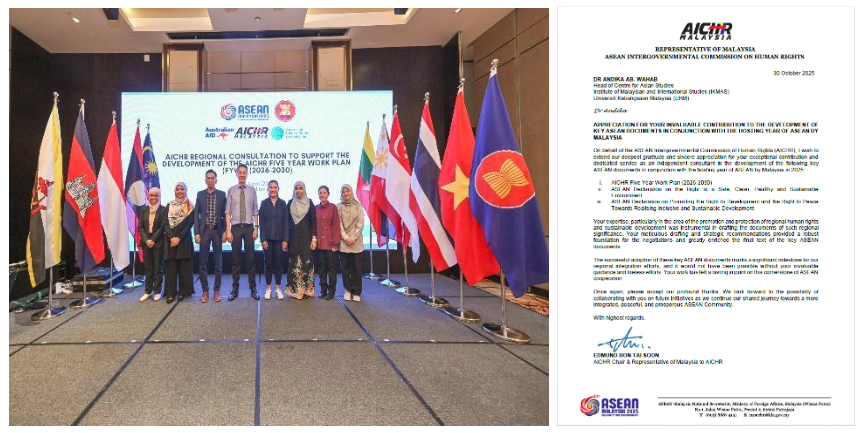
UKM has contributed academic expertise to regional policy development through the involvement of its academic, Associate Professor Dr. Andika Ab. Wahab, as a writer in the development of the ASEAN Intergovernmental Commission on Human Rights (AICHR) Five-Year Work Plan 2026–2030. The Work Plan serves as a regional strategic framework to guide AICHR’s programmes and activities in promoting and protecting human rights across ASEAN and was approved by the ASEAN Foreign Ministers’ Meeting.
The development of the Work Plan involved consultation with key stakeholders and consideration of emerging and evolving human rights challenges affecting the ASEAN region. Through this process, priority issues and challenges were identified and translated into strategic directions, programmes and activities for the 2026–2030 period. The Work Plan also promotes engagement with ASEAN sectoral bodies, external partners, civil society organisations and other stakeholders, supporting an inclusive and collaborative approach to regional policy development.
The framework further provides a basis for the implementation, monitoring and review of AICHR’s programmes and activities. Subsequent AICHR meetings have included the development of a Monitoring and Evaluation framework for implementation of the Five-Year Work Plan, self-assessment of AICHR’s work, reporting on activities, and the review of priority programmes to support continuous improvement and adaptive management.
Through Dr. Andika Wahab’s contribution as a writer, UKM therefore provided direct academic input into a regional intergovernmental policy-development process. This contribution demonstrates UKM’s role in supporting the identification of regional challenges, development of strategic priorities and interventions, and the establishment of mechanisms for implementation, monitoring, evaluation and continuous policy improvement. The contribution is particularly relevant to the Sustainable Development Goals, especially SDG 16 (Peace, Justice and Strong Institutions), while also supporting the human rights dimensions of other SDGs through a regional, people-centred approach.
Source: https://aichr.org/wp-content/uploads/2025/10/20251030_AIHCR-Work-Plan_rev_fin.pdf
16. UKM’s Collaboration with the Negeri Sembilan Islamic Religious Council in Developing the Hibah Enactment 2025
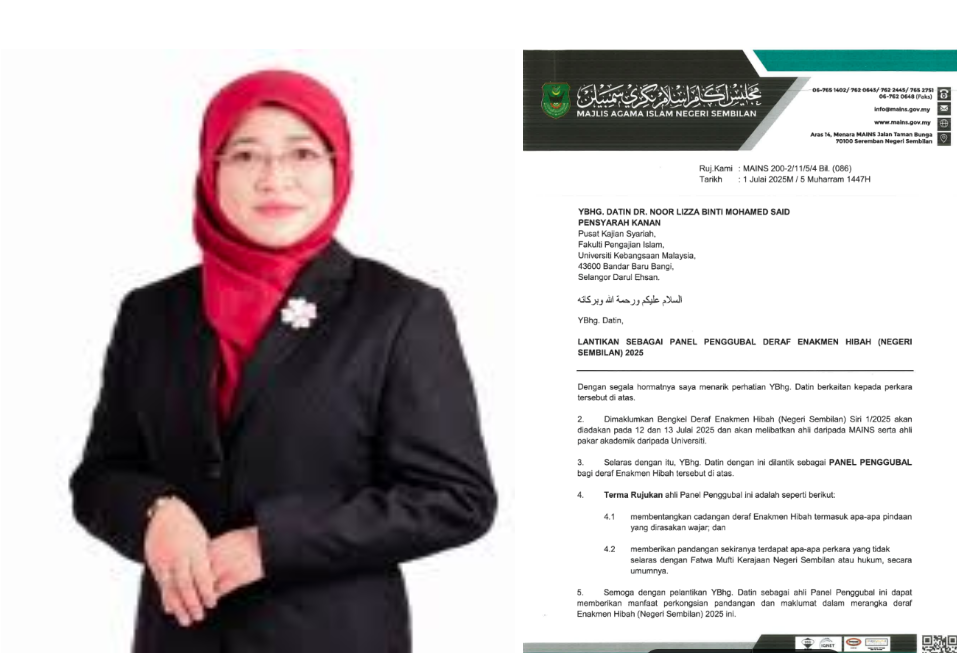
UKM contributes to SDG-related policy development through its collaboration with the Negeri Sembilan Islamic Religious Council (Majlis Agama Islam Negeri Sembilan – MAINS) in drafting the Negeri Sembilan Hibah Enactment 2025. This collaboration is demonstrated through the appointment of Datin Dr. Noor Lizza Mohamed Said, a senior lecturer from UKM’s Faculty of Islamic Studies, as a Member of the Drafting Panel for the Negeri Sembilan Hibah Enactment 2025, as confirmed by an official appointment letter dated 1 July 2025.
Through this government–university engagement, UKM contributes specialist academic expertise in Islamic law and Shariah governance to support the development of state-level legislation concerning hibah (Islamic gifts and voluntary asset transfers). The drafting panel is responsible for developing the proposed enactment, recommending amendments and identifying potential legal inconsistencies to ensure alignment with Islamic legal principles and fatwas issued by the Negeri Sembilan State Fatwa Committee.
This collaboration demonstrates how UKM works with regional government authorities to support SDG 16 (Peace, Justice and Strong Institutions) through the development of transparent, consistent and effective legal frameworks. By integrating academic knowledge into state legislative development, UKM strengthens university–government partnerships, promotes evidence-informed policymaking and contributes to more accountable governance of Islamic wealth and asset management.
UKM’s involvement in drafting the Negeri Sembilan Hibah Enactment 2025 provides evidence of its collaboration with a state government institution in developing SDG-related policy and legislation. The partnership supports institutional capacity-building, knowledge exchange and the integration of university expertise into government decision-making, contributing to the advancement of SDG 16 and SDG 17.